Economic Survey 2019: A Push Towards More Effective Judiciary

The Economic Survey 2019 identifies “ability to enforce contracts and resolve disputes” as the biggest constraint in ease of doing business in India.
The survey, tabled in Parliament on Thursday, considers investing in improving the legal system the “best investment” for the country. India currently ranks a dismal 163 (among 190 nations) when it comes to enforcing contracts.
Pending cases, especially in lower courts, are the biggest culprits of ineffective legal machinery, the survey noted. There are 3.52 crore pending cases and 87.5 percent of these are in district courts and lower levels.
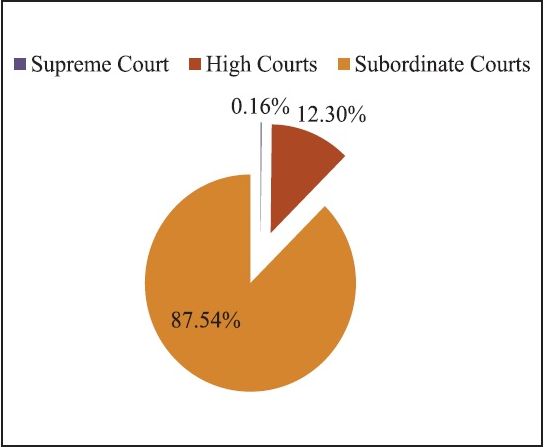
Aim: Achieve 100 percent clearance rate and eliminate the stock of pendency in next five years.
The solution: Addition of 2,279 judges in lower courts and 93 judges in high courts.
Odisha, Bihar, West Bengal, Uttar Pradesh and Gujarat have the highest number of pending cases. Punjab and Delhi have the least average pendency.
“It may not be a coincidence that the worst-performing states are usually (albeit not always) also the poorest.”
This is evidently crucial. The average disposal time—within which a case is finally determined by the relevant court—is significantly higher for India when compared to Council of Europe member states.
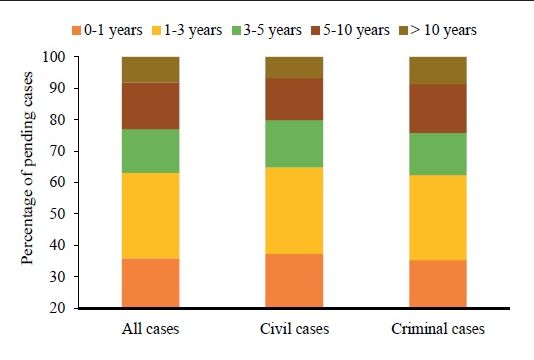
The Problem Of Fewer Judges
The sanctioned strength of 22,750 judges has also not been filled as only 17,891 judges are working, the survey said, adding that 8,152 more judges are needed to clear all the backlog in the next five years.
To clear all the backlog, high courts need 361 additional judges while the Supreme Court would need eight additional judges, it said.
Types Of Judges Required
Civil cases contribute a mere 28.38 percent to the total pendency in district and subordinate courts as on May 31, 2019, whereas criminal cases contribute about 71.62 percent. It is clear that the number of unresolved criminal disputes outweigh civil disputes, the survey said.
The problem is especially acute for criminal original suits such as summons, warrants etc. These contribute 64 percent of the total pendency as of May 31, 2019, with a clearance rate of 85.3 percent, it said.
This implies that additional judges need to specialise in these case types so as to speed up the disposal of such cases. Note that this is a case not merely for additional judges and legal reforms, but also for police reforms.Economic Survey 2019
What Causes Delays?
The data from E-Courts—which keeps data on pending cases—shows that most of the time is spent in ‘Lower Courts Records – Records and Proceedings' stage. This is the stage where a higher court receives case files and records from a lower court—a purely administrative exercise.
Civil cases spend an average of 398 days in this stage and 369 days in the ʻHearing' stage. This inefficiency consumes a significant proportion of a case's life, and is a major factor contributing to delays and backlog. The ʻNotice/Summons' and ʻEvidence' stages are also time-consuming at 322 and 325 days on average, respectively.
Improving Productivity
Without increasing strength of the number of judges, if one was to improve the efficiency of courts (rate at which prior cases are disposed and no backlog exists), the existing workforce would need to gain 58 percent in efficiency and productivity. But with sanctioned strength, the efficiency needs to increase by only 4.3 percent, the report said.
The survey makes the following suggestions to improve productivity:
- Increase number of working days and reduce vacation time for Supreme Court. Number of working days for the Supreme Court is just 190. In contrast, the average is 232 working days for high courts and 244 days for subordinate courts.
- Improve back-end services: For effective functioning, courts require competent administration to ensure that processes are followed. The report proposes creation of a specialised service called Indian Courts and Tribunal Services that focuses on the administrative aspects of the legal system and takes care of administrative glitches, thereby improving system efficiencies.
- It is also crucial to imbibe technology into the workings of the court, the survey said, suggesting future applications of artificial intelligence in Indian courts.
These suggestions may seem ambitious but are achievable, the survey concluded.
Related Coverage:

-
Indians Stay With Family, Not In Hotels | The Reason Why

India still lacks enough clean, reliable and affordable hotels for budget-conscious travellers.
-
The Economic Imperative: Analysing The Material Driving Force Behind India-Canada Strategic Reset
This economic complementarity is further reinforced by deep institutional investment ties and talent mobility, which form the bedrock of the bilateral framework.
-
Medicine Pricing: Where Must Profit Stop?
India must confront excessive margins, hidden incentives and regulatory gaps that threaten the integrity of medicine.
-
Why Amazon And Flipkart Are Struggling To Beat Meesho In India's Smaller Cities
With 274 million users and lowest-cost logistics, Meesho is defending its value commerce crown against giants like Amazon and Flipkart.
-
High US Salaries, No Green Card Certainty: The Financial Calculation Facing Indian H-1B Families
The suspension of PERM processing at eight technology employers does not cancel existing H-1B visas. What it does is force a question many Indian families have been avoiding: is the US salary worth tying your career and family plans to one employer?
-
Swiggy vs Eternal: Food Delivery's Two Rivals Are No Longer In The Same Race
Eternal is building a private AI assistant, dark.ai. Swiggy is still working out how to make Instamart pay, with an operating loss of Rs 895 crore in the July-September quarter while Blinkit stayed profitable.
-
Where You Live Shapes How You Get To Work | The Reason Why
Two-wheelers are the most popular way to get to work in India, accounting for nearly 43% of workplace commutes.
-
Unhedged Position: Can India See An Indonesia-Style Time Correction?
The Nifty is trading below levels it first clocked in 2024. Is there, then, as I have suggested in the headline, potential that the current time correction drags on painfully for the next three-five, even ten years?
-
Navigating Friction And Energy Realities: An Analysis Of Marco Rubio's October Visit To India
Occurring at a critical juncture marked by stalled trade negotiations and escalating geopolitical pressures over global energy supplies, the visit offers a profound window into modern US-India relations.
-
India Exports Capital. Why Not Export Trusteeship?
The big question, then, is whether India can build an institution that global borrowers, investors, banks, and lawyers can trust, even without an Indian connection.










