Delhi’s Air Quality Deteriorates To ‘Severe’ Ahead Of Diwali
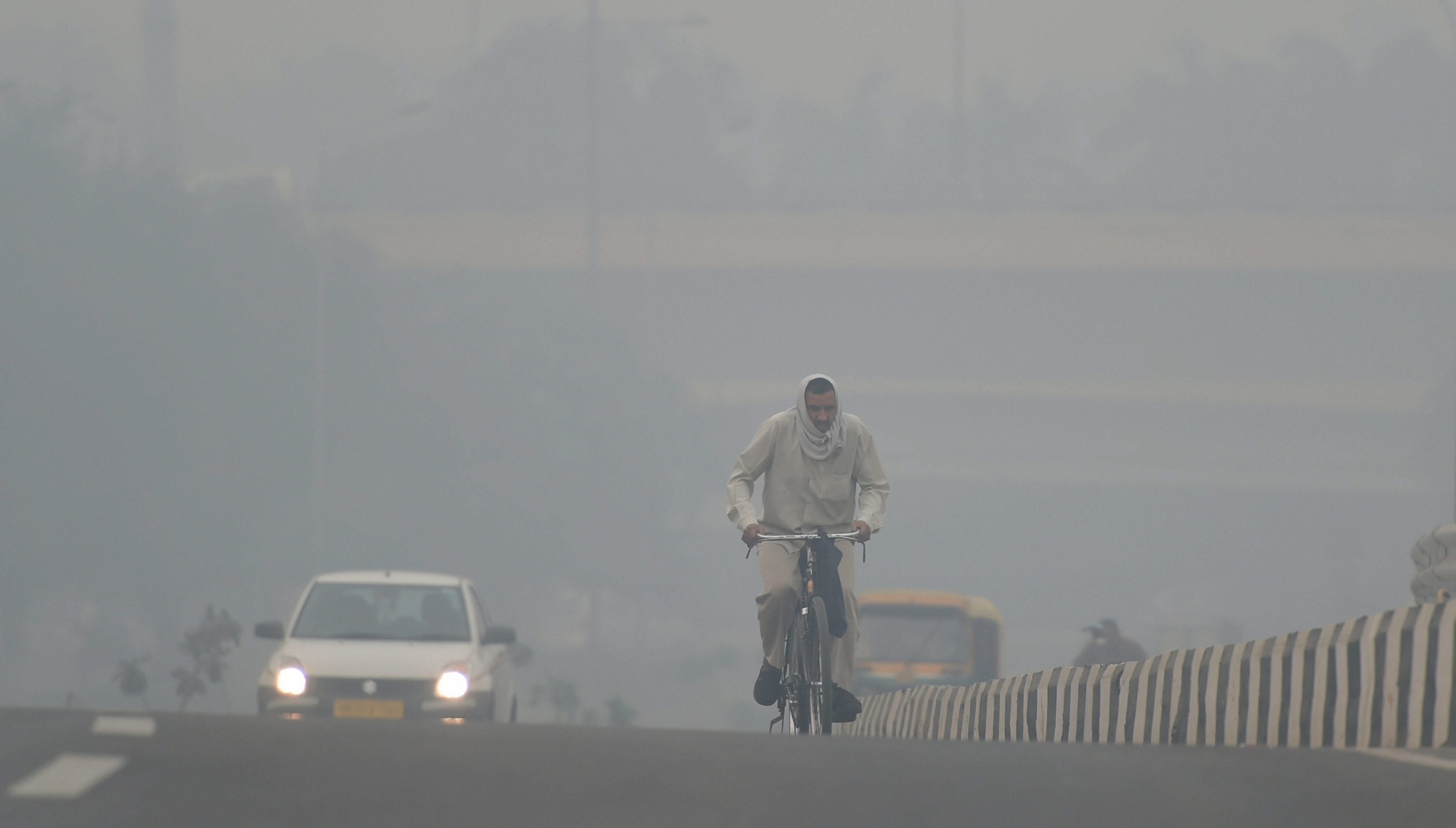
Delhi's air quality deteriorated on Monday to ‘Severe' for the second time within a week due to a change in wind direction and rampant stubble burning in neighbouring states, authorities said.
The overall air quality index on Monday was registered in the ‘Severe' category at 418, a drastic decline from a day before when the index was moderate at 171.
A thick haze engulfed the national capital two days ahead of Diwali, following which experts warned the air quality is likely to worsen further due to local factors.
On Sunday, residents of Delhi had breathed the cleanest air in three weeks, according to Central Pollution Control Board data. The air quality turned ‘Severe' for the first time this season on Oct. 30.
Also, PM2.5 (particles in the air with a diameter of less than 2.5 micrometres) and PM10 concentrations spiked to ‘Severe-plus emergency' category at 361 and 500, respectively, according to the Central Pollution Control Board data.
Officials attributed the sudden deterioration to a change in wind direction, now blowing from the northwestern region towards Delhi, bringing with it dust and smoke from stubble burning in neighbouring states.
An official with the System of Air Quality Forecasting and Research said intensified stubble burning is contributing nearly 24 percent of the air pollution in the national capital.
The Indian Institute of Tropical Meteorology, too, said the increase in PM2.5 concentration is due to a change in the wind direction and biomass burning.
The Delhi government launched an aggressive 10-day “Clean Air Campaign” from Nov. 1 to monitor and report polluting activities and ordered halting of construction activities and regulating vehicular traffic.
Civil construction has been suspended in Delhi and surrounding areas of the National Capital Region. All stone crushers and hot mix plants generating dust pollution have also been closed.
The Delhi Pollution Control Committee directed the transport department and the traffic police to intensify their drive against polluting vehicles until Nov. 10.
Union Environment Minister Harsh Vardhan on Monday said no leniency would be shown to those who are violating pollution-control norms. He warned that legal actions were being initiated against people violating regulations.
Delhi Chief Minister Arvind Kejriwal blamed the stubble burning in Punjab as the main reason behind the current cycle of air pollution in Delhi. On Sunday, Punjab Chief Minister Amarinder Singh termed his claim “nonsense”.
But NASA registered a large number of fire counts in Ludhiana, Jalandhar, Sirsa and other areas of Punjab and Haryana.
Also, the enforcement data provided in response to an RTI query by activist Deepak Juneja showed that despite the Delhi government deregistering 40 lakh old vehicles to curb air pollution, only 3,196 vehicles have been impounded, which is less than 1 percent of the total.
Two agencies—Delhi traffic police and transport department of the Delhi government—are responsible for enforcing the ban on 15-year old petrol and 10-year old diesel vehicles imposed by the National Green Tribunal.
Watch the Primetime debate on Delhi's air pollution here

-
The Economic Imperative: Analysing The Material Driving Force Behind India-Canada Strategic Reset

This economic complementarity is further reinforced by deep institutional investment ties and talent mobility, which form the bedrock of the bilateral framework.
-
Medicine Pricing: Where Must Profit Stop?
India must confront excessive margins, hidden incentives and regulatory gaps that threaten the integrity of medicine.
-
Why Amazon And Flipkart Are Struggling To Beat Meesho In India's Smaller Cities
With 274 million users and lowest-cost logistics, Meesho is defending its value commerce crown against giants like Amazon and Flipkart.
-
High US Salaries, No Green Card Certainty: The Financial Calculation Facing Indian H-1B Families
The suspension of PERM processing at eight technology employers does not cancel existing H-1B visas. What it does is force a question many Indian families have been avoiding: is the US salary worth tying your career and family plans to one employer?
-
Swiggy vs Eternal: Food Delivery's Two Rivals Are No Longer In The Same Race
Eternal is building a private AI assistant, dark.ai. Swiggy is still working out how to make Instamart pay, with an operating loss of Rs 895 crore in the July-September quarter while Blinkit stayed profitable.
-
Where You Live Shapes How You Get To Work | The Reason Why
Two-wheelers are the most popular way to get to work in India, accounting for nearly 43% of workplace commutes.
-
Unhedged Position: Can India See An Indonesia-Style Time Correction?
The Nifty is trading below levels it first clocked in 2024. Is there, then, as I have suggested in the headline, potential that the current time correction drags on painfully for the next three-five, even ten years?
-
Navigating Friction And Energy Realities: An Analysis Of Marco Rubio's October Visit To India
Occurring at a critical juncture marked by stalled trade negotiations and escalating geopolitical pressures over global energy supplies, the visit offers a profound window into modern US-India relations.
-
India Exports Capital. Why Not Export Trusteeship?
The big question, then, is whether India can build an institution that global borrowers, investors, banks, and lawyers can trust, even without an Indian connection.
-
France's Economy & Politics Are In Crisis | The Reason Why
Let's look at how the French economy and politics evolved under Nicolas Sarkozy, Franois Hollande and Emmanuel Macron.










