Centre Informs Supreme Court Interlocutor Appointed For Jammu & Kashmir Talks
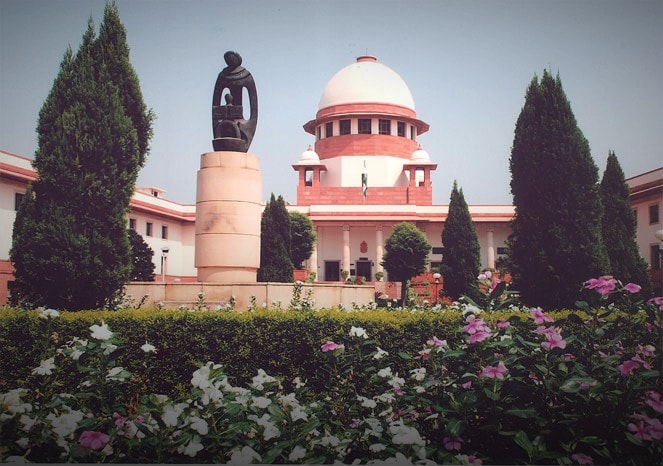
The Supreme Court today adjourned the hearing of the plea challenging Article 35A of the Constitution which empowers the Jammu & Kashmir legislature to define its ‘permanent residents' and bestow on them special rights and privileges.
A three-judge bench headed by Chief Justice Dipak Mishra adjourned the hearing after the Centre told the court that it has appointed a representative to hold talks with all stakeholders to resolve the Kashmir issue, and contended that it was not the right time to proceed with the matter.
Attorney General KK Venugopal had sought six months' time before the hearing of the plea on the sensitive issue could start but the bench, also comprising Justices AM Khanwilkar and DY Chandrachud, posted the matter for listing after three months.
Dineshwar Sharma, a former director of the Intelligence Bureau (IB), was appointed the Centre's interlocutor for Jammu and Kashmir on October 23.
Article 35A, which was added to the Constitution by a Presidential Order in 1954, accords special rights and privileges to the citizens of Jammu and Kashmir and denies property rights to a woman who marries a person from outside the state.
The provision, which leads such women from the state to forfeit their right over property, also applies to their heirs.
The Jammu & Kashmir government, through battery of senior lawyers like Fali S Nariman, Shekhar Naphade, Rakesh Dwivedi, K V Viswanathan and standing counsel Shoeb Alam defended Article 35A. The Advocate General of the State, Jahangir Iqbal Ganai, was also present when the matter was taken up by the court. The state's law minister Abdul Haq Khan and some other ministers were here for the hearing.
The bench was hearing three separate writ petitions challenging Article 35A in addition to the main writ petition filed by a group called We The Citizens.
Several interlocutory petitions have been filed in support of 35A by various individuals and civil society groups seeking continuance of the special status to Jammu & Kashmir.
The state government has cited two verdicts by the Constitution bench of the Supreme Court in 1961 and 1969 which upheld the powers of the president under Article 370(1)(d) of the Constitution of India to pass Constitutional orders.
Article 35A was incorporated into the Constitution of India in 1954 by an order of President Rajendra Prasad on the advice of the Jawaharlal Nehru Cabinet.
The apex court had on August 14 said a Constitution bench may examine whether Article 35A was gender-biased and violative of the basic structure of the Constitution. The court while hearing a plea by Dr Charu Wali Khanna, a Kashmir resident, had indicated that if the Article violated the basic structure of the Constitution or was ultra vires, the issue may be dealt with by a five-judge Constitution bench.
It had tagged the plea challenging Article 35A with a similar petition that is pending for hearing by a three-judge bench.
The state government had earlier said that the issue has already been "prima facie settled" by the High Court in its verdict in 2002. It said that in Dr Susheela Sawhney versus state of Jammu and Kashmir case, the issue was settled by a full bench of the High Court in 2002.
In the case, the high court had, by a majority view, held that a daughter of a permanent resident of Jammu and Kashmir marrying a non-permanent resident will not lose the status of a permanent resident.
Article 35A, empowers the state's legislature to frame any law without attracting a challenge on the grounds of violation of the Right to Equality of people from other states or any other right under the Indian Constitution.
Watch this interview with MM Ansari, former central information commissioner, UGC member and former interlocutor on Jammu & Kashmir.

-
We May Need Another Tukaram Mundhe To Fight Air Pollution | The Reason Why

Developers may install basic measures such as sprinklers and green nets, resume work, and continue violating rules when this equipment stops working.
-
Extracting Value From Battery Scrap Could Be Challenging For India | The Reason Why
A discarded lithium-ion battery still contains valuable materials such as lithium, nickel and cobalt. These can be recovered and reused. When such batteries are crushed and shredded, they produce a dark powder called black mass.
-
One El Nino, India Can Handle. Two Could Break The Granary
India's grain stocks can absorb one bad year, but a second El Nino could drain the buffer in two to three years, economists say.
-
India's Troika Of Good Luck | Joining The Dots
As Jensen Huang's exit drags Nvidia down, a cooling AI trade and resilient earnings have revived investor interest in India. A likely RBI rate hike looms.
-
Talking Points This Week: Leadership Shock At Nvidia, Earnings Strength, And The Fog Over Hormuz
The Anthropic IPO pricing and first trading day, Nvidia's upcoming earnings, and any fresh signals from Iran will set the tone for the following week.
-
Signature Play: The Classic Cocktail Is Dead. Or Is It?
Classic cocktails are disappearing from India's cocktail menus. But they're still being ordered, taught to bartenders and borrowed from. So, who's really having the last drink?
-
A New Samvat Wishlist: Inclusive Prosperity And Human Development
India has strengthened its economic foundations through infrastructure, digital access and enterprise. Its next growth chapter must deepen productivity, create better livelihoods and widen participation in prosperity.
-
Love, Sex Aur Dhokha: The Audacious Plot To Spy On Jensen Huang
A Taipei dinner, a Singapore chip buyer and a suspected Chinese asset: inside the alleged spy operation that got close to NVIDIA's Jensen Huang.
-
Ten Things I Learnt This Samvat
Patience can be a trap. Cheap stocks can stay cheap. Leverage can wipe you out. What did Samvat 2082 teach us? Niraj Shah writes on 10 lessons from the year gone by.
-
Talking Points This Week: Tech Nerves, FII Buying, And A Faraway Banking Shock
The global markets are not shining this Diwali. The exception in the large markets is, India.









