Modi, Xi Hold ‘Forward-Looking’ Talks, Call For Peace In Border Areas
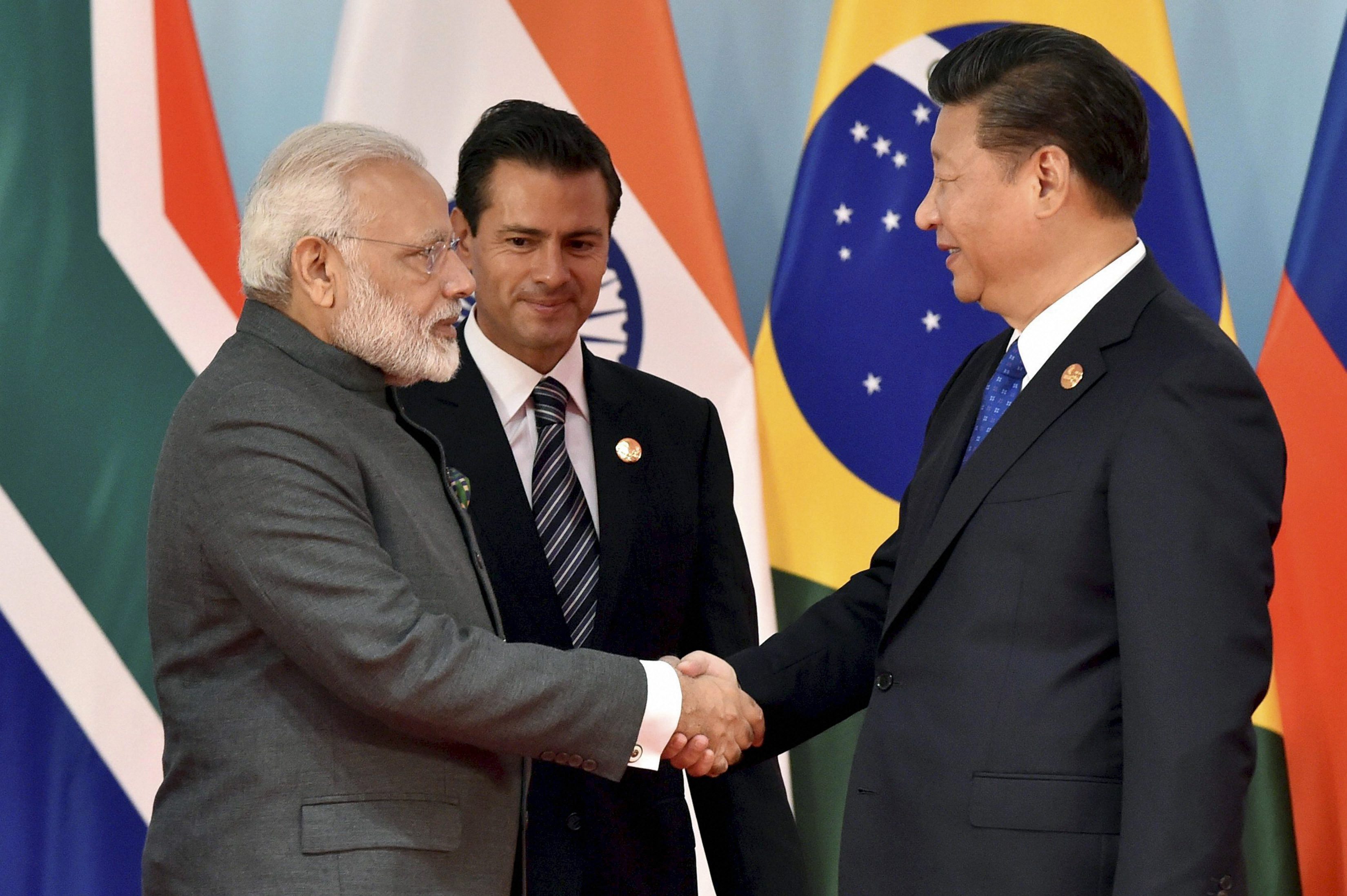
Prime Minister Narendra Modi and Chinese President Xi Jinping on Tuesday held their first substantive bilateral meeting after the Dokalam standoff and reaffirmed that maintaining peace and tranquillity in the border areas was a pre-requisite for ties to move forward.
Modi, who attended the BRICS Emerging Markets and Developing Countries Dialogue earlier in the day, met Xi on the sidelines of the ninth BRICS Summit in Xiamen, China.
Also Read: Modi Risks `Trust Deficit' as India Rips Up Arms Contracts
There was a forward-looking and constructive approach taken by both sides during the over an hour-long meeting between the two leaders, Foreign Secretary S Jaishankar told the media.
Prime Minister Modi and President Xi felt that there should be closer communication between defence and security personnel of India and China, Jaishankar said. The two leaders reaffirmed that it is in the interest of New Delhi and Beijing to have good relations, he said.
During the meeting, Modi and Xi reaffirmed the understanding reached earlier this year at Astana, capital of Kazakhstan, to not allow differences to become disputes. They felt that peace and tranquillity in the border areas is a pre-requisite for ties to move forward, Jaishankar said.
Also Read: PM Modi Seeks Strong Partnership Among BRICS Nations To Spur Growth
Asked if the Dokalam standoff had been left behind by the two sides, Jaishankar said, that it was a forward-looking conversation and not a backward-looking one.
In his initial remarks during the meeting, Modi congratulated Xi on a very successful BRICS Summit, saying the conference had been a success in making the grouping more relevant in a fast-changing world.
Also Read: China's Xi Sees Risks to Global Economy, Opposes Protectionism
Xi told Modi that the two countries should pursue healthy, stable bilateral ties, China's state-run Xinhua news agency reported.
China is willing to work with India on the Five Principles of Peaceful Coexistence (Panchsheel), which were agreed upon by the two nations, to improve mutual trust, promote mutually beneficial cooperation, and push Sino-India ties along the right track, Xi was quoted as saying.
Also Read: Pakistan-Based Terror Groups Named In BRICS Declaration For First Time
The meeting came amid diplomatic efforts by the two sides to overcome the bitterness caused by the 73-day face-off between their troops in the Dokalam area of the Sikkim sector.
The Chinese and the Indian troops were engaged in a standoff since June 16 after the Indian side stopped the construction of a road by the Chinese Army.
On August 28, India's External Affairs Ministry announced that New Delhi and Beijing had decided on "expeditious disengagement" of their border troops from Dokalam.

-
The Economic Imperative: Analysing The Material Driving Force Behind India-Canada Strategic Reset

This economic complementarity is further reinforced by deep institutional investment ties and talent mobility, which form the bedrock of the bilateral framework.
-
Medicine Pricing: Where Must Profit Stop?
India must confront excessive margins, hidden incentives and regulatory gaps that threaten the integrity of medicine.
-
Why Amazon And Flipkart Are Struggling To Beat Meesho In India's Smaller Cities
With 274 million users and lowest-cost logistics, Meesho is defending its value commerce crown against giants like Amazon and Flipkart.
-
High US Salaries, No Green Card Certainty: The Financial Calculation Facing Indian H-1B Families
The suspension of PERM processing at eight technology employers does not cancel existing H-1B visas. What it does is force a question many Indian families have been avoiding: is the US salary worth tying your career and family plans to one employer?
-
Swiggy vs Eternal: Food Delivery's Two Rivals Are No Longer In The Same Race
Eternal is building a private AI assistant, dark.ai. Swiggy is still working out how to make Instamart pay, with an operating loss of Rs 895 crore in the July-September quarter while Blinkit stayed profitable.
-
Where You Live Shapes How You Get To Work | The Reason Why
Two-wheelers are the most popular way to get to work in India, accounting for nearly 43% of workplace commutes.
-
Unhedged Position: Can India See An Indonesia-Style Time Correction?
The Nifty is trading below levels it first clocked in 2024. Is there, then, as I have suggested in the headline, potential that the current time correction drags on painfully for the next three-five, even ten years?
-
Navigating Friction And Energy Realities: An Analysis Of Marco Rubio's October Visit To India
Occurring at a critical juncture marked by stalled trade negotiations and escalating geopolitical pressures over global energy supplies, the visit offers a profound window into modern US-India relations.
-
India Exports Capital. Why Not Export Trusteeship?
The big question, then, is whether India can build an institution that global borrowers, investors, banks, and lawyers can trust, even without an Indian connection.
-
France's Economy & Politics Are In Crisis | The Reason Why
Let's look at how the French economy and politics evolved under Nicolas Sarkozy, Franois Hollande and Emmanuel Macron.










