#GoodNews: Indian-Origin Mathematician Gets Fields Medal Honour
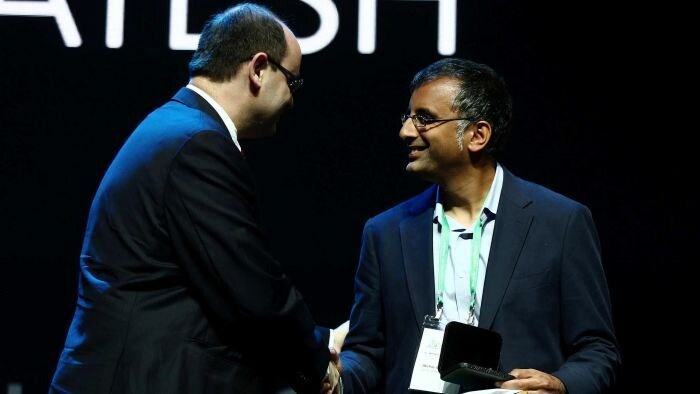

Akshay Venkatesh, a renowned Indian-Australian mathematician, is one of the four winners of mathematics' prestigious Fields Medal, known as the Nobel Prize for math.
The Fields medals are awarded every four years to the most promising mathematicians under the age of 40.
New Delhi-born Venkatesh, 36, who is currently teaching at Stanford University, has won the Fields Medal for his “profound contributions to an exceptionally broad range of subjects in mathematics.”
The citation for his medal – awarded on 1 August at the International Congress of Mathematicians in Rio de Janeiro – highlights his “profound contributions to an exceptionally broad range of subjects in mathematics” and his “strikingly far-reaching conjectures.”
The other three winners are:
- Caucher Birkar, a Cambridge University professor of Iranian Kurdish origin
- Peter Scholze, a German teaching at the University of Bonn
- Alessio Figalli, an Italian mathematician at ETH Zurich.
Each winner receives a 15,000 Canadian-dollar cash prize. At least two, and preferably four people, are always honoured in the award ceremony.
The prize was inaugurated in 1932 at the request of Canadian mathematician John Charles Fields, who ran the 1924 Mathematics Congress in Toronto.
Journey from Delhi to Stanford University
From being a child prodigy to becoming one of the most renowned researchers in the field of mathematics, Venkatesh's journey has been full of achievements and accolades.
He moved to Perth, Australia, with his parents when he was two years old.
He participated in Physics and Math Olympiads, the premier international competitions for high school students, and won medals in the two subjects at ages 11 and 12, respectively.
He finished high school when he was 13 and went to the University of Western Australia, graduating with first class honours in mathematics in 1997, at the age of 16.
In 2002, he earned his PhD at the age of 20. Since then, he has gone from holding a post-doctoral position at MIT to becoming a Clay Research Fellow and, now a professor at Stanford University.
Venkatesh has worked at the highest level in number theory, arithmetic geometry, topology, automorphic forms and ergodic theory.
His research has been recognised with many awards, including the Ostrowski Prize, the Infosys Prize, the Salem Prize and Sastra Ramanujan Prize.

-
AI Bias In Investing Cannot Be Eliminated, But It Can Be Governed

Framing is a particularly important example as identical financial information presented in terms of gains rather than losses can lead an LLM to reach a different assessment.
-
Joining The Dots | Dark Skies, Steady Diya: Why Hope Holds This Diwali
With war, a weak rupee and foreign outflows weighing on sentiment, policymakers at the NDTV World Summit and market veterans at NDTV Profit Ignite: Diwali Edition offered the same advice: stay invested and filter out the noise.
-
The Curious Case of Equitas Small Finance Bank And A CEO Who Quit For Stock
PN Vasudevan believes persistent investor concerns over a perceived conflict of interest had become a governance overhang on Equitas Small Finance Bank's stock, even as the lender improved profitability and asset quality.
-
Talking Points This Week: AI Cash Burn, A Tiger Comeback And An India That Still Finds Its Own Path
India is not immune to higher oil or tighter global liquidity, yet its earnings base is broader, its domestic policy levers are still available.
-
Foreign Investors Own Half Of HDFC Bank and ICICI Bank. An LTCG Cut Could Matter Most Here
Foreign portfolio investors have US$115 billion parked in HDFC Bank, ICICI Bank. If the government cuts long-term capital gains tax, Jefferies says returning foreign money could land here first.
-
'Never Seen This Level Of Negativity': Sandeep Tandon Says The Next Rally May Be Closer Than You Think
Veteran investor Sandeep Tandon says foreign selling is easing, large-caps are due a comeback and mid-caps are crowded, while he turns positive on gold, power and pharma this Diwali.
-
Indians Stay With Family, Not In Hotels | The Reason Why
India still lacks enough clean, reliable and affordable hotels for budget-conscious travellers.
-
The Economic Imperative: Analysing The Material Driving Force Behind India-Canada Strategic Reset
This economic complementarity is further reinforced by deep institutional investment ties and talent mobility, which form the bedrock of the bilateral framework.
-
Medicine Pricing: Where Must Profit Stop?
India must confront excessive margins, hidden incentives and regulatory gaps that threaten the integrity of medicine.
-
Why Amazon And Flipkart Are Struggling To Beat Meesho In India's Smaller Cities
With 274 million users and lowest-cost logistics, Meesho is defending its value commerce crown against giants like Amazon and Flipkart.










