$6.5 Billion Afforestation Fund Has Pitted Forest Departments Against Tribals, Again
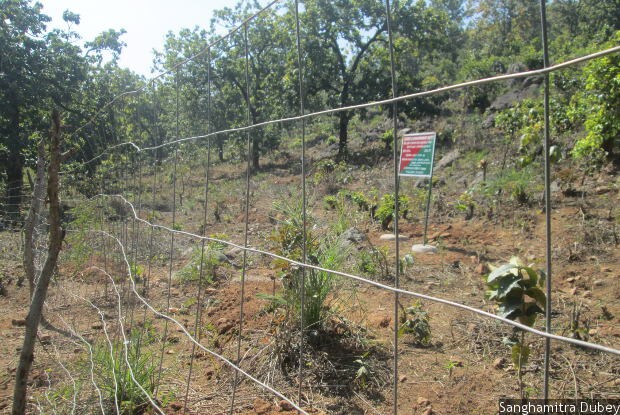
One day in the summer of 2013, Balakrushna Jani, one of the leaders of Burlubaru village in Kandhamal district of southern Odisha, heard from a farmer that some men were planting saplings on forest land a few kilometres outside the village. As per the Forest Rights Act, the land in question belonged to the villagers–primarily of the Kutia Kondh tribe, classified as particularly vulnerable due to their small numbers–and was part of the 50 hectares they had left fallow as per usual practice.
Balakrushna and a few other villagers rushed to see what was going on. They found most of the land covered with teak saplings, and labourers at work to cover the remaining parts. When Balakrushna confronted the forest officials present, they shouted him down and threatened that anyone who tried to prevent the plantation or even enter the area would be arrested.
Back in the village, Balakrushna learnt that a few days back, a group of forest officials had forcibly taken signatures from a couple of Burlubaru residents to allow the department to plant trees, without disclosing the location.
Burlubaru residents are among the 40,000 tribespeople from the heavily forested states of Odisha, Jharkhand, Chhattisgarh and Telangana who are embroiled in a new episode of an old struggle–protecting traditional tribal lands from state forest departments, who, this time, are forcing plantations on their lands. There are at least 22 cases like Burlubaru's that Land Conflict Watch, a data-journalism initiative, has documented so far, spread over an area twice the size of Puducherry.
Testimonies of affected tribespeople, their leaders, and activists and lawyers working for tribes people's land and forest rights point to a conspiracy–forest departments are using afforestation as a tool to exert control over forest lands traditionally used by tribes people, which they lost with the enactment of the Forest Rights Act.
A Law, And A backlash
Burlubaru residents have long been used to forest department highhandedness–many of them have been beaten up, jailed and fined for using forest land. In late 2012, the villagers received titles over their land under the Forest Rights Act, a 2006 law that enables tribespeople to legally claim rights over forest lands they have been occupying and using for generations.
Yet, the forest department has continued to harass them, the plantation drive being the latest episode.
The law empowers gram sabhas (village councils) to manage the forest resources traditionally used by tribals. It does not allow any activity, even by the government, on these lands without prior consent from the village council concerned.
An analysis of cases that Land Conflict Watch has documented reveals that in 80 percent of the cases, the forest department did not take the consent of village councils before planting trees and then fencing lands on which tribal communities have staked claims. In more than half the cases, the communities had already received titles affirming their land rights before the plantation drive began, and in the remaining cases their claims are pending. Together, these 22 cases cover about 1,00,000 hectares of forest land claimed by almost 40,000 tribespeople.
Forest Rights Violations Due To Compensatory Afforestation
Regions where forest departments led plantation programmes funded by Compensatory Afforestation Fund are violating forest rights of tribespeople--accorded to them by the Forest Rights Act--in heavily forested states of India; this is brewing conflicts. Village councils were not consulted in any of the 22 conflicts* reported from Chhattisgarh, Odisha, Jharkhand and Telangana. These conflicts affect the livelihood and survival of 40,000 tribespeople.

Forest departments are carrying out these plantation drives using the Compensatory Afforestation Fund, a corpus of more than Rs 42,000 crore ($6.5 billion) accumulated by the central government from developers of projects–infrastructure, mining or industrial–to compensate for the forests cut down and the plantation to be carried out by the government in their lieu. Part of the payment is also meant to offset the loss of ecological benefits like carbon sequestration, soil preservation and biodiversity.
“The Compensatory Afforestation Fund is just one of the stratagems that the state forest departments have invented over the years to obstruct Forest Rights Act,” said Shomona Khanna, a Supreme Court lawyer and former legal consultant with the union ministry of tribal affairs. “When forest dwelling communities have been granted title to a particular tract of forest land, it is incomprehensible that anyone, leave alone government officials, would plant trees on that land without taking consent of village councils,” she said.
Dispossessing people from their land in the name of plantation is punishable under the Scheduled Castes and Scheduled Tribes (Prevention of Atrocities) Act of 1989, which was amended in 2016. “It may be prudent for the forest department to re-examine their misplaced sense of impunity in light of this law,” said Khanna.
On Nov. 8, 2017, the environment ministry released guidelines to identify land for compensatory afforestation, which said “revenue lands, zudpi jungle, chhote-bade jhar ka jungle, jungle jhari land, waste lands and others… shall be considered for the purpose of compensatory afforestation”. Such lands will be notified as reserve or protected forests, which are controlled by forest departments. Most of the lands over which tribals have traditional rights fall under the above categories.
The guidelines show that the environment ministry aims to grab forests, and common lands–over which communities have customary rights–for compensatory afforestation and get them notified as reserve or protected forests by executive fiat and without due process, said Madhu Sarin, a tribal rights activist. Sarin was a member of the technical support group that drafted the Forest Rights Act.
Ahead of the announcement of final rules, environmentalists and tribal rights activists have intensified campaigns. On November 14, 2017, Community Forest Resource-Learning and Advocacy (CFR-LA), a countrywide group of nonprofits and researchers that advocates for the rights of tribespeople and other forest dwellers, organised a meeting in Delhi in which representatives of tribal communities from various states, tribal activists and researchers participated. They shared testimonies of large-scale violations of forest rights through compensatory afforestation, and demanded that the rules should contain provisions for prior consent of village councils, whether or not forest rights are settled in their regions. They also demanded that afforestation money be handed over directly to village councils. Further, they said, the November 8, 2017, guidelines on identification of land for compensatory plantation should be withdrawn.
“Compensatory afforestation done by the forest departments is a waste of money. Communities have done so much better at protecting and restoring forests and degraded land,” said Tushar Dash, an Odisha-based researcher who is a member CFR-LA. “In Odisha, more than 10,000 communities are successfully protecting and regenerating more than a million hectares of forest.” He said the tribal affairs ministry had issued guidelines in 2015 saying the compensatory afforestation fund should be directly allocated to village councils.
CFR-LA and their fellow activists say their demand stems from ongoing violations, which they believe indicate that forest departments are using afforestation to take back control over forests claimed by tribespeople since the enactment of the Forest Rights Act. Historically, tribespeople and other forest dwellers have never had recorded rights over forests and have often been seen as encroachers on their own land. The Forest Rights Act was passed to correct this “historical injustice”.
A Long History Of Struggle In Burlubaru
For generations, Burlubaru residents have practiced shifting cultivation or podu, in which parts of a forest are cleared, cultivated, harvested and then left fallow by turns. Under the Forest Rights Act, tribal communities have a right to decide how to manage their forest land. Balakrushna said the forest department has often harassed and arrested villagers for purportedly destroying forests. In such situations, he said, the villagers pooled in penalty money–which ranges from Rs 1,500 to Rs 6,000–to bail out those arrested. Three residents are still facing charges, he said.
To be rid of this harassment, in 2010, all 52 families of the village filed applications to get land titles under the Forest Rights Act, which they received two years later. Soon after, the forest department started planting teak saplings on their land.

When repeated requests to the forest department to stop the plantation bore no result, Burlubaru residents approached Odisha's tribal department in 2013, and the National Human Rights Commission (NHRC) in 2015. Both the bodies independently found that the forest department had planted teak on land claimed by the community against its will. Several time between 2014 and 2016, the tribal department and the NHRC wrote to forest officials and the Kandhamal district collector to look into the matter. G Reghu, the then district collector, wrote back to the NHRC saying the community's consent had been taken prior to the plantation.
Pradipta Behera, the district forest officer, said he had recently joined and was “not familiar with the case”. Shashi Paul, the regional chief conservator of the circle, did not respond to questions, either, saying Behera was “the right person to speak about it”.
While officials dither, Burlubaru residents remain without access to their land and their only source of livelihood. They are now forced to perform daily-wage labour under the Mahatma Gandhi National Rural Employment Guarantee Act (MNREGA) programme.
Violations Across India
Like Odisha, podu lands are facing a threat from the state forest department's plantation drive in Telangana too. Hundreds of tribespeople in Khammam district have taken to the streets many times in the recent past, demanding that they be allowed to continue podu cultivation on their village land, which, in many cases, has been taken over by the Telangana forest department to plant trees under a special plantation drive called Haritha Haram (green necklace). Launched in July 2015, Haritha Haram uses the Compensatory Afforestation Fund.
According to local media reports, the forest department has resorted to strong-arm tactics including destroying standing crops and lathi-charging (caning) and arresting protesters. Nearly 10,000 tribespeople practice podu on 30,000 hectares of forest land they have claimed so far under the Forest Rights Act in Khammam alone. Recently, the Communist Party of India (Marxist) raised this issue in the state assembly. The Forest Department has been reported to say that tree felling for podu degrades forest cover.
In Raajbans village of Jharkhand's Garhwa district, too, the state forest department has planted trees on 394 hectares of forest land, on which the local community awaits land titles under the Forest Rights Act. About 400 families have been barred by the forest department from accessing the land that gave them their livelihood. The families also allege that the forest department scorched the village grazing land.
In Chhattisgarh, tribespeople of Sonakhan village in Baloda Bazar district are at loggerheads with the state forest department after it fenced off a forest area–using the Compensatory Afforestation Fund–this September. The fenced area encloses the 20 hectares of land that the community uses for livelihood, as well as a cultural space they call ‘kurrupat' (dev sthal, or holy land) where about 10,000 people of Sonakhan and nearby villages worship. The community of Sonakhan have applied for titles to these 20 hectares.
Tribal rights activists say they have made repeated representations against these violations to the ministries of environment and tribal affairs, but have received no response. The ministries did not respond to emailed queries from IndiaSpend.
Plantations Not forests
The Compensatory Afforestation Fund has been controversial for other reasons too. According to an ongoing study at the Indian School of Business in Hyderabad, which is examining some 19,000 plantation sites in 10 states–Andhra Pradesh, Chhattisgarh, Himachal Pradesh, Jharkhand, Karnataka, Maharashtra, Odisha, Rajasthan, Telangana and Uttarakhand–close to 60 percent of the 18.92 crore (189 million) trees planted belong to commercial species like teak, eucalyptus, acacia and bamboo. Teak alone comprises 21 percent of all commercial species planted.
“Most of these [commercial] trees just give you wood, and when planted as a single-species or monoculture, they badly affect local ecosystems,” said TR Shankar Raman, a wildlife scientist with Nature Conservation Foundation, a Mysore-based nonprofit. Non-native commercial trees like teak require relatively large quantities of water, energy and minerals to survive, competing with other plants and depleting water and soil resources. Even when planted in degraded forests, non-native commercial trees are often poorer in biodiversity because even degraded sites tend to be more diverse with numerous regenerating native species, Raman said.
If CAMPA plantations are to be pro-poor and effective, it is vital that local communities be given the authority to manage their forests; this would include the right to decide whether to have a plantation and of what kind, said Sharachchandra Lele, senior fellow at the Ashoka Trust for Research in Ecology and the Environment, Bengaluru. Their indigenous knowledge is also best suited to decide which species to plant and where, Lele added
Afforestation Fund Siphoned Off
In 2013, the Comptroller and Auditor General of India (CAG) reported that state governments had siphoned off compensatory afforestation money for uses other than afforestation. Between 2006 and 2012, forest departments planted trees on only 7 percent of the 103,000 hectares of non-forest land that was to be covered under compensatory tree-planting during that period. They claimed 61 percent of the afforestation fund released by the centre during that period, but put a large part of it to other uses. In Jammu & Kashmir, the forest department bought iPods, air conditioners, sofa sets and televisions, and even paid officials' private hotel bills using the fund. The Chhattisgarh forest department used the fund to buy expensive vehicles and to construct offices and houses. The Himachal Pradesh government used crores of rupees from the fund to sterilise monkeys.
Such irregularities put a question mark on the plantation schemes the government is carrying out to meet its commitments under the Paris Agreement on Climate Change to increase the country's green cover by 25 million hectares–from the current 70 million hectares–by 2030. Massive plantation drives by state governments over the past decade have not translated into any significant increase in green cover, the Hindustan Times reported in 2016. Although the environment ministry claimed to have carried out tree-plantation on 19.64 million hectares of land between 2003 and 2014 under various government schemes including compensatory afforestation, the corresponding increase in green cover was only 2.4 million hectares, which included private plantations, the report found. Green cover over 17 million hectares were missing.
Six months ago, G Reghu, the then collector of Kadhamal district, held a meeting in Burlubaru village, which forest officials also attended. Balakrushna recalled that Reghu asked him and other residents to stop writing to the NHRC and the state tribal department, promising that when the saplings grew into trees, they would belong to the villagers.
But for Balakrushna and other Burlubaru residents, that is too long a wait. Their concerns are more immediate: Living in a state of desperate poverty, losing access to these lands deprives them of food and livelihood. Daily-wage work, when available, hardly covers the bare essentials. Besides, they are reluctant to trust the forest department given how they have been treated in the past.
The villagers do not want teak plantations; they want free access to their lands. So, they are once again preparing a letter for the Odisha tribal department and the National Human Rights Commission.
Bhasker Tripathi is an environment journalist with Land Conflict Watch, a Delhi-based data journalism initiative. With inputs from Sanghamitra Dubey and Kanan Kapoor.
This article has been published in arrangement with IndiaSpend.

-
Getting To Work Costs Women More | The Reason Why

It is not just about women paying more than men. It is about women paying much more in cities than in villages.
-
AI Bias In Investing Cannot Be Eliminated, But It Can Be Governed
Framing is a particularly important example as identical financial information presented in terms of gains rather than losses can lead an LLM to reach a different assessment.
-
Joining The Dots | Dark Skies, Steady Diya: Why Hope Holds This Diwali
With war, a weak rupee and foreign outflows weighing on sentiment, policymakers at the NDTV World Summit and market veterans at NDTV Profit Ignite: Diwali Edition offered the same advice: stay invested and filter out the noise.
-
The Curious Case of Equitas Small Finance Bank And A CEO Who Quit For Stock
PN Vasudevan believes persistent investor concerns over a perceived conflict of interest had become a governance overhang on Equitas Small Finance Bank's stock, even as the lender improved profitability and asset quality.
-
Talking Points This Week: AI Cash Burn, A Tiger Comeback And An India That Still Finds Its Own Path
India is not immune to higher oil or tighter global liquidity, yet its earnings base is broader, its domestic policy levers are still available.
-
Foreign Investors Own Half Of HDFC Bank and ICICI Bank. An LTCG Cut Could Matter Most Here
Foreign portfolio investors have US$115 billion parked in HDFC Bank, ICICI Bank. If the government cuts long-term capital gains tax, Jefferies says returning foreign money could land here first.
-
'Never Seen This Level Of Negativity': Sandeep Tandon Says The Next Rally May Be Closer Than You Think
Veteran investor Sandeep Tandon says foreign selling is easing, large-caps are due a comeback and mid-caps are crowded, while he turns positive on gold, power and pharma this Diwali.
-
Indians Stay With Family, Not In Hotels | The Reason Why
India still lacks enough clean, reliable and affordable hotels for budget-conscious travellers.
-
The Economic Imperative: Analysing The Material Driving Force Behind India-Canada Strategic Reset
This economic complementarity is further reinforced by deep institutional investment ties and talent mobility, which form the bedrock of the bilateral framework.
-
Medicine Pricing: Where Must Profit Stop?
India must confront excessive margins, hidden incentives and regulatory gaps that threaten the integrity of medicine.












