Charting The Global Economy: Powell Pivots To September Rate Cut
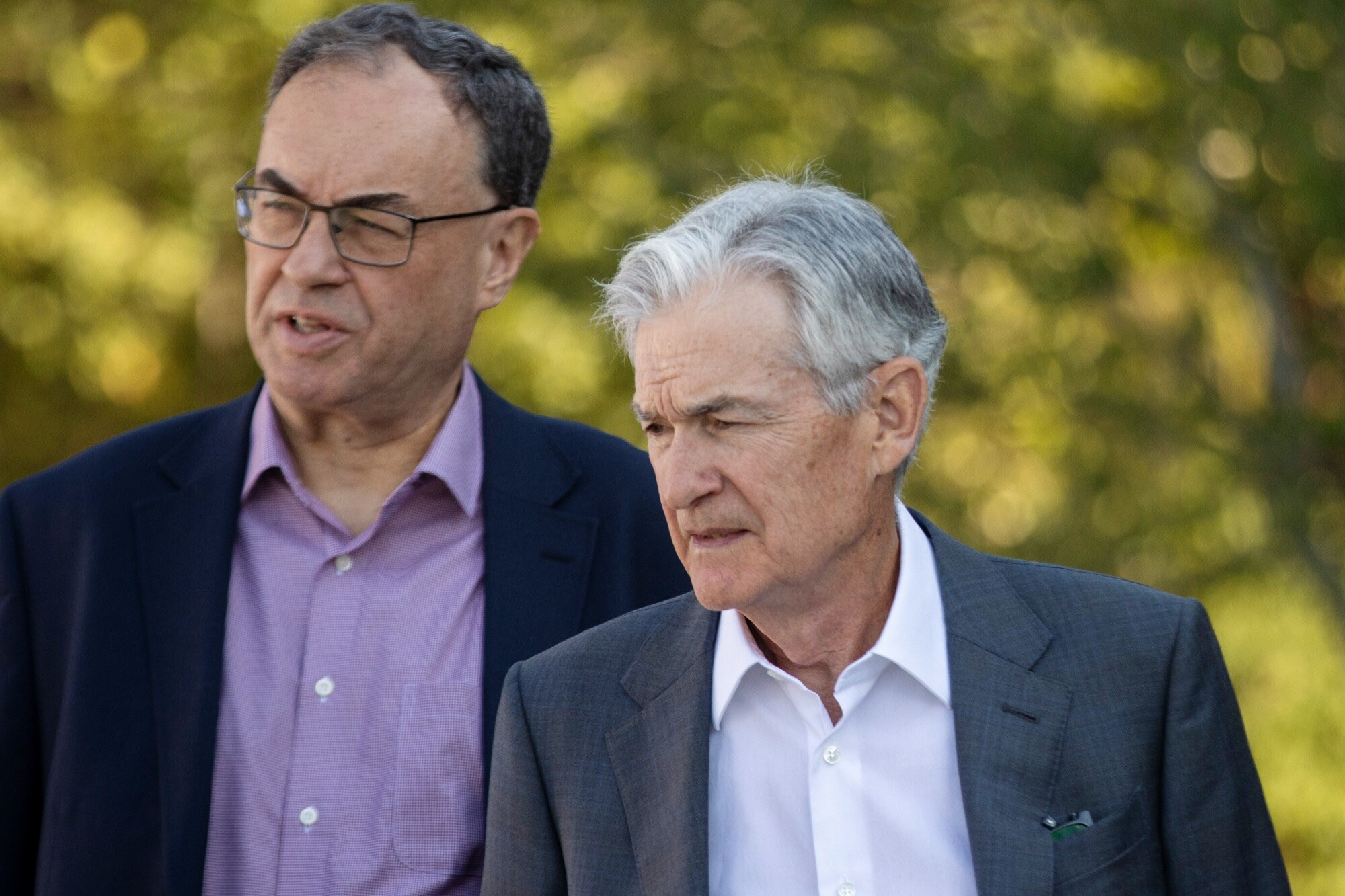
(Bloomberg) -- Chair Jerome Powell said the time has come for the Federal Reserve to cut its key policy rate, affirming expectations that officials will begin lowering borrowing costs next month and making clear his intention to prevent further cooling in the labor market.
“The time has come for policy to adjust,” Powell said Friday at the Kansas City's Fed's annual conference in Jackson Hole, Wyoming. He acknowledged recent progress on inflation and an “unmistakable” slowdown in the labor market.
Here are some of the charts that appeared on Bloomberg this week on the latest developments in the global economy, markets and geopolitics:
US & Canada

While Powell's remarks provided some clarity for financial markets in the near term, they offered few clues as to how the Fed might proceed after its September gathering. Still, the speech confirmed the US central bank is on the cusp of a key turning point in its two-year battle against inflation.

US job growth will likely be revised down by 818,000 for the 12 months through March, the largest downward revision since 2009. The Bureau of Labor Statistics provided at least three Wall Street firms with the highly anticipated number that was delayed on the agency's website, renewing questions about the procedures for disseminating some of the world's most sensitive economic information.

The busiest port complex in the US is churning through import volumes near the highs set during the pandemic despite worries about a cooling economy. Demand now is driven by retailers and other importers that are stocking up ahead of US tariffs on Chinese goods and a possible strike by a large group of American dockworkers — adding to the usual frenzy of pre-holiday ordering that occurs this time of year.

A union filed strike notice against Canada's largest railway on Friday just hours after trains began rolling again, likely derailing plans to revive vital shipping networks. The Teamsters Canada Rail Conference told Canadian National Railway Co. in a letter that it plans to withdraw the services of its roughly 6,500 members effective 10 a.m. Toronto time on Monday.
Europe

The euro-area economy got an unexpectedly strong boost from the Paris Olympics, which propelled private-sector growth to the fastest pace in three months. Much suggests the Olympic spirit won't linger — not even in France, where growth momentum picked up sharply this month. Output in Germany, Europe's largest economy, shrank more than expected.

Ukrainian President Volodymyr Zelenskiy wants refugees to return to keep the war-torn economy running and resist Russia. Much of central and eastern Europe, meanwhile, is enduring a labor shortage, and countries such as Poland and the Czech Republic are reticent to lose people.
Asia

South Korea's household debt grew at a quickening clip last quarter, spurred by mortgage loans. South Korea has one of the highest household debt-to-economy ratios in the world, with many people holding the bulk of their wealth in real estate.

Singapore's core inflation slowed more than expected in July, opening the room for the island's central bank to consider loosening monetary policy settings later this year.

Chinese consumers continued to pull back on gold purchases last month, as record prices and a sustained economic slowdown curbed demand in the world's biggest bullion-buying nation.
Emerging Markets

It's been almost two years now since Luiz Inacio Lula da Silva secured his return to power in Brazil. For investors, they've been bleak — a stark contrast to Lula's first presidential stint two decades ago. He's balked repeatedly at calls for spending cuts to rein in a budget deficit that has ballooned to the equivalent of about 10% of Brazil's gross domestic product.

Mexico's annual inflation slowed much more than expected while economic growth remained feeble. The data clear the way for Banxico, as the Mexican central bank is known, to deliver a second-straight rate cut of a quarter-point at its September meeting.
World

Sweden's Riksbank lowered rates for the second time since May, and Botswana cut as well. Turkey held rates steady for a fifth month. Chinese banks kept their benchmark lending rates unchanged for August as profit margins come under pressure, while Iceland, Thailand, Indonesia, Korea and Paraguay held.
--With assistance from Vinícius Andrade, Krystof Chamonikolas, Laura Dhillon Kane, Andrea Dudik, Sybilla Gross, Sam Kim, Cynthia Li, Jonnelle Marte, Monique Mulima, Natalia Ojewska, Amara Omeokwe, Jana Randow, Andrew Rosati, Augusta Saraiva and Alex Vasquez.
More stories like this are available on bloomberg.com
©2024 Bloomberg L.P.

-
Talking Points This Week: Leadership Shock At Nvidia, Earnings Strength, And The Fog Over Hormuz

The Anthropic IPO pricing and first trading day, Nvidia's upcoming earnings, and any fresh signals from Iran will set the tone for the following week.
-
Signature Play: The Classic Cocktail Is Dead. Or Is It?
Classic cocktails are disappearing from India's cocktail menus. But they're still being ordered, taught to bartenders and borrowed from. So, who's really having the last drink?
-
A New Samvat Wishlist: Inclusive Prosperity And Human Development
India has strengthened its economic foundations through infrastructure, digital access and enterprise. Its next growth chapter must deepen productivity, create better livelihoods and widen participation in prosperity.
-
Love, Sex Aur Dhokha: The Audacious Plot To Spy On Jensen Huang
A Taipei dinner, a Singapore chip buyer and a suspected Chinese asset: inside the alleged spy operation that got close to NVIDIA's Jensen Huang.
-
Ten Things I Learnt This Samvat
Patience can be a trap. Cheap stocks can stay cheap. Leverage can wipe you out. What did Samvat 2082 teach us? Niraj Shah writes on 10 lessons from the year gone by.
-
Talking Points This Week: Tech Nerves, FII Buying, And A Faraway Banking Shock
The global markets are not shining this Diwali. The exception in the large markets is, India.
-
Midterm Rally Lasted A Day. The Hard Reality Of A Divided US May Last Two Years | Opinion
Between a contested AI boom, a debt ceiling that arrives in 2027 and a president with every incentive to act alone, the next two years may prove more volatile than the first day's rally suggests.
-
Blue Wave Will Derail the AI Trade but Won't Dismantle the AI Era | Unhedged Position
The Democrats' sweep of the US Congress will see politics collide with economic forces both over the long and short term.
-
It's Time To Take The GST Council's Bet On Trust Global
Payment records can prove India's services exports, and clear, proportionate rules can bring foreign digital sellers into the tax net.
-
Opinion | India at 38: From Innovation Overperformer to Innovation Powerhouse
India now has 453 VC-backed deep science startups, 18 of them late-stage, after 117 percent growth since 2020. Laurus Labs, at USD 9.3 billion, is the most valuable deep science company in any middle-income economy outside China.









