Von Der Leyen Says EU Will Be Ready If US Trade Talks Break Down
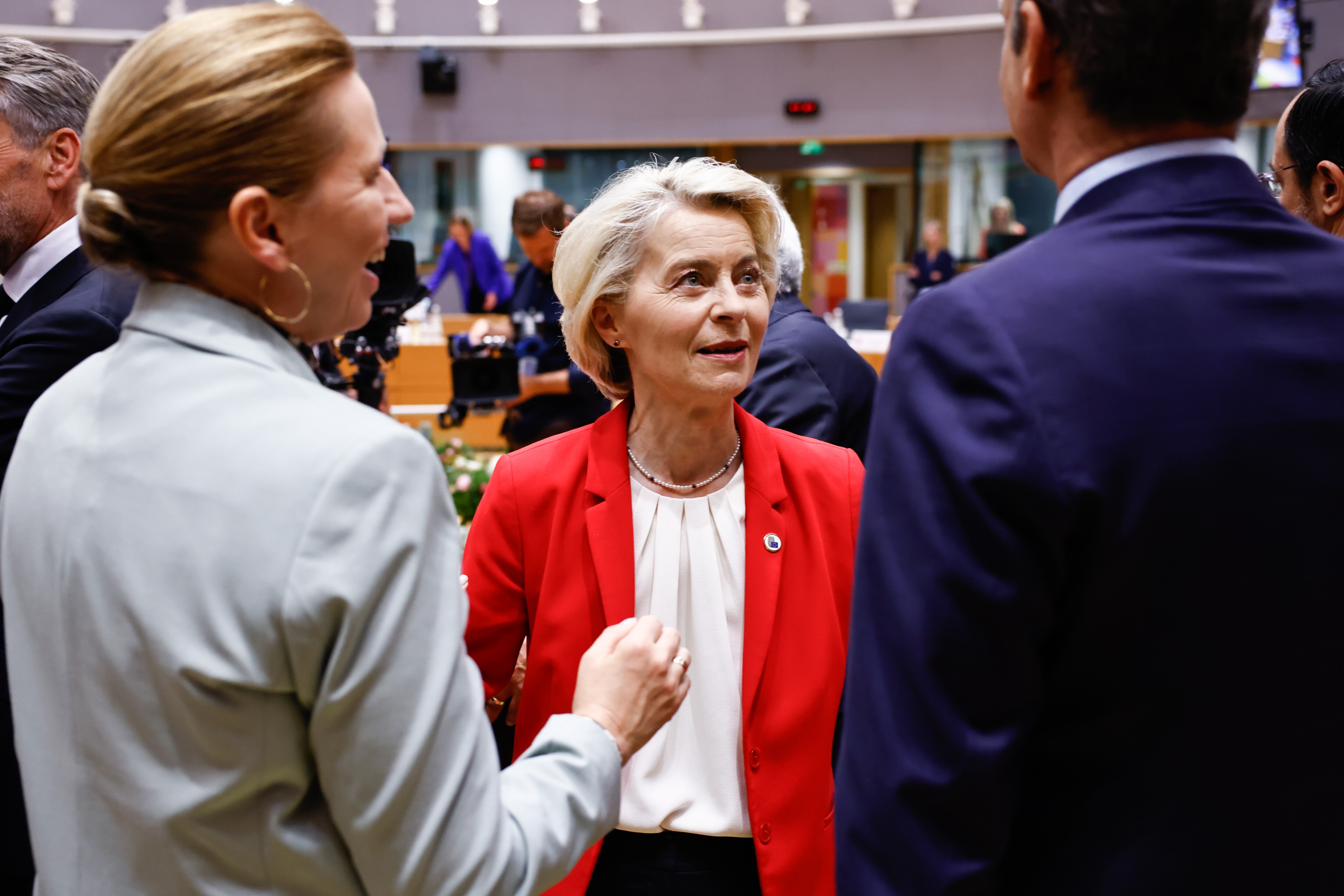
The European Union is prepared for all eventualities in its trade negotiations with the US, including for a breakdown in talks, Ursula von der Leyen said, after discussing the latest proposals from the Trump White House with the bloc's leaders.
The European Commission president said at a press conference in the early hours of Friday that her team is still assessing the latest US tariff offer.
“We are ready for a deal. At the same time we are preparing for the possibility that no satisfactory agreement is reached,” she said. “In short, all options remain on the table.”
The question dogging the leaders and the commission, which handles trade matters for the EU, is whether to accept an asymmetrical trade deal with the US or to strike back, risking escalation and the ire of the US president.
At a summit meeting in Brussels that began Thursday, several member states argued against retaliation. Most suggested that a quick deal with the US is better than holding out for a perfect one, even if that means that many of Trump's tariffs remain in place, according to two people briefed on the discussions.
The EU needs to reach an agreement with Trump by July 9, when levies on nearly all of the bloc's exports to the US increase to 50%. The US president says the EU takes advantage of US with its goods surplus and perceived barriers to American trade.
German Chancellor Friedrich Merz said he'd stressed that deadline to fellow leaders in Brussels, urging them to reach a solution quickly now to remove the threats hanging over key industries.
“We have less than two weeks,” he said. “You can't agree a sophisticated trade agreement in that time.”
Paris, however, rejects the idea of accepting any deal skewed in favor of the US and pushed for a complete removal of tariffs, another official said. French President Emmanuel Macron told reporters after the summit that a quick deal is preferable — but only so long as it is “balanced.”
“The best tariff deal with the US would be zero to zero,” Macron said, insisting that if the US decides to keep 10% tariffs, the bloc would have to respond. “Otherwise we would be naive, or weak, or both,” he said. “And we are neither.”
Detailed discussions with the US are taking place on both tariffs and non-tariff barriers, as well as on key sectors, strategic purchases and regulatory matters the EU is hoping to address through its simplification agenda, said the people, who spoke on the condition of anonymity.
The US is asking the EU to make what the bloc's officials see as unbalanced and unilateral concessions, Bloomberg reported earlier. Discussions on critical sectors — such as steel and aluminum, automobiles, pharmaceuticals, semiconductors and civilian aircraft — have been particularly difficult.
Officials believe the best-case scenario remains an agreement on principles that would allow the negotiations to continue beyond an early July deadline.
Alongside a 10% universal levy on most goods — which is currently facing a US court challenge — Trump has introduced 25% tariffs on cars and double that on steel and aluminum based on a different executive authority. He's also working to expand tariffs on other sectors, including pharmaceuticals, semiconductors and commercial aircraft.
Many of those duties are expected to stay, regardless of an agreement with the Trump administration, according to the people. The EU, which has been seeking a mutually beneficial deal, will assess any end-result and at that stage decide what level of asymmetry — if any — it's willing to accept.

The EU's industry chief, Stephane Sejourne, told Bloomberg this week that the EU would need to respond to any tariffs — including a baseline 10% levy — with countermeasures. But some EU leaders, including Italy's Giorgia Meloni have indicated that they could live with some levies if it allows for a rapid deal that avoids an escalation in the conflict.
During the Brussels summit, the bloc also set its sights on the bloc's broader trade relations. Macron and Merz signaled that European leaders agreed in principle to signing a long-sought free trade agreement with the South American Mercosur bloc, which France has opposed.
The German leader also praised von der Leyen's suggestion at the summit to launch a new international trade organization to supersede what he called the “dysfunctional” World Trade Organization. Von der Leyen first floated the idea at the Group of Seven conference in Canada earlier this month, according to a source with knowledge of the matter.
If the WTO remains in trouble, he said, “we who continue to believe that free trade is right must come up with something new.”

-
AI Bias In Investing Cannot Be Eliminated, But It Can Be Governed

Framing is a particularly important example as identical financial information presented in terms of gains rather than losses can lead an LLM to reach a different assessment.
-
Joining The Dots | Dark Skies, Steady Diya: Why Hope Holds This Diwali
With war, a weak rupee and foreign outflows weighing on sentiment, policymakers at the NDTV World Summit and market veterans at NDTV Profit Ignite: Diwali Edition offered the same advice: stay invested and filter out the noise.
-
The Curious Case of Equitas Small Finance Bank And A CEO Who Quit For Stock
PN Vasudevan believes persistent investor concerns over a perceived conflict of interest had become a governance overhang on Equitas Small Finance Bank's stock, even as the lender improved profitability and asset quality.
-
Talking Points This Week: AI Cash Burn, A Tiger Comeback And An India That Still Finds Its Own Path
India is not immune to higher oil or tighter global liquidity, yet its earnings base is broader, its domestic policy levers are still available.
-
Foreign Investors Own Half Of HDFC Bank and ICICI Bank. An LTCG Cut Could Matter Most Here
Foreign portfolio investors have US$115 billion parked in HDFC Bank, ICICI Bank. If the government cuts long-term capital gains tax, Jefferies says returning foreign money could land here first.
-
'Never Seen This Level Of Negativity': Sandeep Tandon Says The Next Rally May Be Closer Than You Think
Veteran investor Sandeep Tandon says foreign selling is easing, large-caps are due a comeback and mid-caps are crowded, while he turns positive on gold, power and pharma this Diwali.
-
Indians Stay With Family, Not In Hotels | The Reason Why
India still lacks enough clean, reliable and affordable hotels for budget-conscious travellers.
-
The Economic Imperative: Analysing The Material Driving Force Behind India-Canada Strategic Reset
This economic complementarity is further reinforced by deep institutional investment ties and talent mobility, which form the bedrock of the bilateral framework.
-
Medicine Pricing: Where Must Profit Stop?
India must confront excessive margins, hidden incentives and regulatory gaps that threaten the integrity of medicine.
-
Why Amazon And Flipkart Are Struggling To Beat Meesho In India's Smaller Cities
With 274 million users and lowest-cost logistics, Meesho is defending its value commerce crown against giants like Amazon and Flipkart.










