US Payrolls, Wages Pick Up in Jobs Report Dotted With Caveats
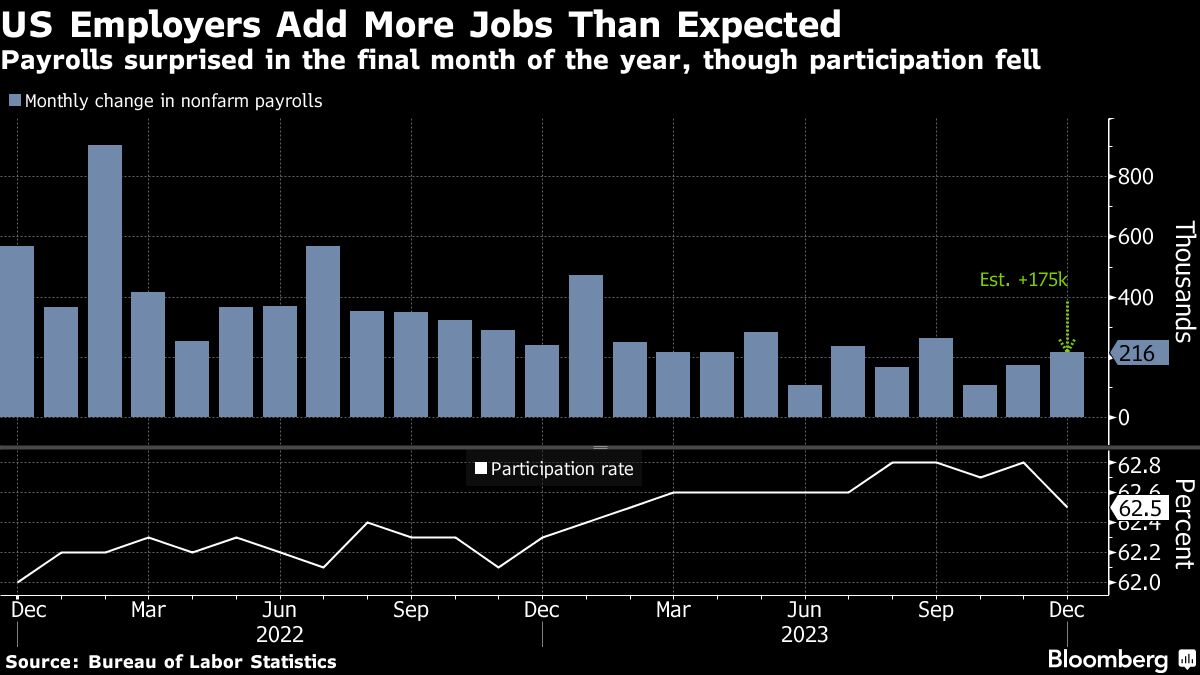
(Bloomberg) -- US job growth picked up in December and wage gains exceeded expectations in a mostly solid report that included some caveats about the strength of the labor market.
Nonfarm payrolls increased 216,000 after downward revisions to the prior two months, a Bureau of Labor Statistics report showed Friday. The unemployment rate held at 3.7%, while average hourly earnings rose 0.4% from a month earlier.

The December figures cap a year where the labor market moderated from its breakneck post-pandemic recovery without sinking into a downturn that was widely forecast earlier in 2023. Despite Federal Reserve interest rates at a two-decade high, the resilient labor market has fueled steady consumer spending and healthy economic growth even as inflation has slowed.
Even so, some analysts said parts of the report signaled underlying weakness, highlighted by a steep drop in the labor-force participation rate.
While Treasury yields rose following the jobs data as traders pulled back from near-certain bets on a Fed rate cut in March, those moves reversed after a private survey on service industries suggested that businesses were aggressively shrinking payrolls.
“The overall picture is of a steady job market that is gradually cooling off,” said Kathy Jones, Charles Schwab's chief fixed-income strategist. “But the rise in average hourly earnings could keep the Fed on hold longer than the market is pricing in.”

The advance in payrolls was led by health care, government, construction and leisure and hospitality. A measure of the breadth of job gains picked up.
But the participation rate — the share of the population that is working or looking for work — fell by 0.3 percentage point to 62.5%, the largest monthly drop in nearly three years. The decrease was concentrated among younger and older cohorts. For those ages 25-54, participation eased 0.1 point.
It's also taking longer for unemployed Americans to find work and the number of full-time employees dropped by the most since April 2020. Moreover, the data indicated a decline in temporary-help employment — often seen as a harbinger of recession — to the lowest since May 2021.
What Bloomberg Economics Says...
“The only piece of good news from December's jobs report is the surprisingly high headline nonfarm payroll print. The rest of the report is permeated with evidence of a fast-cooling labor market: the largest drop in household employment since April 2020, a spike in the duration of unemployment spells, a drop in labor participation, more temp workers unable to find jobs, more people taking part-time work for economic reasons, and a decline in working hours.”
— Anna Wong, Eliza Winger and Estelle Ou
For the full note, click here.
Central bankers are paying close attention to how labor supply and demand dynamics are impacting wage gains. Friday's report showed average hourly earnings increased 4.1% from December 2022. Earnings for nonsupervisory employees, who make up the majority of workers, rose 0.3% from November and 4.3% from a year earlier, though the end of the United Auto Workers strike provided a boost.
The jobs report is made up of two surveys — one of businesses and the other of households. The data incorporated annual revisions to the household survey data, which informs statistics like the unemployment rate and participation rate, but they didn't change the overall employment picture.
--With assistance from Kristy Scheuble, Reade Pickert, Steve Matthews, Mark Niquette and Matthew Boesler.
More stories like this are available on bloomberg.com
©2024 Bloomberg L.P.

-
Getting To Work Costs Women More | The Reason Why

It is not just about women paying more than men. It is about women paying much more in cities than in villages.
-
AI Bias In Investing Cannot Be Eliminated, But It Can Be Governed
Framing is a particularly important example as identical financial information presented in terms of gains rather than losses can lead an LLM to reach a different assessment.
-
Joining The Dots | Dark Skies, Steady Diya: Why Hope Holds This Diwali
With war, a weak rupee and foreign outflows weighing on sentiment, policymakers at the NDTV World Summit and market veterans at NDTV Profit Ignite: Diwali Edition offered the same advice: stay invested and filter out the noise.
-
The Curious Case of Equitas Small Finance Bank And A CEO Who Quit For Stock
PN Vasudevan believes persistent investor concerns over a perceived conflict of interest had become a governance overhang on Equitas Small Finance Bank's stock, even as the lender improved profitability and asset quality.
-
Talking Points This Week: AI Cash Burn, A Tiger Comeback And An India That Still Finds Its Own Path
India is not immune to higher oil or tighter global liquidity, yet its earnings base is broader, its domestic policy levers are still available.
-
Foreign Investors Own Half Of HDFC Bank and ICICI Bank. An LTCG Cut Could Matter Most Here
Foreign portfolio investors have US$115 billion parked in HDFC Bank, ICICI Bank. If the government cuts long-term capital gains tax, Jefferies says returning foreign money could land here first.
-
'Never Seen This Level Of Negativity': Sandeep Tandon Says The Next Rally May Be Closer Than You Think
Veteran investor Sandeep Tandon says foreign selling is easing, large-caps are due a comeback and mid-caps are crowded, while he turns positive on gold, power and pharma this Diwali.
-
Indians Stay With Family, Not In Hotels | The Reason Why
India still lacks enough clean, reliable and affordable hotels for budget-conscious travellers.
-
The Economic Imperative: Analysing The Material Driving Force Behind India-Canada Strategic Reset
This economic complementarity is further reinforced by deep institutional investment ties and talent mobility, which form the bedrock of the bilateral framework.
-
Medicine Pricing: Where Must Profit Stop?
India must confront excessive margins, hidden incentives and regulatory gaps that threaten the integrity of medicine.










