Moody’s Cuts China Credit Outlook to Negative on Rising Debt

(Bloomberg) -- Moody's Investors Service cut its outlook for Chinese sovereign bonds to negative, underscoring deepening global concerns about the level of debt in the world's second-largest economy.
Moody's lowered its outlook to negative from stable while retaining a long-term rating of A1 on the nation's sovereign bonds, according to a statement. China's usage of fiscal stimulus to support local governments and its spiraling property downturn is posing risks to the nation's economy, the grader said.
Read More: Moody's China Outlook Cut Leaked Hours Before Announcement
The government pushed back soon after the outlook change was announced, saying it was “disappointed” with Moody's decision and the nation's economy “will be highly resilient and has large potential.” The impact of the property downturn is well under control, the finance ministry said in a statement.
China Chengxin International Credit Rating Co., one of the leading domestic rating agencies, said the outlook for the nation's sovereign credit was stable, adding that the government has “ample” room to control the rise in debt risks when compared with western countries, according to a statement late Tuesday.
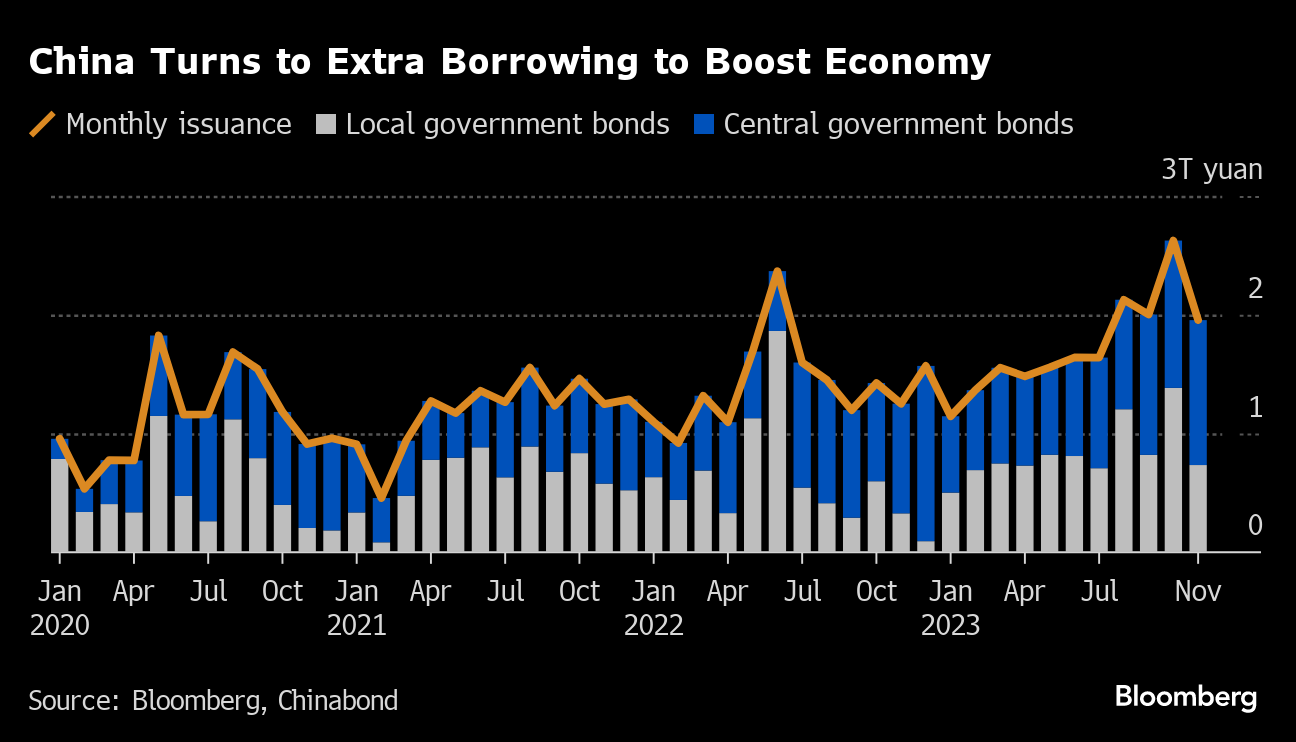
The change in Moody's thinking comes as China's deepening property rout triggers a shift toward fiscal stimulus, with the country ramping up its borrowing as a main measure to bolster its economy. That has raised concerns about the nation's debt levels with Beijing on track for record bond issuance this year.
“These ratings downgrades or negative outlook shifts often mark the low in terms of bad news and market selloffs. I wouldn't see this being the case in two to three months' time,” said Viraj Patel, global macro strategist at Vanda Research. “It's hard for things to get worse than current bearish expectations, and it only takes a little to see a tactical rebound or short squeeze.”
China's economy has struggled for traction this year as a rebound from restrictive Covid Zero policies proved to be weaker than expected and the property crisis deepened. Data last week showed both manufacturing and services activities shrank in November, bolstering a belief that more government action is needed to support a faltering recovery.
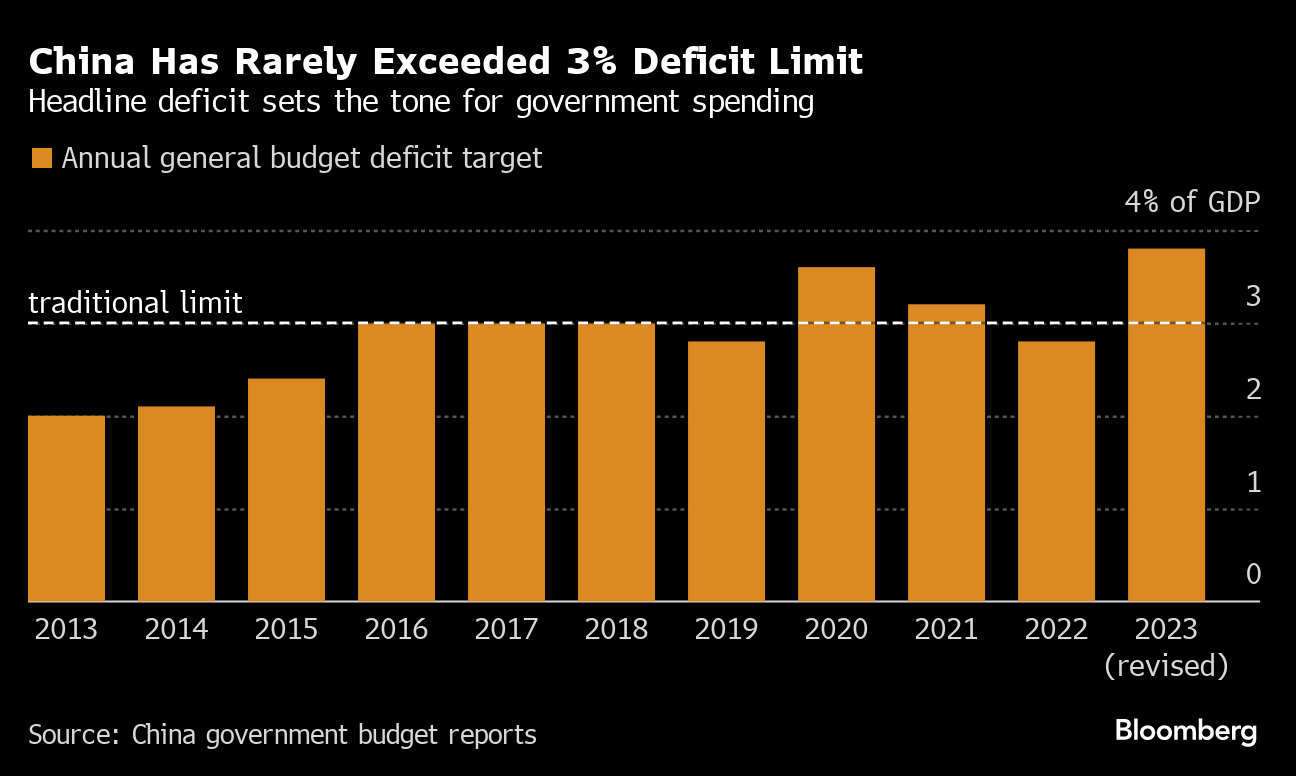
In October, Chinese President Xi Jinping signaled that a sharp slowdown in growth and lingering deflationary risks won't be tolerated, as the government increased its headline budget deficit to the largest in three decades. At 3.8% for 2023, the deficit-to-GDP ratio is well above a long-adhered to 3% limit.
The revision allowed the central government to sell 1 trillion yuan ($140 billion) of additional sovereign bonds within the year to support disaster relief and construction. Local governments were also selling special re-financing bonds to swap some off-balance sheet debt carrying higher costs.
“Considering the policy challenge posed by local government debt, the central government is focused on preventing financial instability,” Moody's said. “Still, maintaining financial market stability while avoiding moral hazard and containing fiscal costs of support is very challenging.”
The yuan was little changed in onshore and overseas trading, while the yield on China's 10-year government bonds was steady at 2.68%. The MSCI China Index slid 1.7%, on course for its lowest close since November 2022. The gauge held onto most of its losses after Moody's move.
China's big state-owned banks sold dollars in large amounts against the yuan in the onshore market after Moody's move, according to traders. Some commercial lenders followed suit in offloading the greenback, helping to trigger a rebound in the Chinese currency, said the traders, who asked not to be named.
Moody's last cut its credit rating on China in 2017, to A1 from Aa3, on the likelihood of a material rise in economy-wide debt and the impact that would have on state finances. That was its first China debt downgrade since 1989.
Earlier this year, Fitch Ratings Ltd. said in an interview with Bloomberg television that it may reconsider China's A+ sovereign credit score. The firm recently affirmed such a rating with a stable outlook.
S&P Global Ratings has kept China's ratings at A+ with stable outlook since its last downgrading in 2017 that followed a similar move by Moody's.
“The risk of a rating downgrade is unlikely to reverse the debt issuances plan, which could help ease concern over property sector and China sluggish growth,” said Ken Cheung, chief Asian FX strategist at Mizuho Securities. “The impact of a cut to the rating's outlook on bond flows should prove limited while the China-US rate spread is still a key driver.”
--With assistance from Iris Ouyang, Ishika Mookerjee, Fran Wang, Ruth Carson, Qizi Sun, Evelyn Yu and Li Liu.
(Updates with China Chengxin comment in fourth paragraph.)
More stories like this are available on bloomberg.com
©2023 Bloomberg L.P.

-
Indians Stay With Family, Not In Hotels | The Reason Why

India still lacks enough clean, reliable and affordable hotels for budget-conscious travellers.
-
The Economic Imperative: Analysing The Material Driving Force Behind India-Canada Strategic Reset
This economic complementarity is further reinforced by deep institutional investment ties and talent mobility, which form the bedrock of the bilateral framework.
-
Medicine Pricing: Where Must Profit Stop?
India must confront excessive margins, hidden incentives and regulatory gaps that threaten the integrity of medicine.
-
Why Amazon And Flipkart Are Struggling To Beat Meesho In India's Smaller Cities
With 274 million users and lowest-cost logistics, Meesho is defending its value commerce crown against giants like Amazon and Flipkart.
-
High US Salaries, No Green Card Certainty: The Financial Calculation Facing Indian H-1B Families
The suspension of PERM processing at eight technology employers does not cancel existing H-1B visas. What it does is force a question many Indian families have been avoiding: is the US salary worth tying your career and family plans to one employer?
-
Swiggy vs Eternal: Food Delivery's Two Rivals Are No Longer In The Same Race
Eternal is building a private AI assistant, dark.ai. Swiggy is still working out how to make Instamart pay, with an operating loss of Rs 895 crore in the July-September quarter while Blinkit stayed profitable.
-
Where You Live Shapes How You Get To Work | The Reason Why
Two-wheelers are the most popular way to get to work in India, accounting for nearly 43% of workplace commutes.
-
Unhedged Position: Can India See An Indonesia-Style Time Correction?
The Nifty is trading below levels it first clocked in 2024. Is there, then, as I have suggested in the headline, potential that the current time correction drags on painfully for the next three-five, even ten years?
-
Navigating Friction And Energy Realities: An Analysis Of Marco Rubio's October Visit To India
Occurring at a critical juncture marked by stalled trade negotiations and escalating geopolitical pressures over global energy supplies, the visit offers a profound window into modern US-India relations.
-
India Exports Capital. Why Not Export Trusteeship?
The big question, then, is whether India can build an institution that global borrowers, investors, banks, and lawyers can trust, even without an Indian connection.










