Fearless Wall Street Traders Refuse To Panic As Tariff War Rages
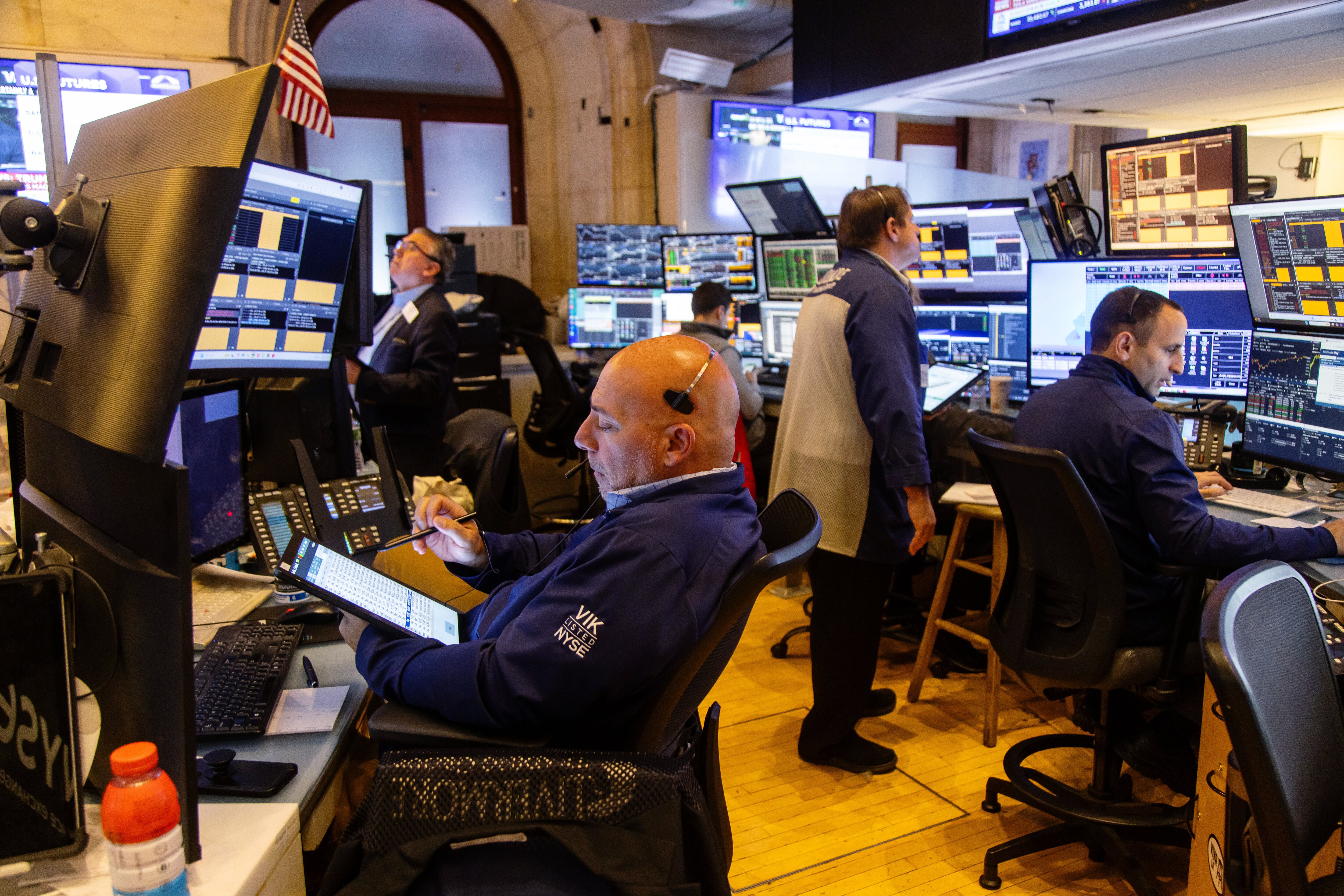
(Bloomberg) -- Wall Street's capacity to process drama got another workout in a week of rapid-fire headlines on tariffs, inflation and the Federal Reserve. Traders proved equal to the task, once again.
From bonds to credit and equities, a standard pattern is emerging in a world beset with uncertainty. Jarring day-to-day swings set an emotional tone for investors — only to dissipate as the sessions wear on. Take government bonds. After falling more than 1% after Wednesday's discouraging inflation report, a popular long-dated Treasury ETF was close to erasing losses for the week, with soft retail data revitalizing bets on interest-rate cuts. Stocks, meanwhile, closed near all-time highs on Friday, with tech sentiment of late proving particularly febrile.
The overall result is a steady — if improbable — fall in pan-market turbulence, even as some measures of policy risk imply a backdrop as unsettled as any in nearly three decades. Weekly moves in 10-year Treasuries have been stuck in a tight range, for the longest such streak in eight months. Volatility in credit has plummeted and is receding as fast as it whips up in equities.
Call it conditioning — the refusal of investors to repeat past mistakes that proved costly when a host of seemingly intractable macro threats quickly faded. The dynamic has played out repeatedly over the previous two presidential administrations, when everything from Covid to Fed rate hikes and Donald Trump's trade bluster failed to dent Wall Street's risk-on march.
“The fear of missing out is more than theoretical. There are real-world consequences for trying to time the market if you are wrong,” said Chris Zaccarelli at Northlight Asset Management. “Investors have been conditioned. Those that went to cash in 2022 have been punished and that is the recency bias impacting a lot of people's thinking.”

Investors had no shortage of event risk to manage in a week that saw Trump pledge to impose reciprocal tariffs on US trading partners, a report showed consumer inflation rising, and Fed Chair Jerome Powell conceded that more work is needed to wring price pressures out of the economy.
In the end, none of it landed in markets. The S&P 500 climbed around 1.5%, near records, while 10-year Treasury yields fell for a fifth straight week, in the longest such rally since 2021. Junk bonds ETFs are back to scoring gains, as gauges measuring their volatility versus risk-free rates narrowed.
Investors' willingness to live with significant discomfort is visible in a pair of indexes purporting to track sentiment and geopolitical risk. Bank of America Corp.'s Market Risk indicator — a cross-asset gauge of expected price swings — has fallen into negative territory, a sign that anxiety has vanished. Meanwhile, an “economic policy uncertainty index” kept by a trio of US academics is at levels seen only during the global financial crisis and 2020 pandemic, driven by an uptick in tariff-related headlines.
“The January 2025 rise in uncertainty is unprecedented in that it is entirely politically driven,” said Stanford University economics professor Nicholas Bloom, one of its inventors. “Domestic US political uncertainty is impacting countries globally in a way we have never seen before.”

The growing disconnect comes as investors attempt to dissect Trump's tariff plans around the globe, while mixed inflation and economic data complicates the monetary-easing path.
Volatility spikes haven't vanished per se, but each has faded swiftly — at the fastest pace on record, per one UBS Group AG gauge. It all reflects a legitimate challenge among market participants to price in Trump's combative trade posture given the near-daily refinement of policy signals. This week's vow for reciprocal tariffs comes not longer after he delayed threats against Canada and Mexico, signaling to many investors that he won't take action that enacts lasting damage to Wall Street.
“It rests on the assumption of the ‘Trump put,'” said Priya Misra, portfolio manager at JP Morgan Asset Management. “There is a belief that the president will be flexible if there is a significant pullback in credit spreads or equities.”
For Charles Lemonides, founder and chief investment officer of ValueWorks, there are still more reasons to be bullish than bearish. Even as the megacap leadership of stock indexes has eased recently, investors have been moving money to other sectors and asset classes rather than bailing out — a sign of strong buying power.
“My takeaway is that after a two-year monster rally, markets have spent four months or so digesting the move,” said Lemonides, “and are now more likely poised to surprise on the upside.”
© 2025 Bloomberg L.P.

-
One El Nino, India Can Handle. Two Could Break The Granary

India's grain stocks can absorb one bad year, but a second El Nino could drain the buffer in two to three years, economists say.
-
India's Troika Of Good Luck | Joining The Dots
As Jensen Huang's exit drags Nvidia down, a cooling AI trade and resilient earnings have revived investor interest in India. A likely RBI rate hike looms.
-
Talking Points This Week: Leadership Shock At Nvidia, Earnings Strength, And The Fog Over Hormuz
The Anthropic IPO pricing and first trading day, Nvidia's upcoming earnings, and any fresh signals from Iran will set the tone for the following week.
-
Signature Play: The Classic Cocktail Is Dead. Or Is It?
Classic cocktails are disappearing from India's cocktail menus. But they're still being ordered, taught to bartenders and borrowed from. So, who's really having the last drink?
-
A New Samvat Wishlist: Inclusive Prosperity And Human Development
India has strengthened its economic foundations through infrastructure, digital access and enterprise. Its next growth chapter must deepen productivity, create better livelihoods and widen participation in prosperity.
-
Love, Sex Aur Dhokha: The Audacious Plot To Spy On Jensen Huang
A Taipei dinner, a Singapore chip buyer and a suspected Chinese asset: inside the alleged spy operation that got close to NVIDIA's Jensen Huang.
-
Ten Things I Learnt This Samvat
Patience can be a trap. Cheap stocks can stay cheap. Leverage can wipe you out. What did Samvat 2082 teach us? Niraj Shah writes on 10 lessons from the year gone by.
-
Talking Points This Week: Tech Nerves, FII Buying, And A Faraway Banking Shock
The global markets are not shining this Diwali. The exception in the large markets is, India.
-
Midterm Rally Lasted A Day. The Hard Reality Of A Divided US May Last Two Years | Opinion
Between a contested AI boom, a debt ceiling that arrives in 2027 and a president with every incentive to act alone, the next two years may prove more volatile than the first day's rally suggests.
-
Blue Wave Will Derail the AI Trade but Won't Dismantle the AI Era | Unhedged Position
The Democrats' sweep of the US Congress will see politics collide with economic forces both over the long and short term.









