China’s LGFVs Must Repay A Record $651 Billion Of Bonds In 2024

(Bloomberg) -- China's local government financing vehicles need to pay back a record amount of maturing local bonds this year, testing the limits of a central government program to help them refinance their debt and avoid default.
The nation's LGFVs — the companies that borrow on behalf of provinces and cities to finance mainly infrastructure projects, such as roads and ports — have 4.65 trillion yuan ($651 billion) worth of bonds due over the next 12 months, according to Bloomberg-compiled data. That's the highest amount on record, and is roughly 13% more than what came due last year.
“Containing the credit contagion and the systemic financial risk from the LGFV sector remain top priorities for the central government this year,” said Zerlina Zeng, senior credit analyst at Creditsights Inc.
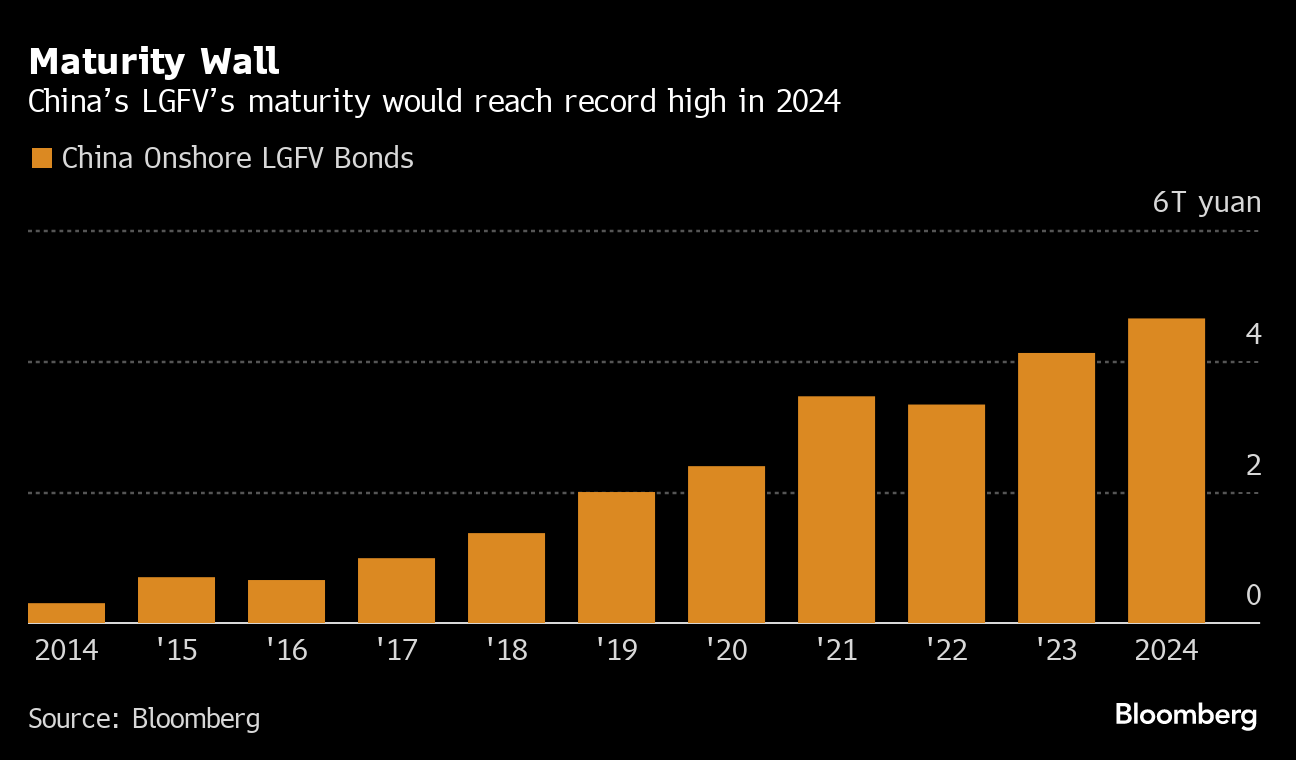
Beijing has taken some steps to alleviate China's long-standing problem with local debt, providing optimism to investors looking for signs any financial risk from the buildup of such debt is contained. Last year, authorities introduced a program worth at least 1 trillion yuan allowing local governments to swap some LGFV debt for official bonds carrying lower interest rates, Bloomberg News reported in August.
While that plan covers a tiny fraction of the roughly $9 trillion in debt those companies are estimated to hold, the country saw a surge in early repayment of debt following the roll-out of that measure.
The moves by Beijing seem to have helped ease the nerves of traders, at least temporarily. The spread on low-rated Chinese LGFV notes narrowed to a record in November, just a couple months after the swap program began.

The prospect of more confident investors is encouraging for the stability of the local debt market, given LGFVs rely heavily on refinancing bonds to repay their upcoming debts.
The market seems to “strongly believe” that the central government does not want any public default in LGFVs, said Gary Ng, senior economist at Natixis SA. He said the refinancing program means most of those companies should be able to access “reasonable liquidity” in 2024 and roll over their debt.
LGFVs spent years accumulating off-balance sheet debt as they funded massive stimulus programs reliant on infrastructure investment — a growth model that's become unsustainable as local government finances have worsened. That's made investors nervous about how much officials can back LGFV debt.
Net financing last year dropped to around 1.49 trillion yuan ($208.9 billion), Bloomberg-compiled data show, the lowest amount since 2019. That doesn't include some figures, such as financing for LGFVs set up after 2022, but is still estimated to account for the lion's share of the money.
Provinces can continue tapping unused local bond quota from prior years to help alleviate the debt held by LGFVs. Around 1.4 trillion yuan of such bonds were sold through late December, the state-run Securities Times has reported. That means regional authorities have about 1.2 trillion yuan of the allowance available for use, before Beijing unveils additional quota for the year in March.
Investor sentiment about LGFV debt ultimately hinges on the ability of local governments to bail out those firms during a time of crisis. But the finances of those local authorities are unlikely to turn around anytime soon. The nation's deep property slump is hurting their ability to make income from selling land, and the broader economy's slowdown has hit their tax revenue.
“There will be liquidity pressure from slower economic growth,” Ng said, adding that a small number of LGFVs from riskier provinces may still run into trouble this year with their maturing debts.
--With assistance from Fran Wang.
More stories like this are available on bloomberg.com
©2024 Bloomberg L.P.

-
Getting To Work Costs Women More | The Reason Why

It is not just about women paying more than men. It is about women paying much more in cities than in villages.
-
AI Bias In Investing Cannot Be Eliminated, But It Can Be Governed
Framing is a particularly important example as identical financial information presented in terms of gains rather than losses can lead an LLM to reach a different assessment.
-
Joining The Dots | Dark Skies, Steady Diya: Why Hope Holds This Diwali
With war, a weak rupee and foreign outflows weighing on sentiment, policymakers at the NDTV World Summit and market veterans at NDTV Profit Ignite: Diwali Edition offered the same advice: stay invested and filter out the noise.
-
The Curious Case of Equitas Small Finance Bank And A CEO Who Quit For Stock
PN Vasudevan believes persistent investor concerns over a perceived conflict of interest had become a governance overhang on Equitas Small Finance Bank's stock, even as the lender improved profitability and asset quality.
-
Talking Points This Week: AI Cash Burn, A Tiger Comeback And An India That Still Finds Its Own Path
India is not immune to higher oil or tighter global liquidity, yet its earnings base is broader, its domestic policy levers are still available.
-
Foreign Investors Own Half Of HDFC Bank and ICICI Bank. An LTCG Cut Could Matter Most Here
Foreign portfolio investors have US$115 billion parked in HDFC Bank, ICICI Bank. If the government cuts long-term capital gains tax, Jefferies says returning foreign money could land here first.
-
'Never Seen This Level Of Negativity': Sandeep Tandon Says The Next Rally May Be Closer Than You Think
Veteran investor Sandeep Tandon says foreign selling is easing, large-caps are due a comeback and mid-caps are crowded, while he turns positive on gold, power and pharma this Diwali.
-
Indians Stay With Family, Not In Hotels | The Reason Why
India still lacks enough clean, reliable and affordable hotels for budget-conscious travellers.
-
The Economic Imperative: Analysing The Material Driving Force Behind India-Canada Strategic Reset
This economic complementarity is further reinforced by deep institutional investment ties and talent mobility, which form the bedrock of the bilateral framework.
-
Medicine Pricing: Where Must Profit Stop?
India must confront excessive margins, hidden incentives and regulatory gaps that threaten the integrity of medicine.










