Chinese Trade Unexpectedly Drops as Demand Slowdown Worsens
(Bloomberg) -- China's exports and imports both unexpectedly fell for the first time in more than two years, with rising risks of a recession causing overseas consumers to buy less and domestic problems such as Covid Zero controls and a housing slump hitting demand at home.
Exports in dollar terms fell 0.3% in October from a year earlier, the customs authority said Monday, well below the 4.5% gain projected by economists. Imports also fell, with the 0.7% decline the first drop since August 2020. That left a trade surplus of $85.15 billion.
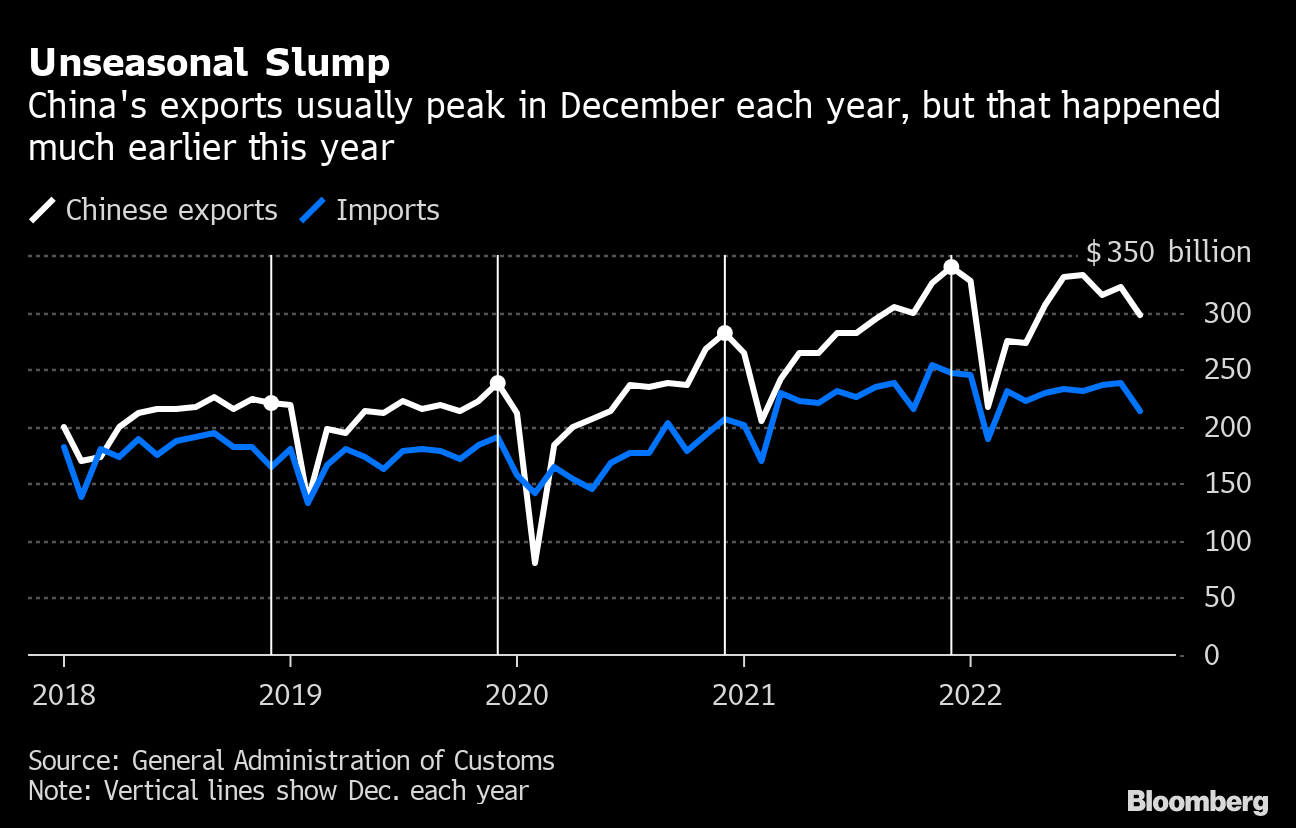
The weakness in exports adds to the domestic pressures on an economy which is already struggling due to the property market slump, persistent disruptions from Covid controls, and weak consumer spending. Resilient exports had been a major support to China's recovery in the past two years due to strong international buying, but that looks to have reversed, with demand from the pandemic disappearing just as the war in Europe boosted global inflation and uncertainty.
“The weak export growth likely reflects both poor external demand as well as the supply disruptions due to Covid outbreaks,” according to Zhang Zhiwei, president and chief economist of Pinpoint Asset Management. “I expect export growth to remain weak in the next few months as the global economy slows.”
Read more: Global Trade Workhorses Ring the Recession Alarm: Supply Lines
The data reinforces the message from Korea's trade figures last week that the global economy is slowing rapidly. South Korean exports in October also showed the first decline in two years as demand for electronics dropped. Almost all the nations in the euro-area saw manufacturing contract further in the month, while US business activity dropped for a fourth-straight month.
“Stagflation worries in developed markets increased as main economies tightened monetary policy further,” said Bruce Pang, chief economist at Jones Lang LaSalle Inc. “The declines in PMI data in the US, Europe and Japan in October from the previous month showed that demand from developed economies may continue to weaken.”
Exports to the US and Europe both fell, the Chinese data showed, as did shipments to Taiwan and Hong Kong. However demand from Southeast Asia continued to be strong, with exports to Asean rising by double digits for a sixth month.
The value of home appliance exports fell the most of any product group in the first 10 months of the year, down 11.5% from a year earlier, according to a breakdown provided by the customs authority. Exports of furniture, lighting equipment and medical devices also dropped during the period.
However, the sudden emergence of the nation as a major car exporter continued, with companies in China shipping 352,000 vehicles and chassis in the month, 60% higher than a year earlier.
Chinese Demand
The decline in imports was widespread, with Chinese purchases from Australia, the US, Japan, South Korea and Taiwan all down. China's commodities imports broadly weakened in October as a slowing economy constrained shipments of items from natural gas to copper and soybeans. Imports of iron ore in the first 10 months of 2022 were down on last year as the continued drop in housing construction destroys demand for steel and other construction materials.
What Bloomberg's Economists Say...
“The surprise drop in China's October exports -- the first year-on-year fall since May 2020 -- provides stark evidence that global demand is falling.
“With the property slump and Covid Zero restraints undercutting growth, policy stimulus will be critical to keeping the recovery going.”
Eric Zhu, economist
-- See here for full report
Authorities had previously warned the momentum was expected to weaken further.
“The risk of external demand growth slowing is increasing” in the fourth quarter, commerce ministry spokeswoman Shu Jueting said at a regular briefing last month. The environment for trade was getting increasingly complex for China and uncertainties are still increasing, she said, citing slowdown in world economic and trade growth.
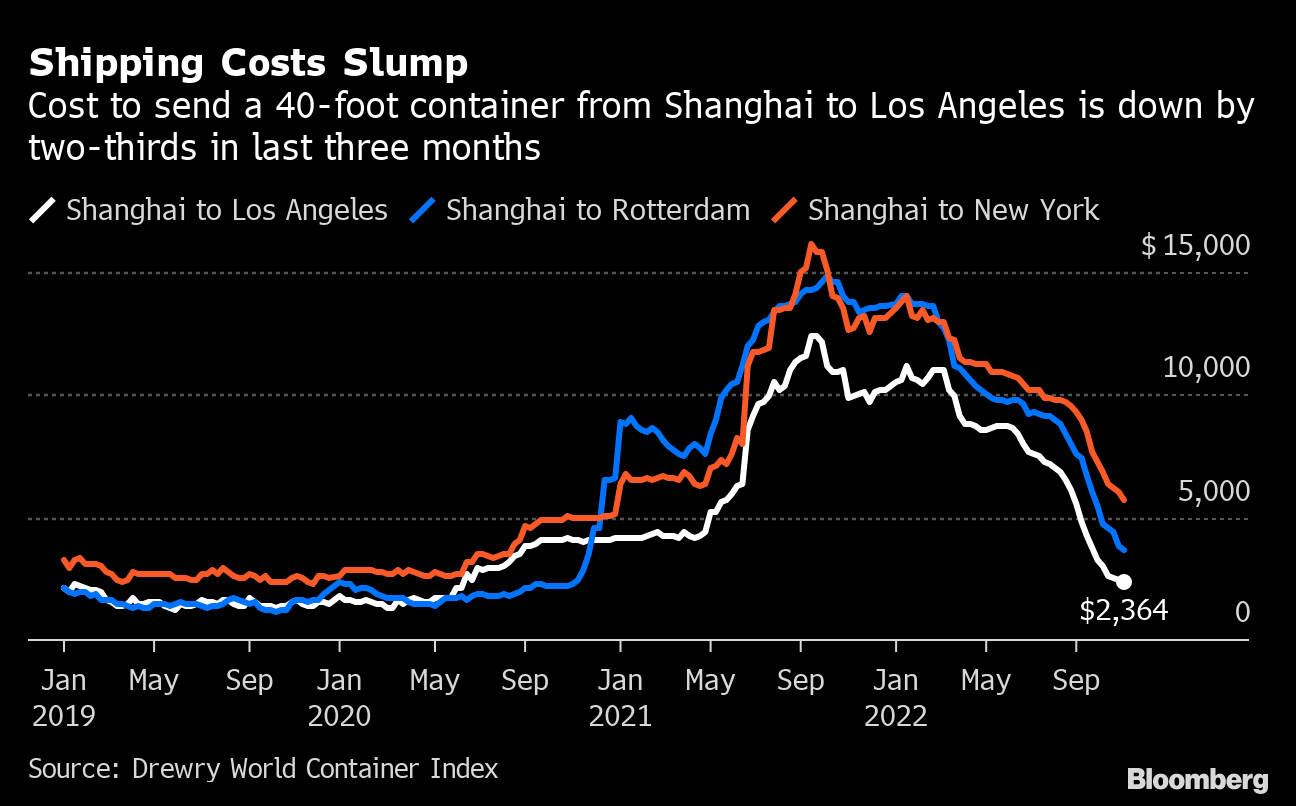
That slowdown has continued to push down the cost of shipping goods out of China, with the price of sending a 40-foot container from Shanghai to Los Angeles now back where it was in mid-2020, before most of the massive spike in prices due to the pandemic. The volume of goods shipped out of China's largest port already fell for two months through September, and with the drop in October that decline may continue, further depressing freight rates.
Aggressive policy tightening by major developed nations is raising fears of a global recession that would further hurt demand for China-made products. The US Federal Reserve last week increased benchmark interest rates for the sixth time this year. European nations are expected to follow suit.
Covid outbreaks and stringent control measures at home are another major source of concern. Mobility restrictions aside, the nation's unswerving commitment to the Covid Zero strategy is dashing hopes of any quick improvement in the economic situation, promoting Chinese households to save at a record pace and cut back on spending.
China's authorities offered little hint of plans to rescue the ailing economy at the party congress last month, which triggered a historic rout in the stock market. Investors should be able to have a clearer idea on whether China will ease up on its zero-tolerance approach to combating Covid and whether China will step up support for the real estate market in coming weeks, with a string of key economic meetings planned.
--With assistance from .
(Updates with details on car exports, commodity imports, and shipping costs.)
More stories like this are available on bloomberg.com
©2022 Bloomberg L.P.

-
Extracting Value From Battery Scrap Could Be Challenging For India | The Reason Why

A discarded lithium-ion battery still contains valuable materials such as lithium, nickel and cobalt. These can be recovered and reused. When such batteries are crushed and shredded, they produce a dark powder called black mass.
-
One El Nino, India Can Handle. Two Could Break The Granary
India's grain stocks can absorb one bad year, but a second El Nino could drain the buffer in two to three years, economists say.
-
India's Troika Of Good Luck | Joining The Dots
As Jensen Huang's exit drags Nvidia down, a cooling AI trade and resilient earnings have revived investor interest in India. A likely RBI rate hike looms.
-
Talking Points This Week: Leadership Shock At Nvidia, Earnings Strength, And The Fog Over Hormuz
The Anthropic IPO pricing and first trading day, Nvidia's upcoming earnings, and any fresh signals from Iran will set the tone for the following week.
-
Signature Play: The Classic Cocktail Is Dead. Or Is It?
Classic cocktails are disappearing from India's cocktail menus. But they're still being ordered, taught to bartenders and borrowed from. So, who's really having the last drink?
-
A New Samvat Wishlist: Inclusive Prosperity And Human Development
India has strengthened its economic foundations through infrastructure, digital access and enterprise. Its next growth chapter must deepen productivity, create better livelihoods and widen participation in prosperity.
-
Love, Sex Aur Dhokha: The Audacious Plot To Spy On Jensen Huang
A Taipei dinner, a Singapore chip buyer and a suspected Chinese asset: inside the alleged spy operation that got close to NVIDIA's Jensen Huang.
-
Ten Things I Learnt This Samvat
Patience can be a trap. Cheap stocks can stay cheap. Leverage can wipe you out. What did Samvat 2082 teach us? Niraj Shah writes on 10 lessons from the year gone by.
-
Talking Points This Week: Tech Nerves, FII Buying, And A Faraway Banking Shock
The global markets are not shining this Diwali. The exception in the large markets is, India.
-
Midterm Rally Lasted A Day. The Hard Reality Of A Divided US May Last Two Years | Opinion
Between a contested AI boom, a debt ceiling that arrives in 2027 and a president with every incentive to act alone, the next two years may prove more volatile than the first day's rally suggests.









