Australia’s Economy Seen Growing Slower As Interest Rates Rise
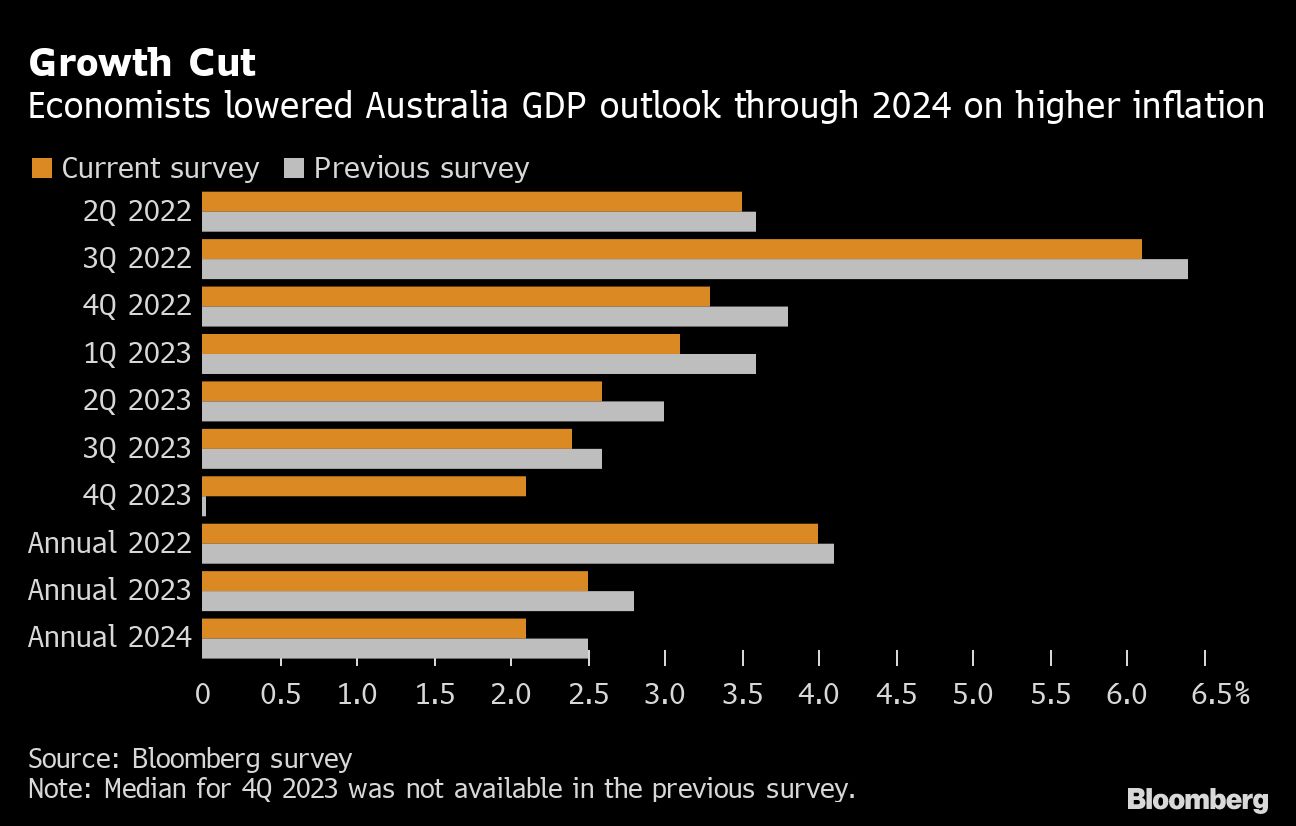
(Bloomberg) -- Australia's economy will expand at a slower pace than previously anticipated this year and next as rapid interest-rate increases to tackle inflation weigh on consumption, a Bloomberg survey showed.
The A$2.2 trillion ($1.5 trillion) economy will grow an annual 3.3% in the fourth quarter and 3.1% in the first three months of 2023, down from previous forecasts of 3.8% and 3.6%, respectively, the poll of 45 analysts showed. The inflation outlook was raised by at least a percentage point in both periods.
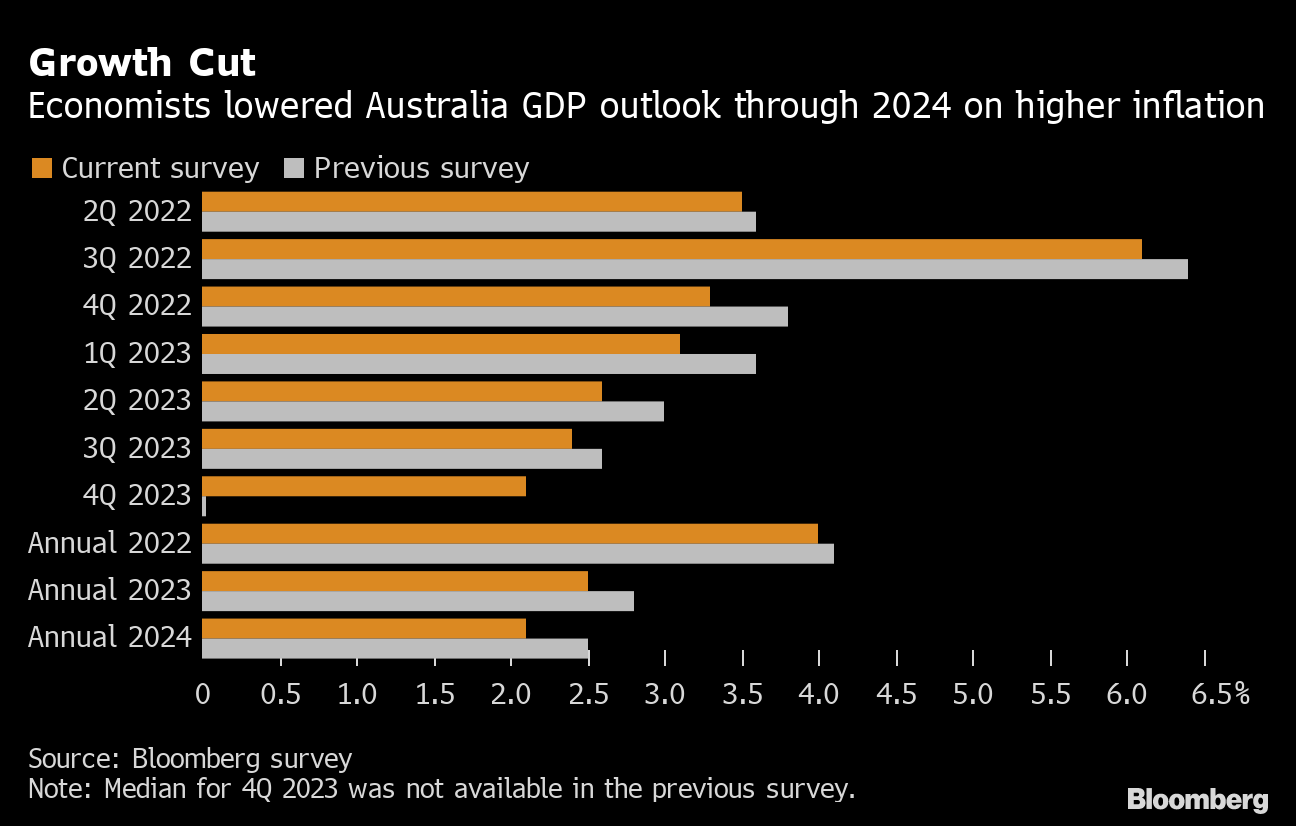
“Higher inflation and higher interest rates will weigh on household consumption,” said Alan Oster, chief economist at National Australia Bank Ltd. He highlighted further risks ahead “including if rates move into more clearly restrictive territory or if the global economy deteriorates rapidly.”
The Reserve Bank of Australia surprised markets this month with a half-point increase in the cash rate, taking the benchmark to 0.85%, as the inflation outlook worsens. It's widely expected to raise by the same amount again in July and traders are pricing in a cash rate of 3.4% by the end of the year.
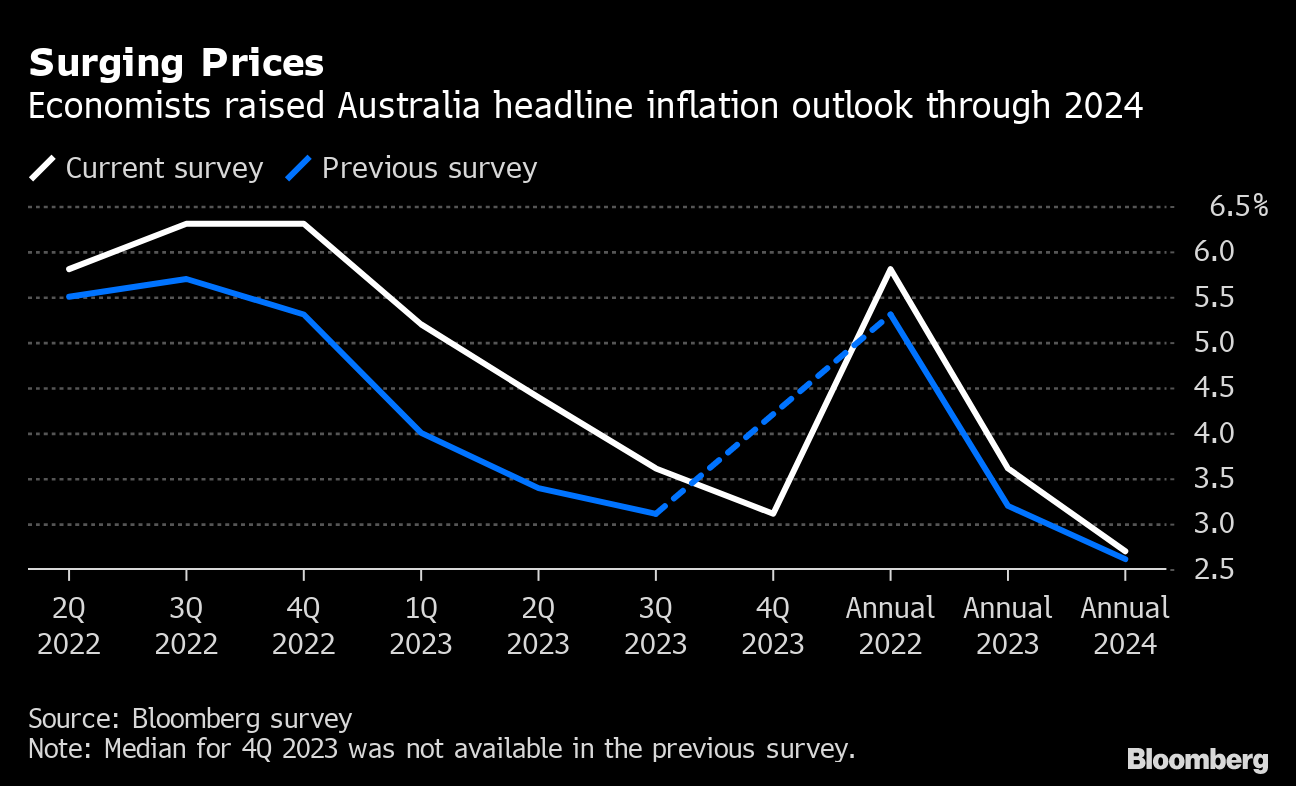
Economists, who had previously expected the RBA to be more cautious than market pricing, are steadily increasing their own forecasts. They now expect the cash rate to finish the year at an average 2.45%, from 1.75% previously, before climbing to 2.6% in the first quarter and then holding there.
Despite the faster pace of rate hikes, economists still expect a soft landing for Australia's economy, in contrast with a growing chorus of warnings about sharp Federal Reserve rate hikes eventually tipping the US into a recession.
The optimism Down Under is helped by A$200 billion of household savings accumulated during the pandemic and a strong jobs market. The survey showed economists expect unemployment to fall to 3.6% in the third quarter, from the current 3.9%, and then edge back up from the second quarter of 2023.
“Ultimately, we still see a ‘soft landing' for Australia, as household have built up savings to draw on and, importantly, we don't expect unemployment to rise materially,” Oster said.
More stories like this are available on bloomberg.com
©2022 Bloomberg L.P.

-
The More Food Turns Into Fuel, The Harder It Is To Read Agricultural Markets | The Reason Why

A policy designed to reduce dependence on imported fuel can create new pressures elsewhere in the food economy.
-
Your iPhone Costs 12 Grams Of Gold, A Car About 100. What Does Your Life Weigh?
Measured in rupees, almost everything looks more expensive than it did a generation ago. Measured in grams of gold, a lot of it has become cheaper.
-
Gold Is Rs 22,000 Cheaper Than A Month Ago. Should You Buy Amid The Wedding Season?
Gold's potential slide to $3,500 could save around Rs 4,700 per 10 grams, but a soft inflation print could just as easily push prices back up. One way to split the risk is to buy in parts, some now and the rest after the Fed's Dec. 9 decision.
-
AI Agents Are Gaining Power. Who Governs Them?
Artificial intelligence agents promise to transform productivity by moving machines from assisting decisions to executing them. But as organisations delegate greater authority to these AI-agents, they must first establish who controls that authority and who remains accountable when things go wrong.
-
Why Swapping Your Old Gold Can Trigger A Rs 5 Lakh Tax Bill, And How You Can Avoid It Legally
Swapping old gold for new is taxed as a sale and a fresh purchase. Getting your own gold remade can cut most of that bill, though it has its own costs.
-
The AI Trade is Done. The Real Opportunity for Investors Starts in 2027 | Unhedged Position
As pureplay AI stocks plunge and circular, capex-led financing unwinds, 2027 is set to be a year of reckoning for AI companies. Yet the bust clears the way for a better opportunity for investors in 2027 -- shifting the spotlight from AI builders to the companies using AI.
-
Leadership As Mission: Why The Age Of AI Demands More Human Leadership
Debjani Ghosh examines how AI is changing leadership, arguing that its success must be measured by its impact on people and the accountability of those guiding its use.
-
We May Need Another Tukaram Mundhe To Fight Air Pollution | The Reason Why
Developers may install basic measures such as sprinklers and green nets, resume work, and continue violating rules when this equipment stops working.
-
Extracting Value From Battery Scrap Could Be Challenging For India | The Reason Why
A discarded lithium-ion battery still contains valuable materials such as lithium, nickel and cobalt. These can be recovered and reused. When such batteries are crushed and shredded, they produce a dark powder called black mass.
-
One El Nino, India Can Handle. Two Could Break The Granary
India's grain stocks can absorb one bad year, but a second El Nino could drain the buffer in two to three years, economists say.









