US Presidential Election's Outcome Could Intensify Challenges For Asia-Pacific Economies: Fitch
Higher trade barriers in the wake of the US elections could pose additional challenges for issuers across multiple credit sectors in Asia-Pacific, particularly if Chinese exports via third-party nations attract more attention, according to Fitch Ratings.
Heightened trade barriers could pose significant challenges, especially for countries reliant on exports to the US, with Vietnam identified as the most vulnerable, as per the latest Fitch Ratings report on the US presidential elections' impact on APAC. Other countries like Taiwan, Thailand, Hong Kong, Singapore, Malaysia, and South Korea also face considerable exposure, it said.
The report highlighted that sharp increases in US tariffs could adversely affect global economic growth, with particular pressure on APAC economies. If trade protectionism escalates, geopolitical tensions may rise, further straining credit profiles for some APAC sovereigns, it warned.
Weaker global growth prospects could lead to a downturn in macroeconomic conditions in the region, especially if China is disproportionately affected, the report stated.
While Trump's platform suggests support for baseline tariffs and reciprocal trade measures, specifics remain ambiguous. "A scenario featuring a 60% tariff on Chinese imports and a 10% across-the-board tariff could severely impact APAC exporters. Moreover, any retaliatory measures from US trading partners could exacerbate these challenges, particularly for technology hardware manufacturers," the report said.
The anticipated consequences of these tariff policies include increased inflationary pressures in the US and potential repercussions on global commodity markets. China, being a dominant player in energy metals and other critical materials, could see its exports disrupted, impacting global supply chains and prices in sectors like technology and automotive, it said.
India Will Be Relatively Unaffected
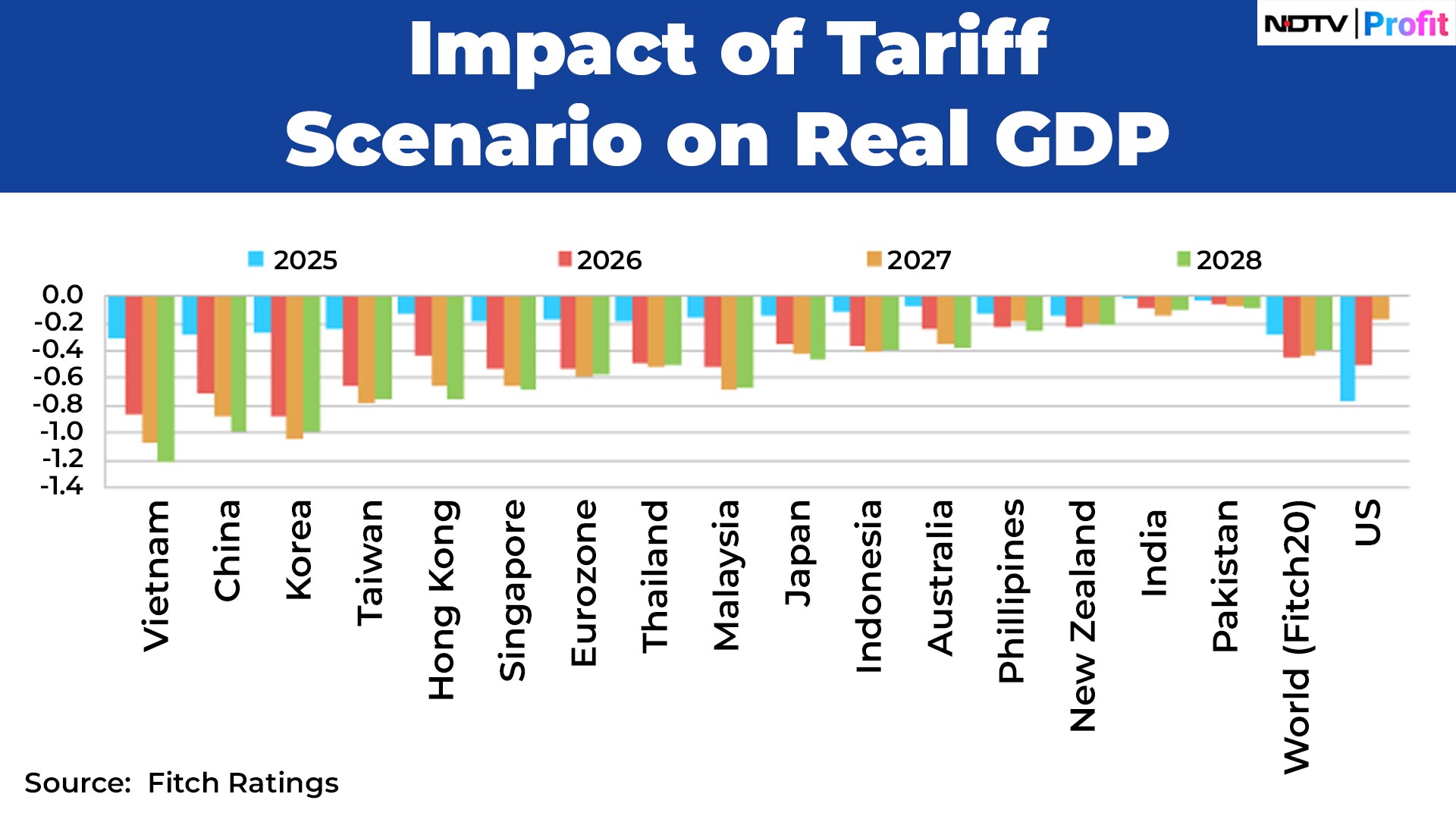
Fitch's analysis indicates that a significant uptick in tariffs could lead to lower real GDP growth in China, Korea, and Vietnam by at least 1% by 2028, compared to current forecasts. Hong Kong, Taiwan, Singapore and Malaysia also stand out as economies that would be significantly hit, it said.
"India, which is less export-oriented than many other Asian economies, would be relatively unaffected," the Fitch Ratings report said.
A stronger US dollar following tariff increases could burden Asian issuers with US dollar-denominated debt, complicating refinancing efforts and increasing financial strain. Additionally, supply chain disruptions may lead to higher production costs, delayed manufacturing, and investment uncertainties, further squeezing profit margins for firms operating in the region.
The outcome of the US elections could herald significant policy shifts, introducing new risks for APAC issuers amid an already volatile global economic landscape, the report said.

-
Gold Is Rs 22,000 Cheaper Than A Month Ago. Should You Buy Amid The Wedding Season?

Gold's potential slide to $3,500 could save around Rs 4,700 per 10 grams, but a soft inflation print could just as easily push prices back up. One way to split the risk is to buy in parts, some now and the rest after the Fed's Dec. 9 decision.
-
AI Agents Are Gaining Power. Who Governs Them?
Artificial intelligence agents promise to transform productivity by moving machines from assisting decisions to executing them. But as organisations delegate greater authority to these AI-agents, they must first establish who controls that authority and who remains accountable when things go wrong.
-
Why Swapping Your Old Gold Can Trigger A Rs 5 Lakh Tax Bill, And How You Can Avoid It Legally
Swapping old gold for new is taxed as a sale and a fresh purchase. Getting your own gold remade can cut most of that bill, though it has its own costs.
-
The AI Trade is Done. The Real Opportunity for Investors Starts in 2027 | Unhedged Position
As pureplay AI stocks plunge and circular, capex-led financing unwinds, 2027 is set to be a year of reckoning for AI companies. Yet the bust clears the way for a better opportunity for investors in 2027 -- shifting the spotlight from AI builders to the companies using AI.
-
Leadership As Mission: Why The Age Of AI Demands More Human Leadership
Debjani Ghosh examines how AI is changing leadership, arguing that its success must be measured by its impact on people and the accountability of those guiding its use.
-
We May Need Another Tukaram Mundhe To Fight Air Pollution | The Reason Why
Developers may install basic measures such as sprinklers and green nets, resume work, and continue violating rules when this equipment stops working.
-
Extracting Value From Battery Scrap Could Be Challenging For India | The Reason Why
A discarded lithium-ion battery still contains valuable materials such as lithium, nickel and cobalt. These can be recovered and reused. When such batteries are crushed and shredded, they produce a dark powder called black mass.
-
One El Nino, India Can Handle. Two Could Break The Granary
India's grain stocks can absorb one bad year, but a second El Nino could drain the buffer in two to three years, economists say.
-
India's Troika Of Good Luck | Joining The Dots
As Jensen Huang's exit drags Nvidia down, a cooling AI trade and resilient earnings have revived investor interest in India. A likely RBI rate hike looms.
-
Talking Points This Week: Leadership Shock At Nvidia, Earnings Strength, And The Fog Over Hormuz
The Anthropic IPO pricing and first trading day, Nvidia's upcoming earnings, and any fresh signals from Iran will set the tone for the following week.









