US Bank Lending Slumps By Most On Record In Final Weeks Of March

(Bloomberg) -- US bank lending contracted by the most on record in the last two weeks of March, indicating a tightening of credit conditions in the wake of several high-profile bank collapses that risks damaging the economy.
Commercial bank lending dropped nearly $105 billion in the two weeks ended March 29, the most in Federal Reserve data back to 1973. The more than $45 billion decrease in the latest week was primarily due to a a drop in loans by small banks.
The pullback in total lending in the last half of March was broad and included fewer real estate loans, as well as commercial and industrial loans.
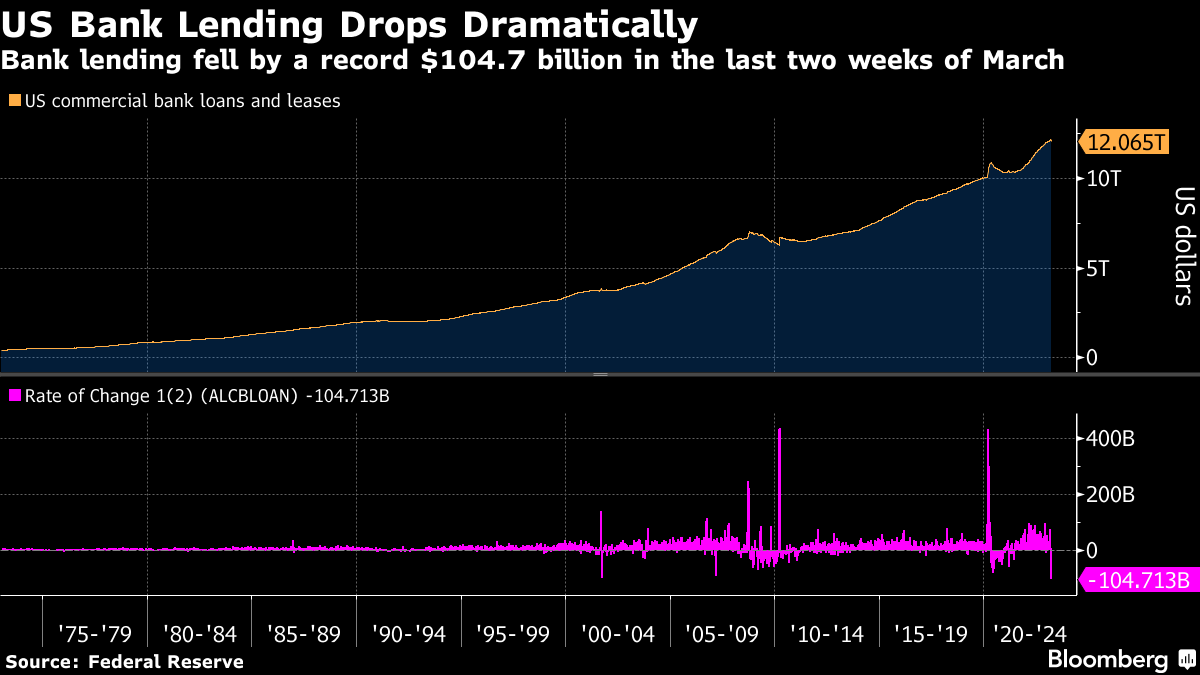
Friday's report also showed commercial bank deposits dropped $64.7 billion in the latest week, marking the 10th-straight decrease that mainly reflected a decline at large firms.
The slide in lending follows the collapse of several firms including Silicon Valley Bank and Signature Bank.
Economists are closely monitoring the Fed's so-called H.8 report, which provides an estimated weekly aggregate balance sheet for all commercial banks in the US, to gauge credit conditions. The recent bank failures have complicated the central bank's efforts to reduce inflation without sending the economy into a recession.
On Thursday, the American Bankers Association index of credit conditions fell to the lowest level since the onset of the pandemic, indicating bank economists see credit conditions weakening over the next six months. As a result, banks are likely to become more cautious about extending credit.
The banking crisis has made a recession more likely, according to JPMorgan Chase & Co.'s Jamie Dimon. The bank's chief executive officer said in an annual letter that the failures have “provoked lots of jitters in the market and will clearly cause some tightening of financial conditions as banks and other lenders become more conservative.”
The Fed's report showed that by bank size, lending decreased $23.5 billion at the 25 largest domestically chartered banks in the latest two weeks, and plunged $73.6 billion at smaller commercial banks over the same period. Lending by foreign institutions in the US fell $7.5 billion.
The biggest 25 domestic banks account for almost three-fifths of lending, although in some key areas — including commercial real estate — smaller banks are the most important providers of credit.
In a note on the report, the Fed said domestically chartered banks made divestments to nonbank institutions that affected $60 billion in loans in the week ended March 22, meaning those loans are no longer held by commercial lenders.
Meanwhile, so-called “other” deposits, which exclude large time deposits, have fallen $260.8 billion at commercial banks since the week ended March 15. At domestically chartered banks, they declined $236 billion, mostly reflecting a drop at the 25 largest institutions. Deposits at small banks fell $58.1 billion.
Two-Week Changes:
- Commercial and industrial lending — considered a closely followed gauge of economic activity — fell $68 billion
- Commercial real estate loans dropped $35.3 billion
- Total assets, which includes vault cash, as well as balances due from depository institutions and the Fed, decreased nearly $220 billion
- Total liabilities declined more than $188 billion
The Fed's report on assets and liabilities of commercial banks includes breakdowns of credit by destination — such as consumer, real estate and commercial loans — as well as categories based on bank size.
For a list of banks commercial banks ranked by assets, click here.
The H.8 release is primarily based on data that are reported weekly by a sample domestically chartered banks and foreign-related institutions.
--With assistance from Benjamin Purvis and Reade Pickert.
(Adds transfer to non-bank institutions)
More stories like this are available on bloomberg.com
©2023 Bloomberg L.P.

-
The Economic Imperative: Analysing The Material Driving Force Behind India-Canada Strategic Reset

This economic complementarity is further reinforced by deep institutional investment ties and talent mobility, which form the bedrock of the bilateral framework.
-
Medicine Pricing: Where Must Profit Stop?
India must confront excessive margins, hidden incentives and regulatory gaps that threaten the integrity of medicine.
-
Why Amazon And Flipkart Are Struggling To Beat Meesho In India's Smaller Cities
With 274 million users and lowest-cost logistics, Meesho is defending its value commerce crown against giants like Amazon and Flipkart.
-
High US Salaries, No Green Card Certainty: The Financial Calculation Facing Indian H-1B Families
The suspension of PERM processing at eight technology employers does not cancel existing H-1B visas. What it does is force a question many Indian families have been avoiding: is the US salary worth tying your career and family plans to one employer?
-
Swiggy vs Eternal: Food Delivery's Two Rivals Are No Longer In The Same Race
Eternal is building a private AI assistant, dark.ai. Swiggy is still working out how to make Instamart pay, with an operating loss of Rs 895 crore in the July-September quarter while Blinkit stayed profitable.
-
Where You Live Shapes How You Get To Work | The Reason Why
Two-wheelers are the most popular way to get to work in India, accounting for nearly 43% of workplace commutes.
-
Unhedged Position: Can India See An Indonesia-Style Time Correction?
The Nifty is trading below levels it first clocked in 2024. Is there, then, as I have suggested in the headline, potential that the current time correction drags on painfully for the next three-five, even ten years?
-
Navigating Friction And Energy Realities: An Analysis Of Marco Rubio's October Visit To India
Occurring at a critical juncture marked by stalled trade negotiations and escalating geopolitical pressures over global energy supplies, the visit offers a profound window into modern US-India relations.
-
India Exports Capital. Why Not Export Trusteeship?
The big question, then, is whether India can build an institution that global borrowers, investors, banks, and lawyers can trust, even without an Indian connection.
-
France's Economy & Politics Are In Crisis | The Reason Why
Let's look at how the French economy and politics evolved under Nicolas Sarkozy, Franois Hollande and Emmanuel Macron.










