RBI Panel Likely To Recommend India Retains 4% Inflation Target

An internal committee of the Reserve Bank of India is in favor of retaining the current inflation target in an upcoming government review, according to people familiar with the matter, giving investors some reassurance about the continuity of monetary policy.
The panel will likely recommend the RBI ask the government to keep the target at 4%, with a tolerance band of 2%-6%, the people said, asking not to be identified because the discussions are private. The panel is also in favor of retaining the consumer price index as the target, they said, instead of using a measure that excludes food, as some government officials have argued.
The inflation targeting framework, which has been in place since 2016, has been effective in managing volatility in price gains even during periods of supply shocks triggered by geopolitical events, the people said. The policy is reviewed every five years, with the current framework valid until March 2026.
The RBI and Ministry of Finance didn't immediately respond to emailed requests for comment. An official from the Ministry of Finance said last month the government will hold talks with the central bank on the inflation targeting policy in the coming months. The ministry is also seeking information on possible changes to the consumer price basket before finalizing the new framework, the official said, asking not to be identified because the discussions are private.
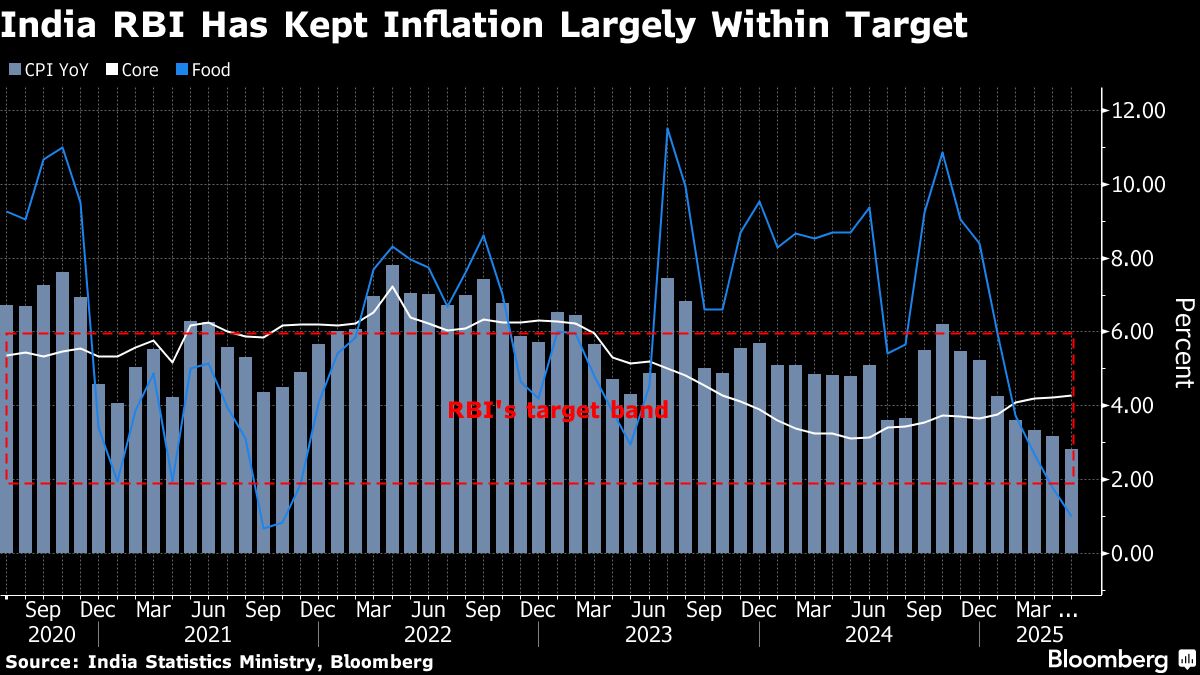
The RBI has long said the policy framework has worked in keeping inflation under control. The central bank has mostly managed to keep inflation within the target band, although surging energy and food costs in 2022 caused it to miss its target for three consecutive quarters. That triggered a condition that required an explanation from the governor.
Retaining the inflation target would remove some uncertainty about the process and reassure market participants about policy continuity under Governor Sanjay Malhotra — who took office in December — and a relatively new set of members on the Monetary Policy Committee. The governor surprised economists last month by cutting interest rates more than expected, with some saying he sent conflicting signals about monetary policy at the time.
The RBI's internal committee will finalize its recommendations by September and submit them to the central bank's leadership, the people said. The proposals will then be discussed with the Ministry of Finance before a decision is taken on the inflation target and the framework for the next five years, they added. The government, in consultation with the RBI, sets the target.
The central bank and some government officials differ over whether headline CPI is an appropriate measure to achieve the 4% target in a country like India, where volatile food prices account for 46% of the index.
India's Chief Economic Adviser V Anantha Nageswaran, a top official in the Ministry of Finance, last year argued the RBI should use an inflation measure that excluded food, since food prices are often driven by supply shocks that are outside the control of the central bank. Former RBI Governor Shaktikanta Das rejected that view.
The RBI's internal committee sees food as an important household expenditure item, indicating it can't be left out of the inflation target, people familiar with the matter said. A separate review of the CPI will likely see the weighting of food items in the CPI come down only marginally, they said.
The RBI panel's reasoning is that food is an important input into other goods and the central bank can prevent a secondary round of shocks through a monetary policy response.
India adopted an inflation targeting regime almost a decade ago, joining global central banks like the Bank of England and the Reserve Bank of New Zealand.

-
We May Need Another Tukaram Mundhe To Fight Air Pollution | The Reason Why

Developers may install basic measures such as sprinklers and green nets, resume work, and continue violating rules when this equipment stops working.
-
Extracting Value From Battery Scrap Could Be Challenging For India | The Reason Why
A discarded lithium-ion battery still contains valuable materials such as lithium, nickel and cobalt. These can be recovered and reused. When such batteries are crushed and shredded, they produce a dark powder called black mass.
-
One El Nino, India Can Handle. Two Could Break The Granary
India's grain stocks can absorb one bad year, but a second El Nino could drain the buffer in two to three years, economists say.
-
India's Troika Of Good Luck | Joining The Dots
As Jensen Huang's exit drags Nvidia down, a cooling AI trade and resilient earnings have revived investor interest in India. A likely RBI rate hike looms.
-
Talking Points This Week: Leadership Shock At Nvidia, Earnings Strength, And The Fog Over Hormuz
The Anthropic IPO pricing and first trading day, Nvidia's upcoming earnings, and any fresh signals from Iran will set the tone for the following week.
-
Signature Play: The Classic Cocktail Is Dead. Or Is It?
Classic cocktails are disappearing from India's cocktail menus. But they're still being ordered, taught to bartenders and borrowed from. So, who's really having the last drink?
-
A New Samvat Wishlist: Inclusive Prosperity And Human Development
India has strengthened its economic foundations through infrastructure, digital access and enterprise. Its next growth chapter must deepen productivity, create better livelihoods and widen participation in prosperity.
-
Love, Sex Aur Dhokha: The Audacious Plot To Spy On Jensen Huang
A Taipei dinner, a Singapore chip buyer and a suspected Chinese asset: inside the alleged spy operation that got close to NVIDIA's Jensen Huang.
-
Ten Things I Learnt This Samvat
Patience can be a trap. Cheap stocks can stay cheap. Leverage can wipe you out. What did Samvat 2082 teach us? Niraj Shah writes on 10 lessons from the year gone by.
-
Talking Points This Week: Tech Nerves, FII Buying, And A Faraway Banking Shock
The global markets are not shining this Diwali. The exception in the large markets is, India.