RBI Dividends to Modi’s Government May Double, Aiding Fiscal Gap
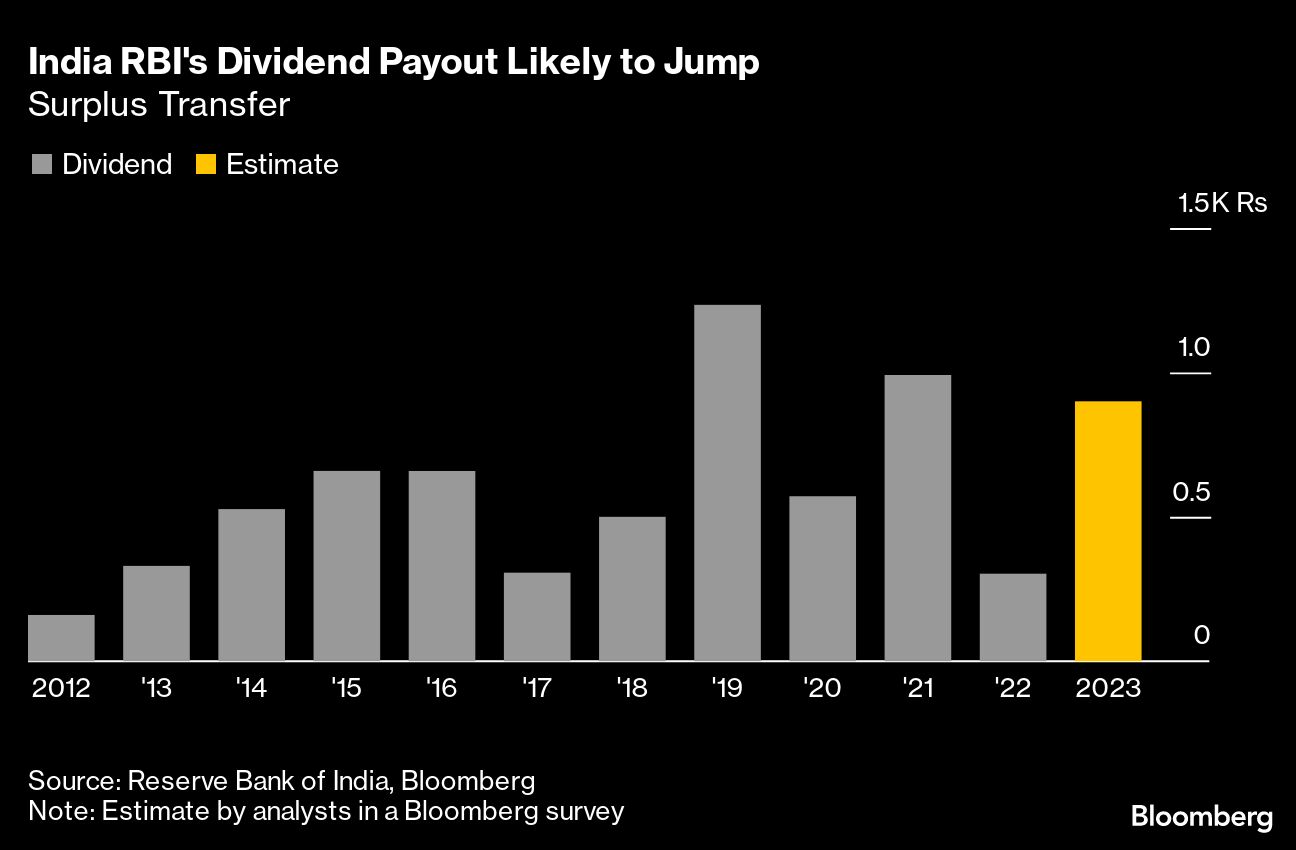
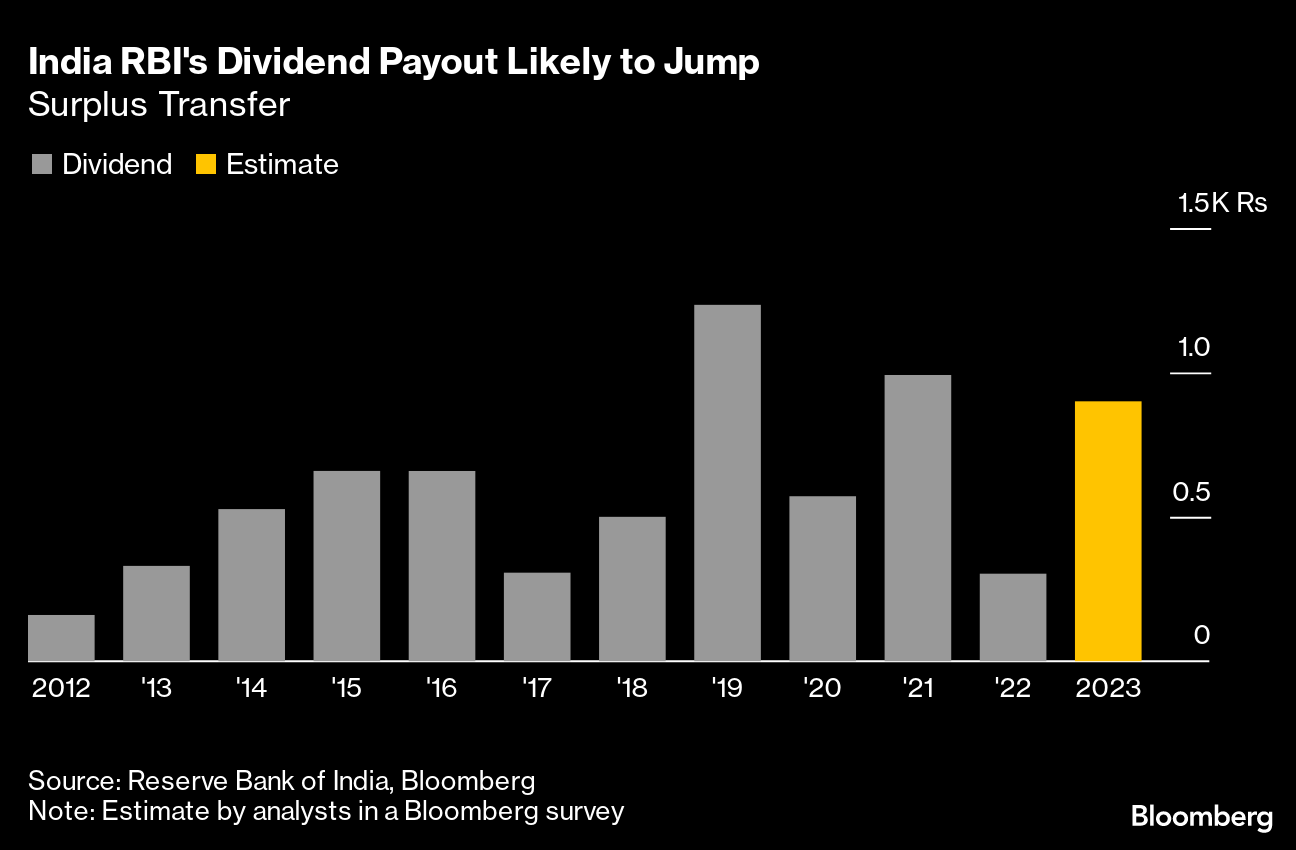
(Bloomberg) -- The Reserve Bank of India board may decide to nearly double its dividend to the government from official estimates due to revaluation gains and profits from selling dollars, which could help bridge the fiscal deficit.
A Bloomberg survey of nine economists saw the surplus transfer at 900 billion rupees ($10.9 billion) for the year ended March, compared to the government's own estimate of 480 billion rupees, which includes dividends from state-controlled banks. Last year, the RBI approved a payout of 303.1 billion rupees, the lowest in a decade.
The RBI board is set to meet on Friday as early signs of slowing growth emerge with elevated interest rates and falling global demand. A higher dividend payout will help Prime Minister Narendra Modi's government to meet its target of lowering the fiscal deficit to 5.9% of gross domestic product in the current fiscal year from 6.4% a year ago and shore up revenues ahead of the 2024 national vote.
The government is expecting the RBI to transfer a significantly higher dividend, which will help reduce its market borrowing, people familiar with the matter told Bloomberg on Thursday.
“Gains from the near record gross foreign exchange sales in fiscal year 2022-23 would be the major driver of higher surplus,” said Madhavi Arora, economist at Emkay Global Financial Services. The dividend could bring in additional revenue of 0.2% of GDP, which could partly offset losses in bonds and cover for lower tax revenue and slower divestment, she said.
The RBI makes an annual payout to the government from the surplus income earned from investments and valuation changes on its foreign exchange holdings, including the dollar, and the fees it gets from printing currency notes. It is mandated to maintain a contingency risk buffer of within 5.5% to 6.5% of its balance sheet.
Economists polled by Bloomberg expect the dividend to range between 525 billion rupees to 1.65 trillion rupees. The highest estimate surpasses the central bank's record 1.23 trillion dividend transfer for the year 2018-19.
The RBI embarked on massive dollar sales likely for currency intervention in the last fiscal year with data showing $206.4 billion of the currency sold in 11 months to February. This compares with $96.7 billion in the whole of the fiscal year 2021-22.
The RBI probably acquired the greenback at around 62.7 rupees per dollar in the last fiscal year, and sold it around 81-82 rupee level, earning as much as 690 billion rupees from foreign exchange transactions, according to Gaura Sen Gupta, an economist at IDFC First Bank.
Since the central bank denominates its balance sheet in rupees, a stronger dollar results in a revaluation gain that can also be tapped to boost the transfer, she added.
The RBI's balance sheet probably expanded about 2% in the last fiscal year, the slowest since 2016-17's demonetization exercise, and compares with 9% expansion a year before, according to Arora, as abundant liquidity in the system limited the need for bond purchases from the markets.
However, rising interest rates globally likely lowered the value of foreign bonds held by the RBI, leading to nominal losses dragging down the earnings, said Abhishek Upadhyay, an economist at ICICI Securities Primary Dealership Ltd.
“Given there is no buffer left in the interest rate revaluation account for foreign securities, this loss will need to be charged directly to contingency reserves that is part of RBI realized equity,” Upadhyay said.
Other economists cautioned against a higher dividend payout as India's foreign exchange reserves have stayed below $600 billion for the past 13 months though portfolio inflows and currency appreciation against the dollar are supporting the case.
“The moot point would be to gauge whether RBI draws comfort from distributing higher dividend purely out of revaluation reserves owing to rupee weakness or shows prudence at a time when in reality foreign exchange reserve kitty has declined over the year,” said Siddharth Kothari, an economist with Sunidhi Consultancy Services.
More stories like this are available on bloomberg.com
©2023 Bloomberg L.P.

-
Talking Points This Week: Leadership Shock At Nvidia, Earnings Strength, And The Fog Over Hormuz

The Anthropic IPO pricing and first trading day, Nvidia's upcoming earnings, and any fresh signals from Iran will set the tone for the following week.
-
Signature Play: The Classic Cocktail Is Dead. Or Is It?
Classic cocktails are disappearing from India's cocktail menus. But they're still being ordered, taught to bartenders and borrowed from. So, who's really having the last drink?
-
A New Samvat Wishlist: Inclusive Prosperity And Human Development
India has strengthened its economic foundations through infrastructure, digital access and enterprise. Its next growth chapter must deepen productivity, create better livelihoods and widen participation in prosperity.
-
Love, Sex Aur Dhokha: The Audacious Plot To Spy On Jensen Huang
A Taipei dinner, a Singapore chip buyer and a suspected Chinese asset: inside the alleged spy operation that got close to NVIDIA's Jensen Huang.
-
Ten Things I Learnt This Samvat
Patience can be a trap. Cheap stocks can stay cheap. Leverage can wipe you out. What did Samvat 2082 teach us? Niraj Shah writes on 10 lessons from the year gone by.
-
Talking Points This Week: Tech Nerves, FII Buying, And A Faraway Banking Shock
The global markets are not shining this Diwali. The exception in the large markets is, India.
-
Midterm Rally Lasted A Day. The Hard Reality Of A Divided US May Last Two Years | Opinion
Between a contested AI boom, a debt ceiling that arrives in 2027 and a president with every incentive to act alone, the next two years may prove more volatile than the first day's rally suggests.
-
Blue Wave Will Derail the AI Trade but Won't Dismantle the AI Era | Unhedged Position
The Democrats' sweep of the US Congress will see politics collide with economic forces both over the long and short term.
-
It's Time To Take The GST Council's Bet On Trust Global
Payment records can prove India's services exports, and clear, proportionate rules can bring foreign digital sellers into the tax net.
-
Opinion | India at 38: From Innovation Overperformer to Innovation Powerhouse
India now has 453 VC-backed deep science startups, 18 of them late-stage, after 117 percent growth since 2020. Laurus Labs, at USD 9.3 billion, is the most valuable deep science company in any middle-income economy outside China.









