Items In 28% GST Rate Slab Needs To Be Pruned, Says Revenue Secretary Adhia
The number of goods in the highest 28 percent GST slab would be brought down and a committee of officers will calculate the revenue impact before further reduction in tax rates, Revenue Secretary Hasmukh Adhia said today
“It is required, the fitment of rates which has happened is mainly based on excise and VAT,” he said when asked if the GST Council is considering pruning of the number of items in 28 percent tax bracket.
Goods and Services Tax, rolled out from July 1, has subsumed over two dozen taxes and has transformed India into a single market for seamless flow of goods and services. All goods and services have been fitted in the four-tier GST rate structure of 5, 12, 18 and 28 percent.
Also Read: Will Analyse Shortfall In Filing Of GST Returns, Says Revenue Secretary
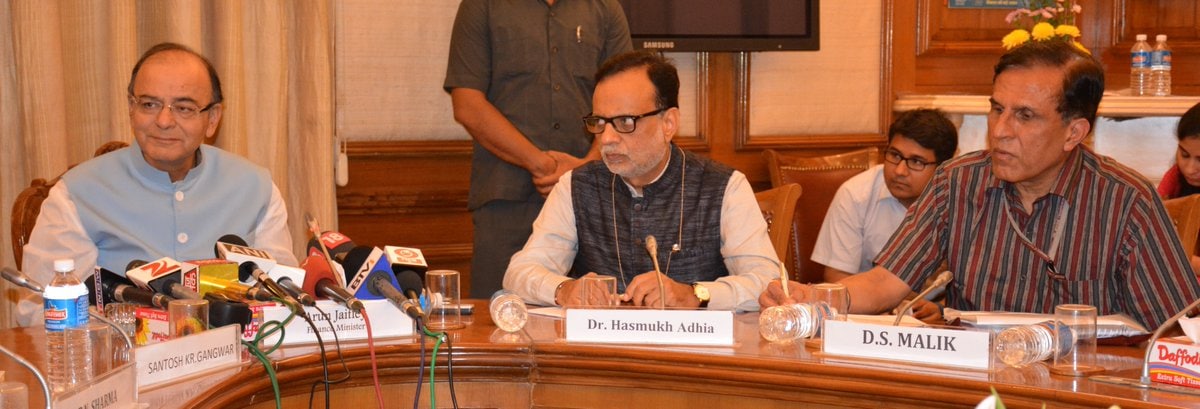
Adhia said while fitting goods and services in various tax bracket, the GST Council has taken into consideration only the excise duty and VAT rate applicable on those items prior to GST.
There are industries where 95 percent of production used to take place in MSME and all of them used to avail excise duty exemption. So that means the excise rate we have taken for that item is only theoretical in nature and actually, we have done a substantial increase in the rate of that item.Hasmukh Adhia, Revenue Secretary
“That way it is being pointed out that it is a theoretical rate which has been derived, there is a need for rationalisation. Instead of doing a piecemeal reduction here and there, we do need to look at the entire rate of 28 percent,” Adhia said at a GST Townhall organised by CNBC-TV18.
There is definitely scope for rationalisation of rates but it will happen only after the fitment committee does a detailed calculations of its revenue impact. “The fitment committee will have to look at how much revenue we got from this items from excise and VAT earlier before we agree to any further wholesale reduction of rates. If we find that revenue reduction is too much, we may have to do that in stages,” he added.
Filing GST Returns
In the last 30-40 days glitches faced by GST Network software has reduced and there would be no leniency shown on businesses for delayed filing of returns, the revenue secretary pointed out.
Asked if the government is planning to waive penalty for delayed filing of GST returns, Adhia said “it cannot be a consideration because the moment we say we will not take any penalty till March, the compliance rate will come down further”.
.jpg "Workers sit on sacks of goods at a wholesale market in the Old Delhi area of Delhi. (Photographer: Anindito Mukherjee/Bloomberg)")
Also Read: Around 43 Lakh Taxpayers File GSTR-1 Returns For July
He said that any waiver, if at all is to be given, will be post facto. "It can't be immediate. It is now absolutely essential that we bring discipline in businesses (for timely filing of returns)".
As many as 55 lakh businesses had filed the initial GSTR-3B returns for July, the number was only 46 lakh who had filed final returns for the month. Besides, 48 lakh businesses had filed initial GSTR-3B returns for August, and till today morning 10 lakh businesses had filed 3B returns for September.
The government had earlier waived late fee for all taxpayers who could not file GSTR-3B for July within due date in view of glitches in GSTN portal.
Real Estate Under GST Ambit?
With regard to bringing real estate under GST, Adhia said any such move would require businesses are able to claim seamless credit of any taxes paid for a project.
“For that to happen, you will have to start taxing it from land itself. Land has to be part of GST. Now there are several issues connected with that. The issue of whether you want to put an extra GST on real estate while continuing with stamp duty. Stamp duty is a big source of income for state government,” he said.
Finance Minister Arun Jaitley had last week said real estate is a sector where maximum amount of tax evasion and cash generation takes place and the GST Council in its next meeting on November 10 will discuss bringing it within the fold of GST.
A 12 percent GST is levied on construction of a complex, building, civil structure or intended for sale to a buyer, wholly or partly. However, land and other immovable property have been exempted from the GST.
Also Read: What If Real Estate Is Brought Under GST?

-
One El Nino, India Can Handle. Two Could Break The Granary

India's grain stocks can absorb one bad year, but a second El Nino could drain the buffer in two to three years, economists say.
-
India's Troika Of Good Luck | Joining The Dots
As Jensen Huang's exit drags Nvidia down, a cooling AI trade and resilient earnings have revived investor interest in India. A likely RBI rate hike looms.
-
Talking Points This Week: Leadership Shock At Nvidia, Earnings Strength, And The Fog Over Hormuz
The Anthropic IPO pricing and first trading day, Nvidia's upcoming earnings, and any fresh signals from Iran will set the tone for the following week.
-
Signature Play: The Classic Cocktail Is Dead. Or Is It?
Classic cocktails are disappearing from India's cocktail menus. But they're still being ordered, taught to bartenders and borrowed from. So, who's really having the last drink?
-
A New Samvat Wishlist: Inclusive Prosperity And Human Development
India has strengthened its economic foundations through infrastructure, digital access and enterprise. Its next growth chapter must deepen productivity, create better livelihoods and widen participation in prosperity.
-
Love, Sex Aur Dhokha: The Audacious Plot To Spy On Jensen Huang
A Taipei dinner, a Singapore chip buyer and a suspected Chinese asset: inside the alleged spy operation that got close to NVIDIA's Jensen Huang.
-
Ten Things I Learnt This Samvat
Patience can be a trap. Cheap stocks can stay cheap. Leverage can wipe you out. What did Samvat 2082 teach us? Niraj Shah writes on 10 lessons from the year gone by.
-
Talking Points This Week: Tech Nerves, FII Buying, And A Faraway Banking Shock
The global markets are not shining this Diwali. The exception in the large markets is, India.
-
Midterm Rally Lasted A Day. The Hard Reality Of A Divided US May Last Two Years | Opinion
Between a contested AI boom, a debt ceiling that arrives in 2027 and a president with every incentive to act alone, the next two years may prove more volatile than the first day's rally suggests.
-
Blue Wave Will Derail the AI Trade but Won't Dismantle the AI Era | Unhedged Position
The Democrats' sweep of the US Congress will see politics collide with economic forces both over the long and short term.