India Sees ‘Opportunity Of A Lifetime’ In Trump’s Trade Policy
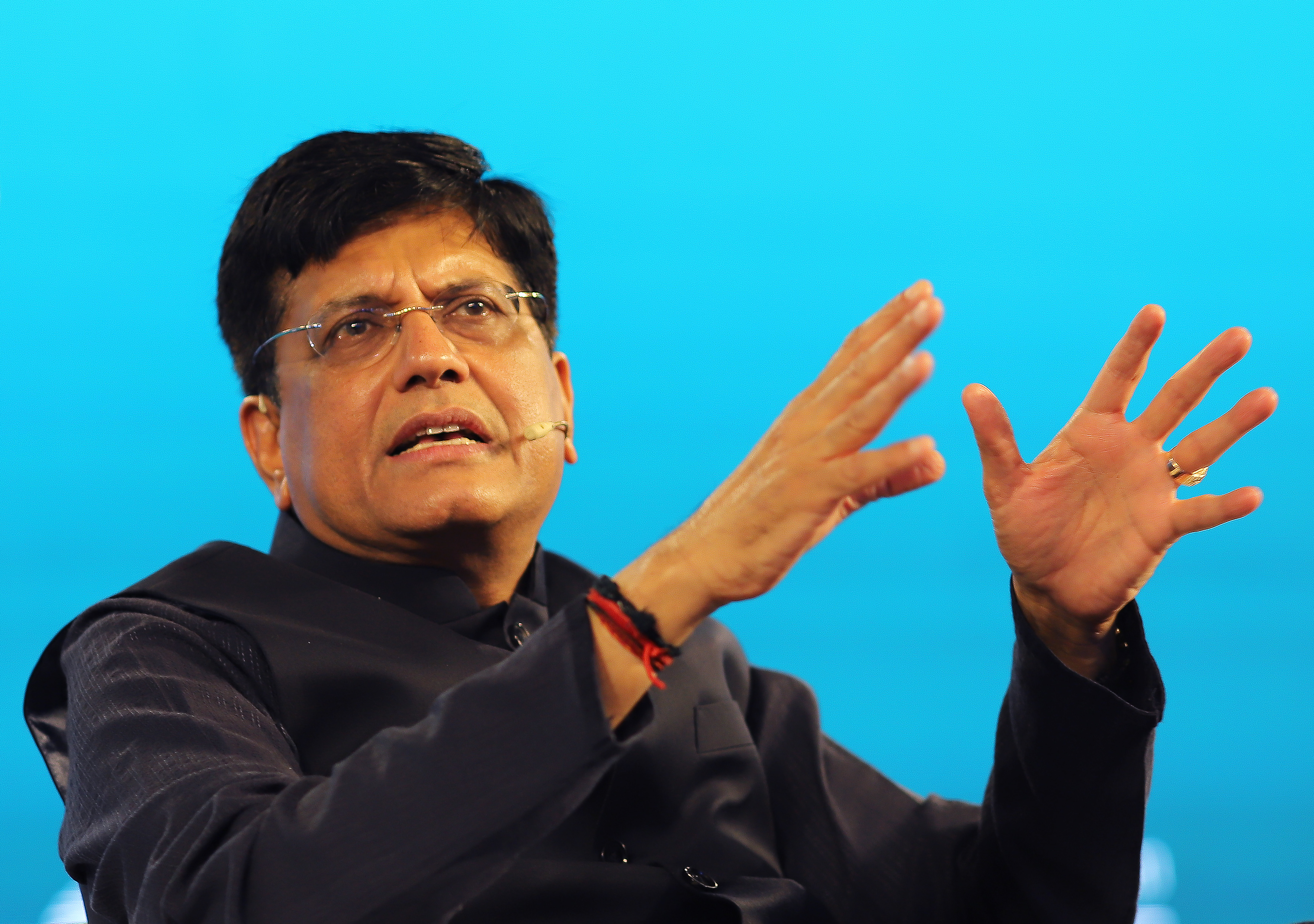
While Donald Trump's reciprocal tariffs have unleashed fear and fury around the world, there is one major economy that sees an “opportunity of a lifetime” in the disruptions.
India's Commerce Minister Piyush Goyal on Monday said the coming changes to global trade will not only bring fairness to supply chains, but also be advantageous for the world's fastest-growing large economy.
“We stand at a moment in history where India is well poised to convert the current situation into an opportunity,” Goyal said at the India Global Forum in Mumbai. “We have an opportunity of a lifetime,” he added.
The minister's comments came on the day Asian shares posted a historic loss as Trump threatened China with additional tariffs, and continued to keep world leaders in the dark about whether they will be able to delay the levies. Volatility has surged with $10 trillion wiped off global equities after the US unveiled sweeping tariffs last week.
In his remarks, Goyal said the current turmoil in global economy can be traced back to China joining the World Trade Organisation almost 25 years ago. “If somebody was to ask me what would be the trigger point of where we are today and why we are going through this churn, the starting point of this actually goes to the beginning of 2000 when China was admitted as the member of the WTO,” Goyal said.
China's growth since then has been fuelled at “the cost of fair trade,” he said. The minister's comments appear to back Trump's criticism of China's trade practices and indicate New Delhi isn't in a hurry to ease its own investment and trade restrictions on its larger neighbour, despite recent signs of a thaw in relationship. The two nations began easing a border standoff in recent months and Prime Minister Narendra Modi met Chinese President Xi Jinping on the sidelines of the BRICS summit last year, agreeing to restart direct flights.
Washington last week announced 26% tariffs on US imports from the South Asian nation, which is lower than the rate imposed on regional rivals like China and Vietnam. India's response is in stark contrast with China's, which has retaliated with a tit-for-tat 34% duties on US imports, and European Union's, which plans to impose 25% tariffs on some American goods.
Unlike other major economies, India has indicated it won't take retaliatory action against the US, focusing its efforts instead on negotiating a bilateral trade deal with the Trump administration. The South Asian nation has first-mover advantage over its rivals since the government has already started talks on a trade deal, which they plan to seal by fall of this year, officials said.
In another step in that direction, US Secretary of State Marco Rubio and India's External Affairs Minister Subrahmanyam Jaishankar on Monday discussed tariffs and “how to make progress toward a fair and balanced trade relationship,” according to a readout from the US.
Goyal also played down any immediate hit to the economy, even though analysts see a 20-40 basis point growth drag following the tariffs. “India is not an export-dependent economy,” he told Bloomberg's Haslinda Amin during a fireside chat at the forum. “Large domestic demand has kind of kept India strong and any trade disruption may really not have that large an impact on India.”
There are some early signs that major companies are looking at India to mitigate the damage to supply chains once tariffs kick in. Apple Inc. is steering more devices made in India to the US market, Bloomberg News has reported.
Apart from the US, India is also negotiating pacts with other trading partners, including the EU and the UK. When it comes to Chinese investments, Goyal said India will restrict market access to EV giant BYD, even as it courts US rival Tesla.
“India has to be cautious about its strategic interests, who we allow to invest,” he said. “As of now it is a no” to BYD.

-
Getting To Work Costs Women More | The Reason Why

It is not just about women paying more than men. It is about women paying much more in cities than in villages.
-
AI Bias In Investing Cannot Be Eliminated, But It Can Be Governed
Framing is a particularly important example as identical financial information presented in terms of gains rather than losses can lead an LLM to reach a different assessment.
-
Joining The Dots | Dark Skies, Steady Diya: Why Hope Holds This Diwali
With war, a weak rupee and foreign outflows weighing on sentiment, policymakers at the NDTV World Summit and market veterans at NDTV Profit Ignite: Diwali Edition offered the same advice: stay invested and filter out the noise.
-
The Curious Case of Equitas Small Finance Bank And A CEO Who Quit For Stock
PN Vasudevan believes persistent investor concerns over a perceived conflict of interest had become a governance overhang on Equitas Small Finance Bank's stock, even as the lender improved profitability and asset quality.
-
Talking Points This Week: AI Cash Burn, A Tiger Comeback And An India That Still Finds Its Own Path
India is not immune to higher oil or tighter global liquidity, yet its earnings base is broader, its domestic policy levers are still available.
-
Foreign Investors Own Half Of HDFC Bank and ICICI Bank. An LTCG Cut Could Matter Most Here
Foreign portfolio investors have US$115 billion parked in HDFC Bank, ICICI Bank. If the government cuts long-term capital gains tax, Jefferies says returning foreign money could land here first.
-
'Never Seen This Level Of Negativity': Sandeep Tandon Says The Next Rally May Be Closer Than You Think
Veteran investor Sandeep Tandon says foreign selling is easing, large-caps are due a comeback and mid-caps are crowded, while he turns positive on gold, power and pharma this Diwali.
-
Indians Stay With Family, Not In Hotels | The Reason Why
India still lacks enough clean, reliable and affordable hotels for budget-conscious travellers.
-
The Economic Imperative: Analysing The Material Driving Force Behind India-Canada Strategic Reset
This economic complementarity is further reinforced by deep institutional investment ties and talent mobility, which form the bedrock of the bilateral framework.
-
Medicine Pricing: Where Must Profit Stop?
India must confront excessive margins, hidden incentives and regulatory gaps that threaten the integrity of medicine.










