Financial Cycles Provide Early Warning Of Business Downturns, Says RBI Paper

Financial cycles in India tend to last longer than business cycles, indicating that lending institutions and policymakers need to take into account the factors affecting credit supply, equity prices and exchange rates when creating policies for businesses.
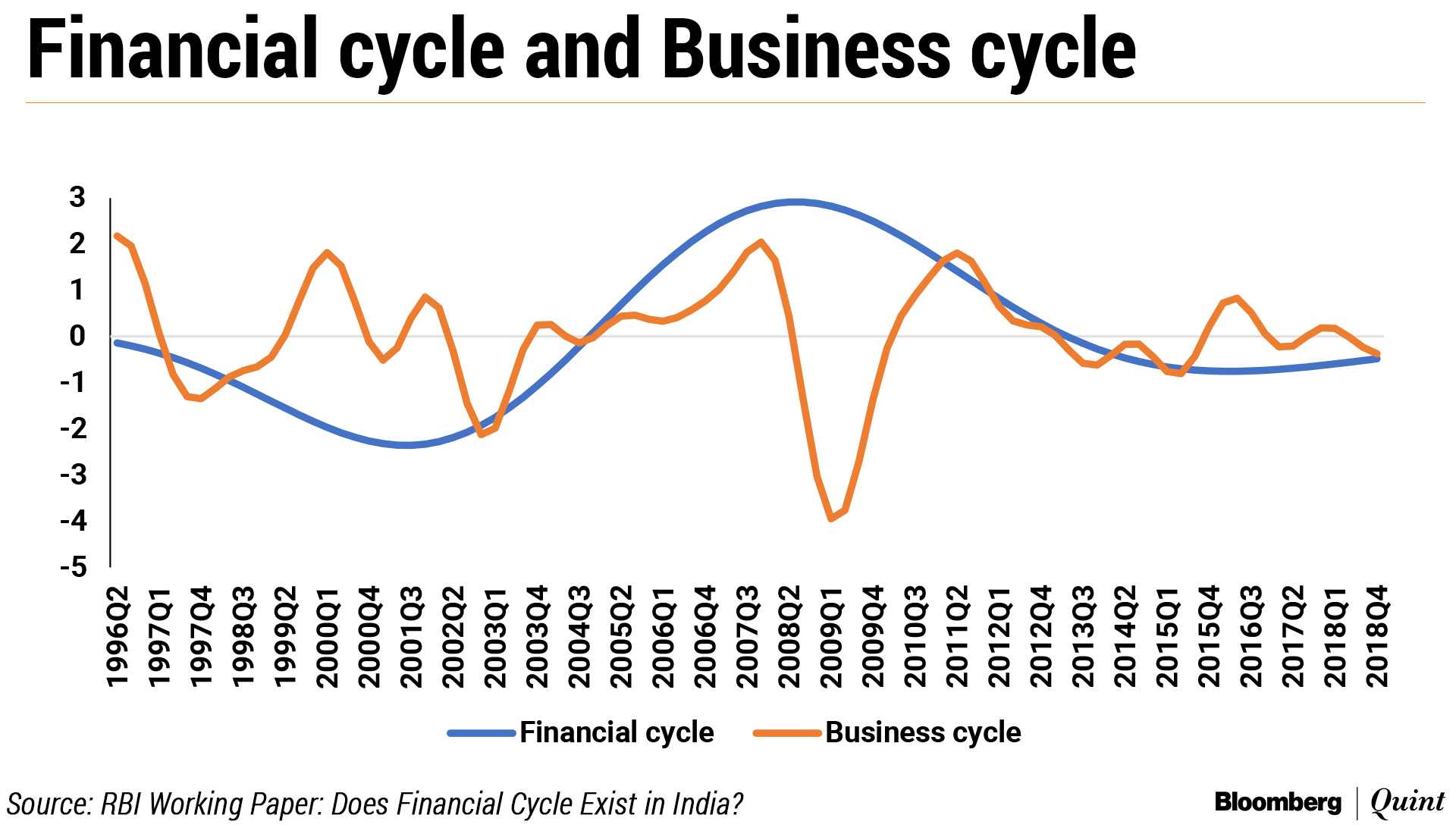
A Reserve Bank of India working paper, released on July 3, found that the average length of a financial cycle is around 12 years compared to a business cycle which lasts an average of about five years.
The report titled Does Financial Cycle Exist in India? uses financial variables like real (non-food) bank credit, credit-to-GDP ratio, real equity prices, real effective exchange rate and real house prices to ascertain the length and extent of financial and business cycles in the pre-1991 and post-liberalisation period.
“The co-existence of financial sector stress along with economic slowdown reminds us the ongoing global debate on financial cycle,” said the report's authors Harendra Behera and Saurabh Sharma, adding that an overhang of gross non-performing assets of banks and recent defaults by non-banking financial companies has prompted the need for such a study.
The study found that the cycle length for GDP growth is, on average, 4.5 years, while credit cycles last around 15.1 years in the post-1991 period.
Business cycles, the study found, last for a shorter duration than financial cycles. However, the volatility of a financial cycle, on average, is almost 1.5 times larger than that of a business cycle.
Equity price cycles last around 8.3 years while exchange rate cycles last around 3.6 years in the post-1991 period, it said.
In the case of credit-to-GDP ratio, an average cycle lasts 15.1 years in the post-1991 period compared to 5.4 years in the pre-1991 period, it added.
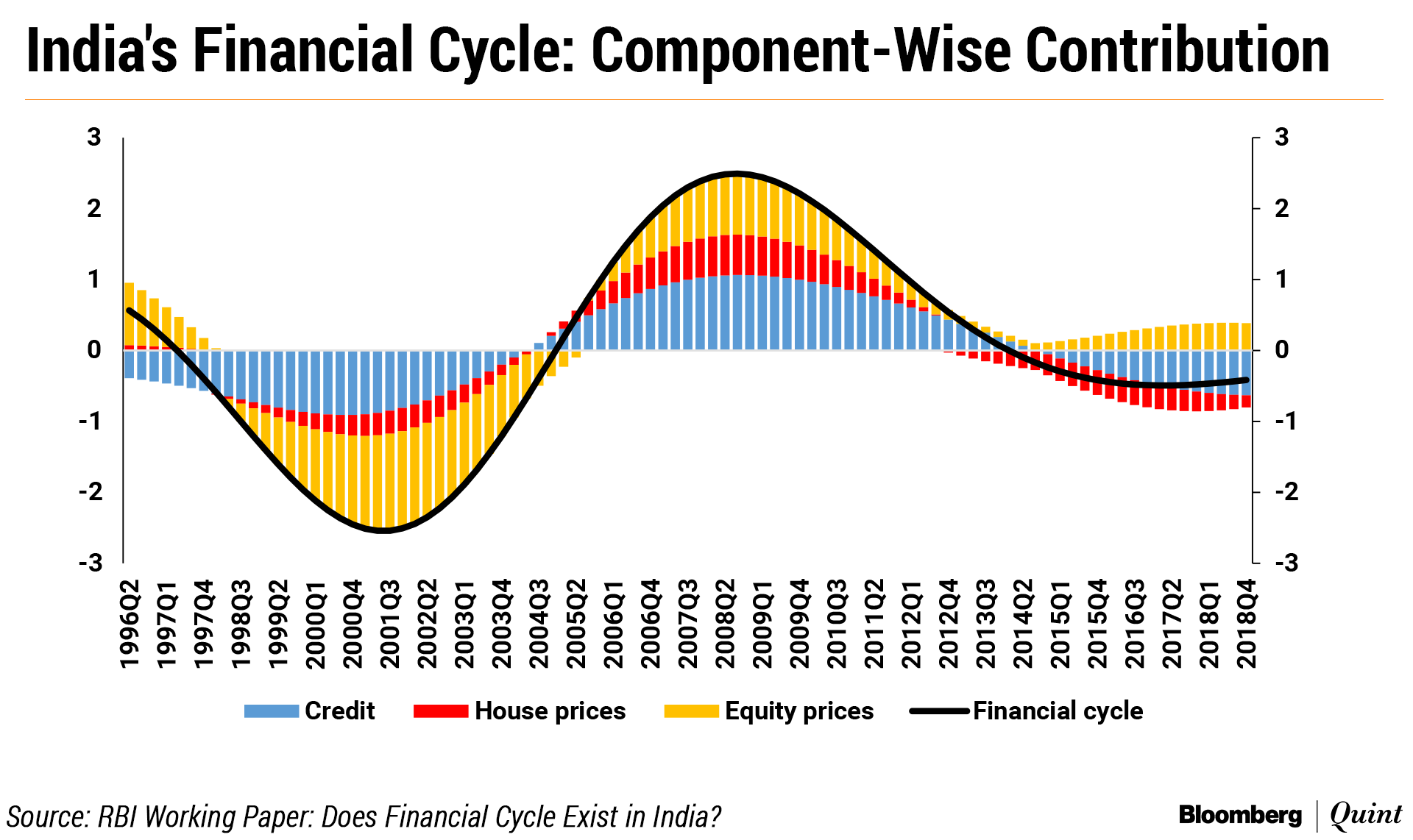
The study found that house prices do not play a significant role in contributing to the overall financial cycle, although since the mid-2000s, the role of house prices has increased.
Understanding financial cycles is useful for policy purposes, the authors said, mainly in terms of serving as an early-warning indicator for detecting stress in the financial system.
“It is often found that business cycle recessions are much deeper when they coincide with the contraction phases of a financial cycle,” the report said. “On the other hand, GDP growth tends to be more stable in expansion phases of financial cycles with fading out of recession risks due to rise in asset prices and decline in leverage.”
Any financial cycle is based on the interaction of asset prices and debt leverages, the authors said, adding if there is a sharp upturn in the financial cycle, that is asset price inflation and higher debt leverages, it needs to be monitored and contained.
While buffers need to be maintained at a policy level in order to take care of the downturn as any upturn in the financial cycle is momentarily followed by a downturn, the authors said.
Easy monetary policy, according to the study, may have assisted if not contributed to exorbitant credit growth which eventually led to high NPAs for banks in the following years.
GNPAs for banks increased from 2.3 percent of total advances in 2007-08 to 11.2 percent in 2017-18. Between 2004 and 2009, credit expansion was at its peak as indicated by the financial cycle, the study found.
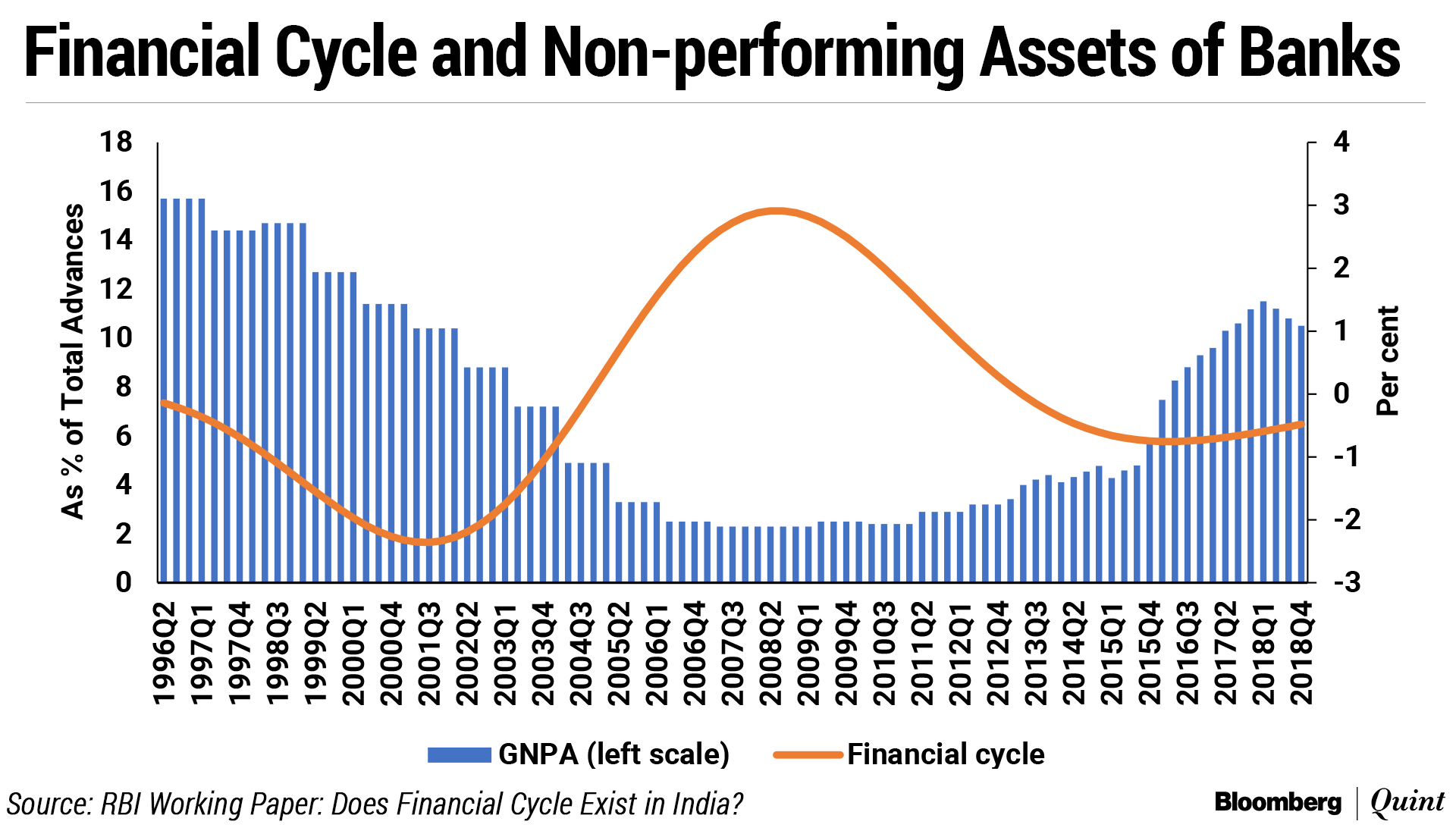
There was a reduction in stressed assets for the banking sector during 2001-2008, when there was an upturn in the financial cycle. Thereafter, credit cycles entered a contractionary phase and stressed assets in the banking system rose to historical highs.
“Though the sharp downturn in business cycle in 2008 could have been driven by the global financial crisis, a part of this downturn and the weak economic activity in subsequent years could be seen as an evidence of early warning by the peak of the financial cycle in 2008,” the report noted.

-
Indians Stay With Family, Not In Hotels | The Reason Why

India still lacks enough clean, reliable and affordable hotels for budget-conscious travellers.
-
The Economic Imperative: Analysing The Material Driving Force Behind India-Canada Strategic Reset
This economic complementarity is further reinforced by deep institutional investment ties and talent mobility, which form the bedrock of the bilateral framework.
-
Medicine Pricing: Where Must Profit Stop?
India must confront excessive margins, hidden incentives and regulatory gaps that threaten the integrity of medicine.
-
Why Amazon And Flipkart Are Struggling To Beat Meesho In India's Smaller Cities
With 274 million users and lowest-cost logistics, Meesho is defending its value commerce crown against giants like Amazon and Flipkart.
-
High US Salaries, No Green Card Certainty: The Financial Calculation Facing Indian H-1B Families
The suspension of PERM processing at eight technology employers does not cancel existing H-1B visas. What it does is force a question many Indian families have been avoiding: is the US salary worth tying your career and family plans to one employer?
-
Swiggy vs Eternal: Food Delivery's Two Rivals Are No Longer In The Same Race
Eternal is building a private AI assistant, dark.ai. Swiggy is still working out how to make Instamart pay, with an operating loss of Rs 895 crore in the July-September quarter while Blinkit stayed profitable.
-
Where You Live Shapes How You Get To Work | The Reason Why
Two-wheelers are the most popular way to get to work in India, accounting for nearly 43% of workplace commutes.
-
Unhedged Position: Can India See An Indonesia-Style Time Correction?
The Nifty is trading below levels it first clocked in 2024. Is there, then, as I have suggested in the headline, potential that the current time correction drags on painfully for the next three-five, even ten years?
-
Navigating Friction And Energy Realities: An Analysis Of Marco Rubio's October Visit To India
Occurring at a critical juncture marked by stalled trade negotiations and escalating geopolitical pressures over global energy supplies, the visit offers a profound window into modern US-India relations.
-
India Exports Capital. Why Not Export Trusteeship?
The big question, then, is whether India can build an institution that global borrowers, investors, banks, and lawyers can trust, even without an Indian connection.










