One El Nino, India Can Handle. Two Could Break The Granary
India's grain stocks can absorb one bad year, but a second El Nino could drain the buffer in two to three years, economists say.
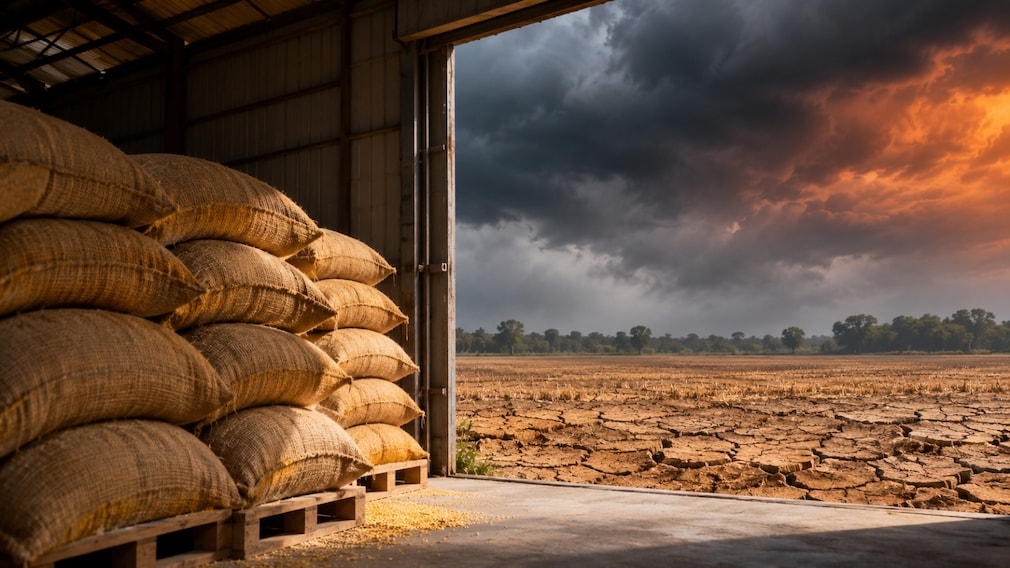
The parched fields of Maharashtra have begun to crack like bare heels on a north Indian winter night, with 85% of the state's talukas battling drought. In Bihar, farmers are staring at an uncertain rabi (winter crop) season after an erratic kharif (monsoon crop) harvest. Some expect output to halve by harvest time.
In Rajasthan, irrigation systems are failing as water runs short and groundwater goes unreplenished. The situation is expected to deteriorate by mid-November. A strengthening Super El Niño is bringing a large part of India's agriculture to its knees, and the effects are only beginning to cascade.
It is tempting to look for someone to blame, but El Niño is natural and recurring. Every two to seven years, the trade winds over the central and eastern Pacific Ocean weaken, and sea surface temperatures in that region rise well above average.
The knock-on effect is felt across Asia. The southwest monsoon falters over countries such as India, Malaysia and Indonesia, and the rainfall deficit hangs like a sword over farming.
"Fields are still waterlogged from the unexpected floods in Bihar towards the end of the monsoon. This can delay sowing of rabi crops," said Jan Gopal Singh, a farmer in his 60s.
In the worst case, Singh said, output of staple rabi crops such as wheat could fall by half. A more likely outcome, if average temperatures rise in February, is a yield 10% to 15% below normal.
"El Niño will make things worse. Crop quality will suffer. Wheat grains will mature faster than they should and will be smaller," he said.
In Rajasthan, the kharif crop has already taken a hit, according to Dr L.N. Harsh, former Vice Chancellor of Agriculture University, Jodhpur, and a member of the Intergovernmental Panel on Climate Change (IPCC) that shared the 2007 Nobel Peace Prize. Among pulses, moong was hit hardest, with production close to negligible, Harsh said. Bajra output also suffered.
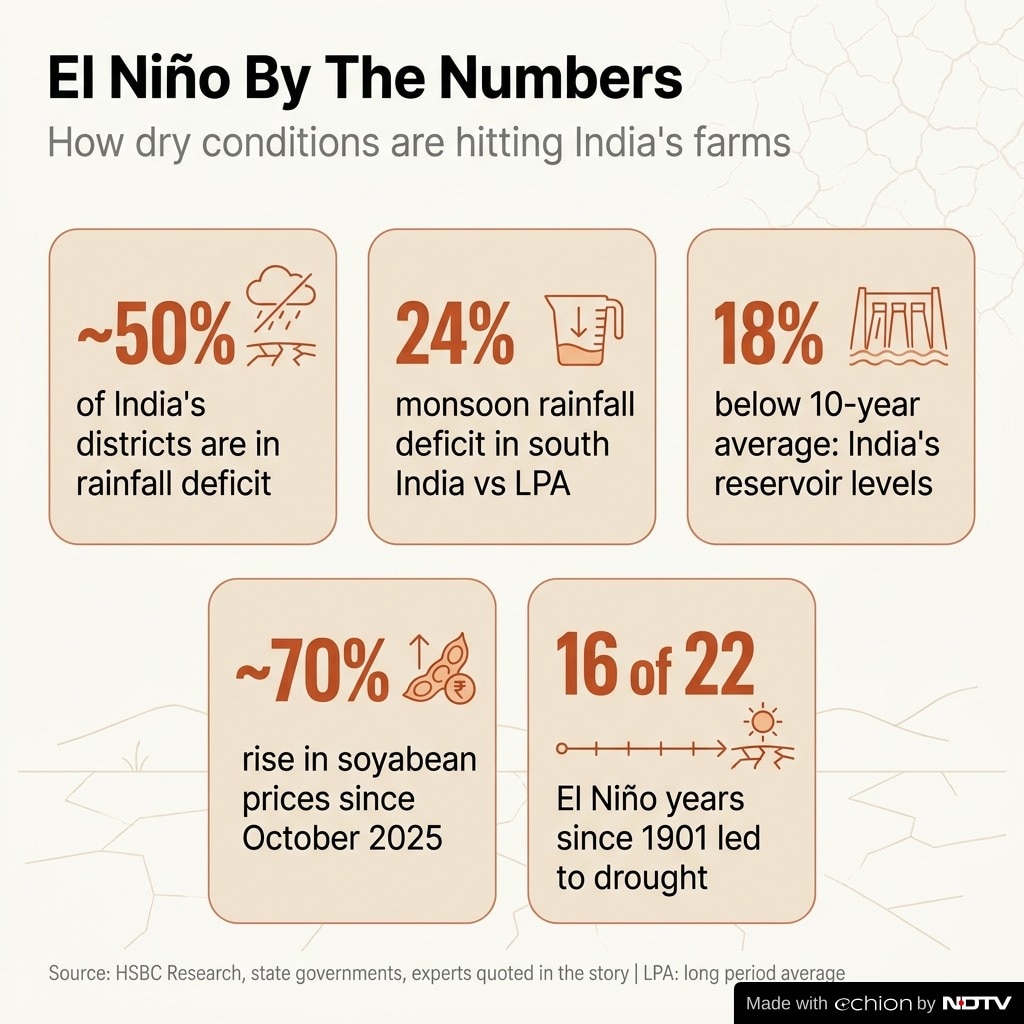
Prices of the two crops have risen 24% and 8% year-on-year, respectively, according to HSBC Research, which noted that reservoir levels are 18% below the 10-year average.
Irrigation has also become ineffective as canals dry up and soil temperatures stay high, Harsh said.
"Too much heat ends up burning the seeds after they are sown," he said. He expects wheat production to suffer, given the poor health of the soil and rising salinity in the water left in the canals.
The South Is Drier Still
This is not just a north Indian problem. Nearly half the districts in the country are in rainfall deficit, and 2026 is shaping up to be the driest 12 months in five years. The south could be the most exposed.
"The Southern region is most vulnerable with a 24% monsoon rainfall deficit vs LPA and lower reservoir levels (c46% lower vs the 10-yr avg)," HSBC said in its note. LPA, or long period average, is the benchmark India uses to measure monsoon rainfall.
By mid-October, Telangana Chief Minister Revanth Reddy had asked farmers to skip one crop this season, citing mounting pressure on water and power supply due to El Niño.
The cracks have spread from Maharashtra to Karnataka, where the government has declared drought in 226 of 240 taluks. Tamil Nadu is not far behind
"We need to keep our fingers crossed," said Devinder Sharma, a food and trade policy analyst and author of 'GATT and India: The Politics of Agriculture'.
The country is heading towards a crisis, he warned, with the gap between the rural and urban economy widening.
"What we are experiencing now is climate change in tandem with El Nino, and the disruption is expected to be huge," said Harjeet Singh, climate activist and Strategic Advisor to the Fossil Fuel Non-Proliferation Treaty Initiative.What worries him most is that even heat-resilient crops such as millets and pulses are under strain.
"Fields are empty in Uttar Pradesh. Jowar and bajra should be grown, but the fields were empty," Harjeet Singh said. Sugarcane, soyabean and groundnut will also remain under stress, he added.
Oilseeds have seen the sharpest price spike, with soyabean up nearly 70% since October 2025.
India Has Been Here Before
This is not India's first rodeo. Of the 22 El Niño events since 1901, 16 led to drought-like conditions. The last five have been especially harsh.
Southeast Asian peers such as Malaysia and Indonesia have already started stockpiling to guard against shortages. In early October, Malaysia's food security minister said the country had six months' worth of rice stocks and enough fish to last 240 days.
The 2023 El Niño hurt India's wheat crop, and Sharma expects a repeat. "At this particular juncture, the global temperature is at its highest. The heat will affect yield and grain formation," he said, recalling that a dry August in 2023 hit rice output hard.
Delayed rabi sowing will add to shortage fears, Sharma said, because wheat sown after mid-November will not yield enough. Experts estimate India's buffer stock could last up to a year, even if prices rise on lower yields. The question is what happens after that.
An El Niño in 2026 does not rule out another in 2028. It does not knock before it enters.
In 2009, India suffered its worst monsoon drought in over three decades, with rainfall 22% below normal. Devastating floods in Andhra Pradesh and Karnataka followed, pushing food inflation to 13.5% in April-December.
The Manmohan Singh government responded with export bans on wheat and non-basmati rice, higher minimum support prices (MSPs), the floor prices at which the government buys crops from farmers, and subsidies on fertiliser and other inputs.
India is far better stocked today to handle a shortfall. But if it does face one and has to repeat those measures, global food supply would be thrown into disarray, Sharma said.
"It is very humiliating for any country to import food, so everything else can wait but not agriculture," Jawaharlal Nehru had said in his address from the ramparts of the Red Fort in 1955. Such a predicament may not be on anyone's radar right now, but it is not a distant reality.
More Painful Years Ahead? Perhaps...
If the climate phenomenon, or more specifically its ripples were to carry through to Kharif sowing season next year, then the impact could permeate through 2028 as well.
"One bad year is manageable but a second El Niño year would be painful," outlined Dr. Ritu Srivastava, Associate Professor of Economics at K J Somaiya Institute of Management.
The Central pool is about 87 million tonnes (Mnt) against a required minimum of 30.77 mnt, leaving around 56 mnt in excess, she explained, adding that with procurement prices falling and Public Distribution System (PDS), Pradhan Mantri Garib Kalyan Anna Yojana (PMGKAY) and open market sales eating into grain stocks, a net loss of 15-25 mt a year would drain that in two to three years.
"Come 2028, the government would inevitably reduce open-market sales and lift export bans, import wheat and rice duty-free, and face rising cereal inflation and PMGKAY demands," the professor projected.
Is There A Need To Prepare?
Not immediately; well, not for urban households at least. Farming households, on the other hand, need to act now as the prevailing conditions are shaping up to be a double whammy for them.
Lower yield will hit farmer incomes directly, which average around Rs 10,000 a month after a plethora of mandi cuts, according to subject matter expert Devinder Sharma.
"The real concern is for smallholders in drought-affected districts, where a poor monsoon means a shorter crop and an impact on a household's cash flow. For farm households, the immediate concern is not about grain storage but about securing income," Srivastava stated.
The signs to prepare will be nearly identical for all stakeholders, and therefore, the professor advised consumers to be watchful of early-2027 wheat harvest and procurement, reservoir levels before the start of 2027 kharif and central pool stocks if they dip below 29 million tonnes.
-
India's Troika Of Good Luck | Joining The Dots

As Jensen Huang's exit drags Nvidia down, a cooling AI trade and resilient earnings have revived investor interest in India. A likely RBI rate hike looms.
-
Talking Points This Week: Leadership Shock At Nvidia, Earnings Strength, And The Fog Over Hormuz
The Anthropic IPO pricing and first trading day, Nvidia's upcoming earnings, and any fresh signals from Iran will set the tone for the following week.
-
Signature Play: The Classic Cocktail Is Dead. Or Is It?
Classic cocktails are disappearing from India's cocktail menus. But they're still being ordered, taught to bartenders and borrowed from. So, who's really having the last drink?
-
A New Samvat Wishlist: Inclusive Prosperity And Human Development
India has strengthened its economic foundations through infrastructure, digital access and enterprise. Its next growth chapter must deepen productivity, create better livelihoods and widen participation in prosperity.
-
Love, Sex Aur Dhokha: The Audacious Plot To Spy On Jensen Huang
A Taipei dinner, a Singapore chip buyer and a suspected Chinese asset: inside the alleged spy operation that got close to NVIDIA's Jensen Huang.
-
Ten Things I Learnt This Samvat
Patience can be a trap. Cheap stocks can stay cheap. Leverage can wipe you out. What did Samvat 2082 teach us? Niraj Shah writes on 10 lessons from the year gone by.
-
Talking Points This Week: Tech Nerves, FII Buying, And A Faraway Banking Shock
The global markets are not shining this Diwali. The exception in the large markets is, India.
-
Midterm Rally Lasted A Day. The Hard Reality Of A Divided US May Last Two Years | Opinion
Between a contested AI boom, a debt ceiling that arrives in 2027 and a president with every incentive to act alone, the next two years may prove more volatile than the first day's rally suggests.
-
Blue Wave Will Derail the AI Trade but Won't Dismantle the AI Era | Unhedged Position
The Democrats' sweep of the US Congress will see politics collide with economic forces both over the long and short term.
-
It's Time To Take The GST Council's Bet On Trust Global
Payment records can prove India's services exports, and clear, proportionate rules can bring foreign digital sellers into the tax net.