Deadlock Over GST Compensation Continues Between Centre And 10 States
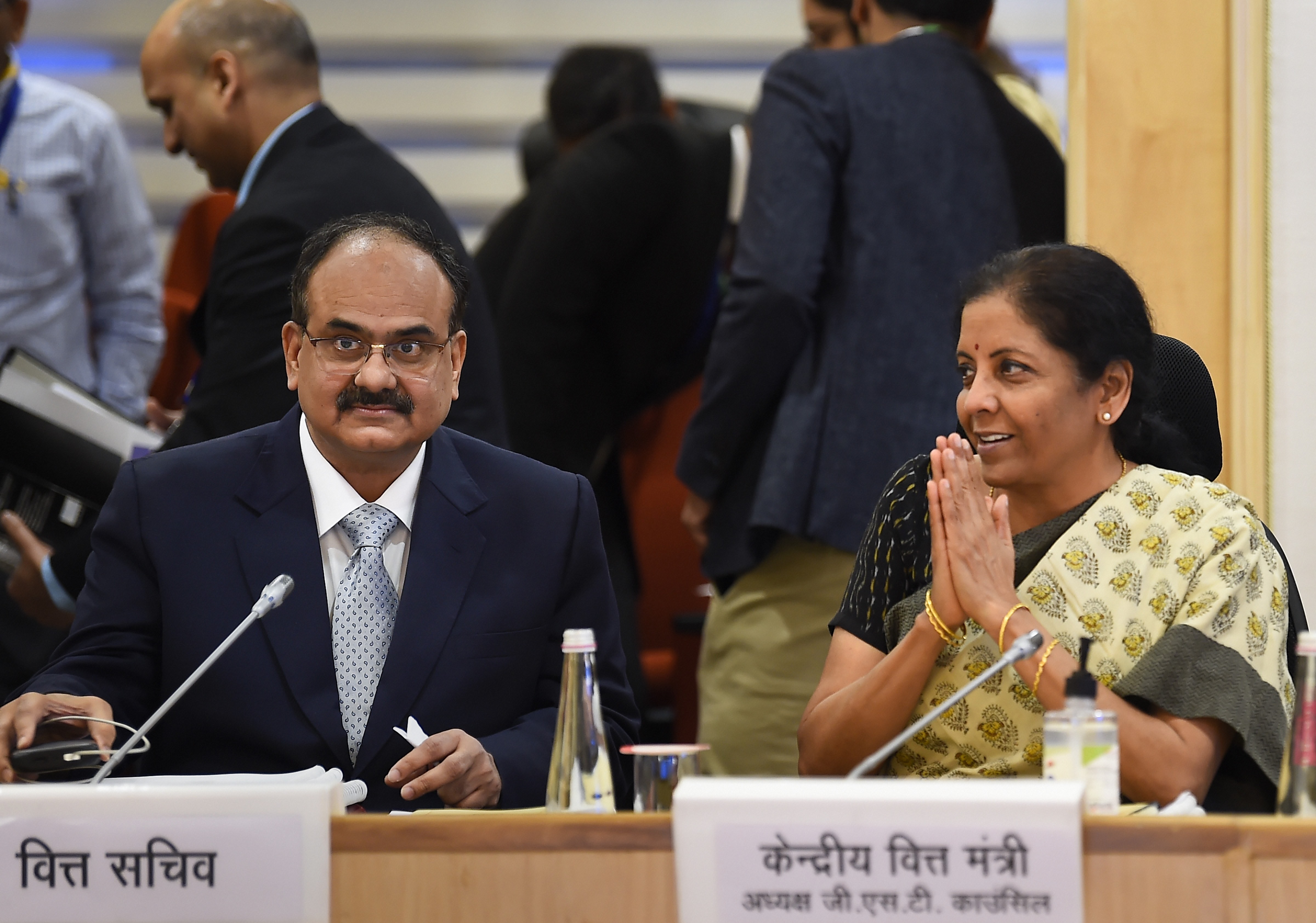
The Goods and Services Tax Council failed to arrive at a consensus on borrowing from the market to meet the shortfall in GST compensation, as per the two options proposed by the central government last month.
Twenty one states, most governed by BJP or its allies, have opted for the first borrowing option, Finance Minister Nirmala Sitharaman told reporters in a briefing on Oct. 5. That involves borrowing from the market with help, such as a letter of comfort, from the central government. The amount to be borrowed under this window has been raised to Rs 1.10 lakh crore from Rs 97,000 crore, as states wanted the GST revenue growth assumption to be scaled down from 10% to 7%, she said.
But 10 states, most run by opposition parties, haven't picked any option, and want the centre to borrow for meeting the shortfall in GST compensation, Sitharaman said.
Such states stated the decision taken by the 21 states can't be forced upon them, she said, adding that they wanted a fresh option.
10 states demand that full compensation should be paid to the states during the current year as per clauses in the law and centre should borrow. Decision was postponed to the next meeting on 12th of October.
October 5, 2020The increased borrowing limit under option one isn't expected to pacify the opposition party-ruled states, forcing the central government to either set up a panel of ministers or a dispute resolution mechanism to arrive at a consensus, said Divakar Vijayasarathy, managing partner at DVS Advisors LLP.
During the meeting, Bihar Deputy Chief Minister Sushil Modi said although some states are in dire need of funds, a few more days should be given to the objecting states, the finance minister told reporters.
The GST Council will meet again on Oct 12, and take a decision, Sitharaman said. “I'm always open for more and more talk.”
“The issue has to be resolved, it can't be lingered with,” Punjab Finance Minister Manpreet Singh Badal told BloombergQuint. He said the centre has already revised the compensation amount from Rs 97,000 crore to Rs 1.10 lakh crore, and if more amount is pitched in by the centre, the issue can be resolved. A provisional settlement of excess IGST (integrated GST) collected would also help in reducing the amount of compensation due to states, he said.
With economic activity picking up, as evident in August GST collections, the central government will have funds to compensate states, Badal told BloombergQuint.
Ready For A Compromise: Kerala FM
Kerala Finance Minister Thomas Isaac told BloombergQuint that states such as his are ready to borrow a part of the compensation, and the central government must borrow a part of it.
“We're ready for a compromise too,” Isaac said. Kerala is also ready to accept a deferral of some part of the compensation payment, he said.
However, if the central government decides to push for implementation of the first borrowing option, the states will be left with no choice but to move the Supreme Court, Isaac said, as the GST Council is against setting up of a dispute resolution mechanism.
Article 279A(11) of the Constitution states that the GST Council create a mechanism to resolve disputes between the central government and states or among two or more states.
In the meantime, about Rs 20,000 crore collected as compensation cess until now, will be disbursed to states tonight, Sitharaman said. The GST Council has also decided to extend the levy of compensation cess beyond five years, Sitharaman said.
The increased tenure of the levy of cess as an option for compensating states would mean continuation of increased prices for goods on which the cess is imposed for another couple of years, said Abhishek Jain, a partner at EY India.
Besides this, about Rs 24,000 crore will be given as states' share of IGST to those states that received less IGST in previous years by next week, Sitharaman had said.

-
'Never Seen This Level Of Negativity': Sandeep Tandon Says The Next Rally May Be Closer Than You Think

Veteran investor Sandeep Tandon says foreign selling is easing, large-caps are due a comeback and mid-caps are crowded, while he turns positive on gold, power and pharma this Diwali.
-
Indians Stay With Family, Not In Hotels | The Reason Why
India still lacks enough clean, reliable and affordable hotels for budget-conscious travellers.
-
The Economic Imperative: Analysing The Material Driving Force Behind India-Canada Strategic Reset
This economic complementarity is further reinforced by deep institutional investment ties and talent mobility, which form the bedrock of the bilateral framework.
-
Medicine Pricing: Where Must Profit Stop?
India must confront excessive margins, hidden incentives and regulatory gaps that threaten the integrity of medicine.
-
Why Amazon And Flipkart Are Struggling To Beat Meesho In India's Smaller Cities
With 274 million users and lowest-cost logistics, Meesho is defending its value commerce crown against giants like Amazon and Flipkart.
-
High US Salaries, No Green Card Certainty: The Financial Calculation Facing Indian H-1B Families
The suspension of PERM processing at eight technology employers does not cancel existing H-1B visas. What it does is force a question many Indian families have been avoiding: is the US salary worth tying your career and family plans to one employer?
-
Swiggy vs Eternal: Food Delivery's Two Rivals Are No Longer In The Same Race
Eternal is building a private AI assistant, dark.ai. Swiggy is still working out how to make Instamart pay, with an operating loss of Rs 895 crore in the July-September quarter while Blinkit stayed profitable.
-
Where You Live Shapes How You Get To Work | The Reason Why
Two-wheelers are the most popular way to get to work in India, accounting for nearly 43% of workplace commutes.
-
Unhedged Position: Can India See An Indonesia-Style Time Correction?
The Nifty is trading below levels it first clocked in 2024. Is there, then, as I have suggested in the headline, potential that the current time correction drags on painfully for the next three-five, even ten years?
-
Navigating Friction And Energy Realities: An Analysis Of Marco Rubio's October Visit To India
Occurring at a critical juncture marked by stalled trade negotiations and escalating geopolitical pressures over global energy supplies, the visit offers a profound window into modern US-India relations.










