China’s Inflation Declines Below Zero For First Time In Year

China's consumer inflation dropped below zero for the first time in 13 months, a reading skewed by seasonal distortions but also a reminder of persistent deflationary pressures in the economy.
The consumer price index declined 0.7% from a year earlier, the National Bureau of Statistics said Sunday, compared with a 0.5% gain in the previous month. The median forecast of economists surveyed by Bloomberg was a 0.4% drop.
China's core CPI, which excludes volatile items such as food and energy, decreased for the first time since 2021 with a drop of 0.1% — only the second time the gauge has contracted over more than 15 years. Factory deflation extended into a 29th month.
“China's economy still faces deflationary pressure,” said Zhiwei Zhang, president and chief economist at Pinpoint Asset Management. “Domestic demand remains weak.”
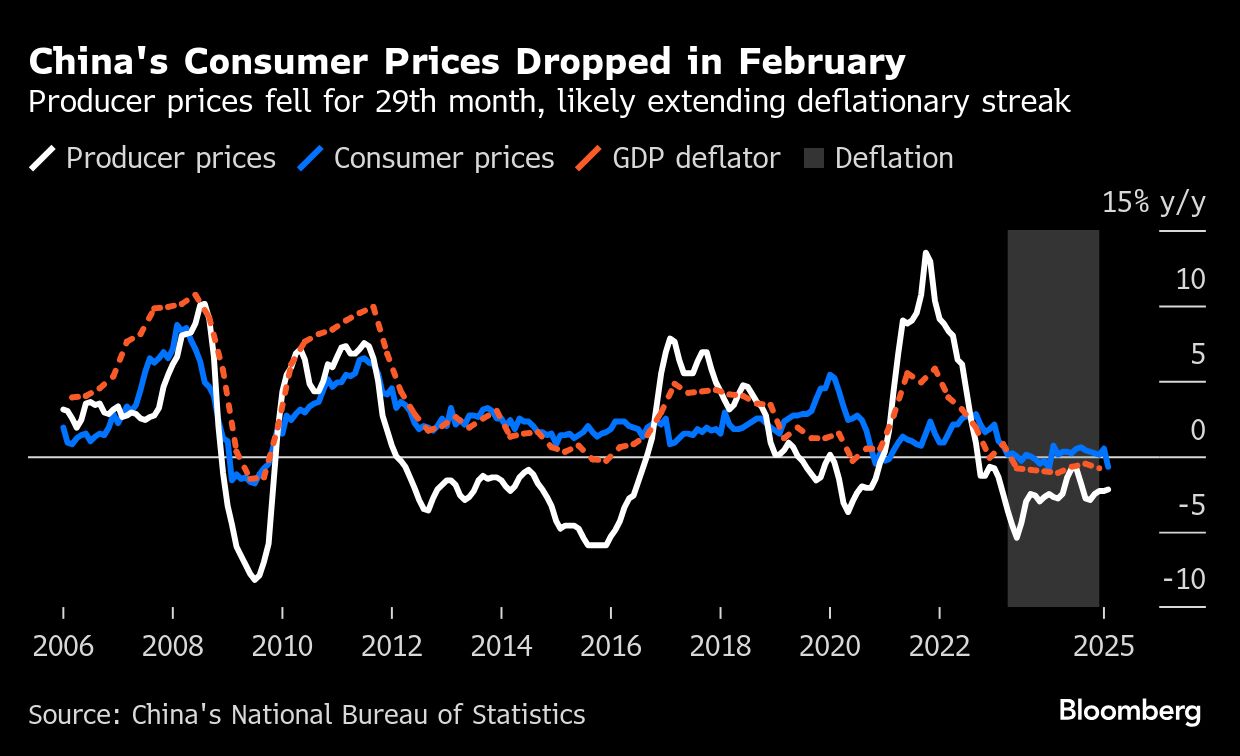
The statistics bureau said a key factor for the decline in inflation was the effect of a high base from a year earlier, created by elevated prices caused by spending during the Lunar New Year.
The festival had an earlier-than-usual start in 2025. It's a moving holiday that fell entirely in February 2024 but ran from Jan. 28 to Feb. 4 this year.
When adjusted for seasonal swings, the statistics bureau estimates consumer inflation actually rose 0.1% from a year earlier in February, according to a statement published on Sunday.
A clearer read on China's inflation trajectory will emerge in March, as investors look for signs that the government's stimulus is translating into stronger domestic demand. The country is on track for the longest streak of economy-wide price declines since the 1960s as a result of weak spending, while the property crash has yet to bottom out.
China has set its inflation target at the lowest level in over 20 years and now aims to bring consumer-price growth to around 2% in 2025 — down from the previous 3% target. It's a signal top leaders are finally recognizing the deflationary pressures weighing on the world's second-largest economy, with consumer inflation stuck at just 0.2% for the past two years.
What Bloomberg Economics Says...
“China's weaker-than-expected February price data highlight slack demand and an urgent need for policymakers to deliver on pledged stimulus quickly. Without a powerful boost from fiscal and monetary policies, deflationary pressures will continue to weigh on the economy.”
— David Qu, economist. For full analysis, click here
Urgency has grown for the government to reflate the economy. At the annual parliament session Wednesday, China announced an ambitious economic growth goal of about 5% for 2025, despite the threat of an intensifying trade war with the US. Beijing also laid out plans to boost fiscal stimulus and domestic consumption.
Still, Bloomberg's calculations based on China's deficit estimates show nominal economic growth is expected to be around 5% this year, matching Beijing's inflation-adjusted target. The outlook suggests officials anticipate little to no overall inflation.
Highlights from inflation data
The producer price index declined 2.2% in February from a year earlier — slightly more than forecast and compared with a 2.3% decrease in January
Food inflation slumped 3.3%, the most since January 2024, after a 0.4% increase the prior month
Consumer goods costs fell 0.9%, while services prices slipped 0.4%
The price of so-called new-energy vehicles, which includes electric cars and hybrid models, fell 6% from a year earlier

-
The Curious Case of Equitas Small Finance Bank And A CEO Who Quit For Stock

PN Vasudevan believes persistent investor concerns over a perceived conflict of interest had become a governance overhang on Equitas Small Finance Bank's stock, even as the lender improved profitability and asset quality.
-
Talking Points This Week: AI Cash Burn, A Tiger Comeback And An India That Still Finds Its Own Path
India is not immune to higher oil or tighter global liquidity, yet its earnings base is broader, its domestic policy levers are still available.
-
Foreign Investors Own Half Of HDFC Bank and ICICI Bank. An LTCG Cut Could Matter Most Here
Foreign portfolio investors have US$115 billion parked in HDFC Bank, ICICI Bank. If the government cuts long-term capital gains tax, Jefferies says returning foreign money could land here first.
-
'Never Seen This Level Of Negativity': Sandeep Tandon Says The Next Rally May Be Closer Than You Think
Veteran investor Sandeep Tandon says foreign selling is easing, large-caps are due a comeback and mid-caps are crowded, while he turns positive on gold, power and pharma this Diwali.
-
Indians Stay With Family, Not In Hotels | The Reason Why
India still lacks enough clean, reliable and affordable hotels for budget-conscious travellers.
-
The Economic Imperative: Analysing The Material Driving Force Behind India-Canada Strategic Reset
This economic complementarity is further reinforced by deep institutional investment ties and talent mobility, which form the bedrock of the bilateral framework.
-
Medicine Pricing: Where Must Profit Stop?
India must confront excessive margins, hidden incentives and regulatory gaps that threaten the integrity of medicine.
-
Why Amazon And Flipkart Are Struggling To Beat Meesho In India's Smaller Cities
With 274 million users and lowest-cost logistics, Meesho is defending its value commerce crown against giants like Amazon and Flipkart.
-
High US Salaries, No Green Card Certainty: The Financial Calculation Facing Indian H-1B Families
The suspension of PERM processing at eight technology employers does not cancel existing H-1B visas. What it does is force a question many Indian families have been avoiding: is the US salary worth tying your career and family plans to one employer?
-
Swiggy vs Eternal: Food Delivery's Two Rivals Are No Longer In The Same Race
Eternal is building a private AI assistant, dark.ai. Swiggy is still working out how to make Instamart pay, with an operating loss of Rs 895 crore in the July-September quarter while Blinkit stayed profitable.










