Budget 2019: Stamp Duty Reform May Plug Avoidance By Equity Investors

Stamp duty has been one of the major sources of direct tax revenue for the government, which is levied and payable under the Indian Stamp Act, 1899.
The Constitution empowers the central government to collect stamp duty on all documented financial instruments including bills of exchange, promissory notes, transfer forms for transfer of shares, debentures, bills of lading, debentures, proxies and letters of credit.
On the other hand, while state governments do not have the power to enact any laws for payment of stamp duty in respect of these instruments, each state can prescribe a stamp duty on other instruments that fall within its list, i.e. the state list, and is reflected in Schedule 1A of the Stamp Act.
Under the Stamp Act, the rate of tax on debentures or shares is decided by the central government, but the states do not follow this rate. Instead, they levy stamp duty on the total contract value that raises the transaction cost for investors. This would result in states using different powers in the law to tax these transactions at varied rates, which in turn lead to arbitrage, inasmuch as intermediaries would seek to route the transactions through states that offer lower rates than where they originate.
With a view to bring uniformity in the stamp duty rate across the country on transfer of financial instruments such as debentures and stocks on a destination-based principle, the government has made several attempts to amend the Stamp Act, but states have been reluctant to give up their powers to levy the duty.
However, after the successful nationwide implementation of Goods and Services Tax regime one and half years ago, the central government has managed to make inroads with the states agreeing to the changes to be made to the century old legislation.
Now, Finance Minister Piyush Goyal, presenting the final budget for Narendra Modi government, announced that the stamp duty regime for financial securities transactions will be amended in order to usher in a streamlined system. The fine print of Finance Bill 2019 seeks to, among other things,
- Insert definitions for ‘securities' including debentures, under the Stamp Act, and
- Impose 0.005 percent stamp duty on the issue of securities other than debentures and of 0.015 percent on transfer thereof, on delivery basis.
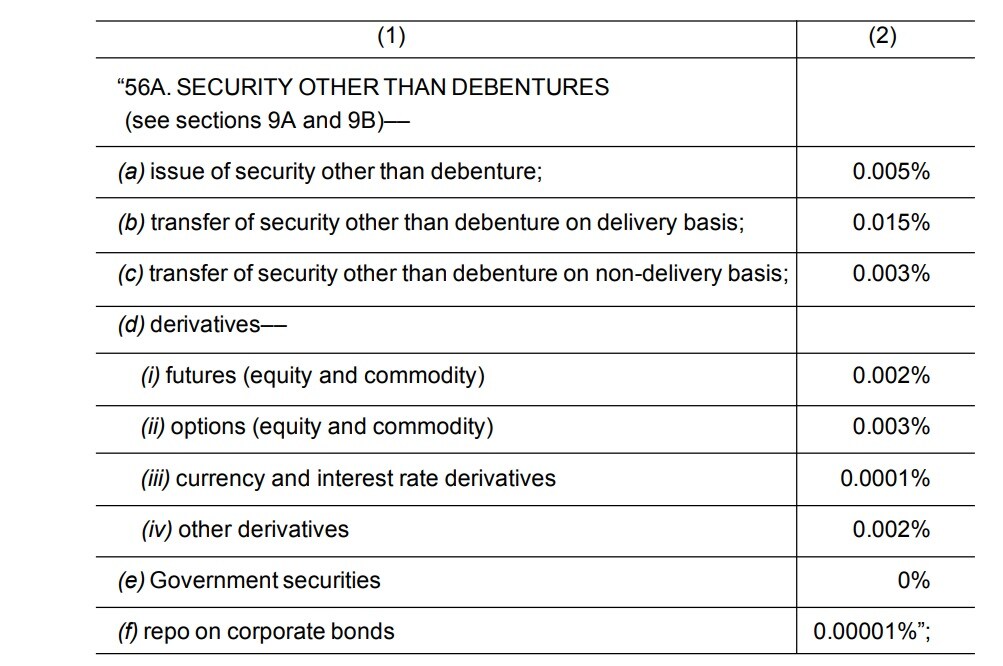
The bill also seeks to levy stamp duty on equity transactions, which is contrary to the expectations of the brokers who in fact hoped for the abolishing of the securities transaction tax.
The two levies—stamp duty and STT—could increase the cost of transaction for investors.
On the other hand, the government's proposal of levying stamp duty on one instrument relating to one transaction and new model for collection of stamp duty, is a welcome move. Stock exchanges are being authorised to collect stamp duty and distribute it to the states as per the domicile of the investor.
Albeit an additional burden, such compliance would stop leakages and end ambiguity about the applicable state rates, and where the stamp duty has to be deposited.
The stock exchanges have customers' details and can easily credit the stamp duty to the concerned state.
With stamp duty being kept out of the GST ambit, these proposals showcase the government's efforts to increase ease of doing business.
Jigar Doshi is an indirect tax partner at SKP Business Consulting LLP.
The views expressed here are those of the author and do not necessarily represent the views of BloombergQuint or its editorial team.

-
Signature Play: The Classic Cocktail Is Dead. Or Is It?

Classic cocktails are disappearing from India's cocktail menus. But they're still being ordered, taught to bartenders and borrowed from. So, who's really having the last drink?
-
A New Samvat Wishlist: Inclusive Prosperity And Human Development
India has strengthened its economic foundations through infrastructure, digital access and enterprise. Its next growth chapter must deepen productivity, create better livelihoods and widen participation in prosperity.
-
Love, Sex Aur Dhokha: The Audacious Plot To Spy On Jensen Huang
A Taipei dinner, a Singapore chip buyer and a suspected Chinese asset: inside the alleged spy operation that got close to NVIDIA's Jensen Huang.
-
Ten Things I Learnt This Samvat
Patience can be a trap. Cheap stocks can stay cheap. Leverage can wipe you out. What did Samvat 2082 teach us? Niraj Shah writes on 10 lessons from the year gone by.
-
Talking Points This Week: Tech Nerves, FII Buying, And A Faraway Banking Shock
The global markets are not shining this Diwali. The exception in the large markets is, India.
-
Midterm Rally Lasted A Day. The Hard Reality Of A Divided US May Last Two Years | Opinion
Between a contested AI boom, a debt ceiling that arrives in 2027 and a president with every incentive to act alone, the next two years may prove more volatile than the first day's rally suggests.
-
Blue Wave Will Derail the AI Trade but Won't Dismantle the AI Era | Unhedged Position
The Democrats' sweep of the US Congress will see politics collide with economic forces both over the long and short term.
-
It's Time To Take The GST Council's Bet On Trust Global
Payment records can prove India's services exports, and clear, proportionate rules can bring foreign digital sellers into the tax net.
-
Opinion | India at 38: From Innovation Overperformer to Innovation Powerhouse
India now has 453 VC-backed deep science startups, 18 of them late-stage, after 117 percent growth since 2020. Laurus Labs, at USD 9.3 billion, is the most valuable deep science company in any middle-income economy outside China.









