Budget 2019: Cleaning Up The Mound Of Pre-GST Litigation

From a good governance perspective, if one has to name the single biggest policy formulation in this budget, it has to be the Sabka Vishwas (Legacy Dispute Resolution) Scheme, 2019. The scheme seeks swift closure of pending cases under such indirect tax laws which have been subsumed under the Goods and Services Tax. Had the current spate of tax disputes been allowed to continue unabated under the normal course, it was projected that the winding down of these cases would easily take another 8-10 years. Such is the state of the judicial system in the country that these were the projections not taking into account the fresh batch of disputes yet to arise under the GST law.
Tax litigation in India can many a times be initiated by the tax authorities on weak grounds which nevertheless draws the taxpayer in a protracted battle until relief can be obtained from the High Court or the Supreme Court. It seems that the government being fully aware of this has looked to bury the past and begin on a fresh note under GST. The mechanics of the scheme works like this.
The scheme proposes to grant a waiver of anywhere between 70 percent to 40 percent—depending on the amount and reason of dispute—of the tax which remains disputed or voluntarily declared or quantified in an investigation.
The relief a taxpayer can expect in different scenarios is summarised below:
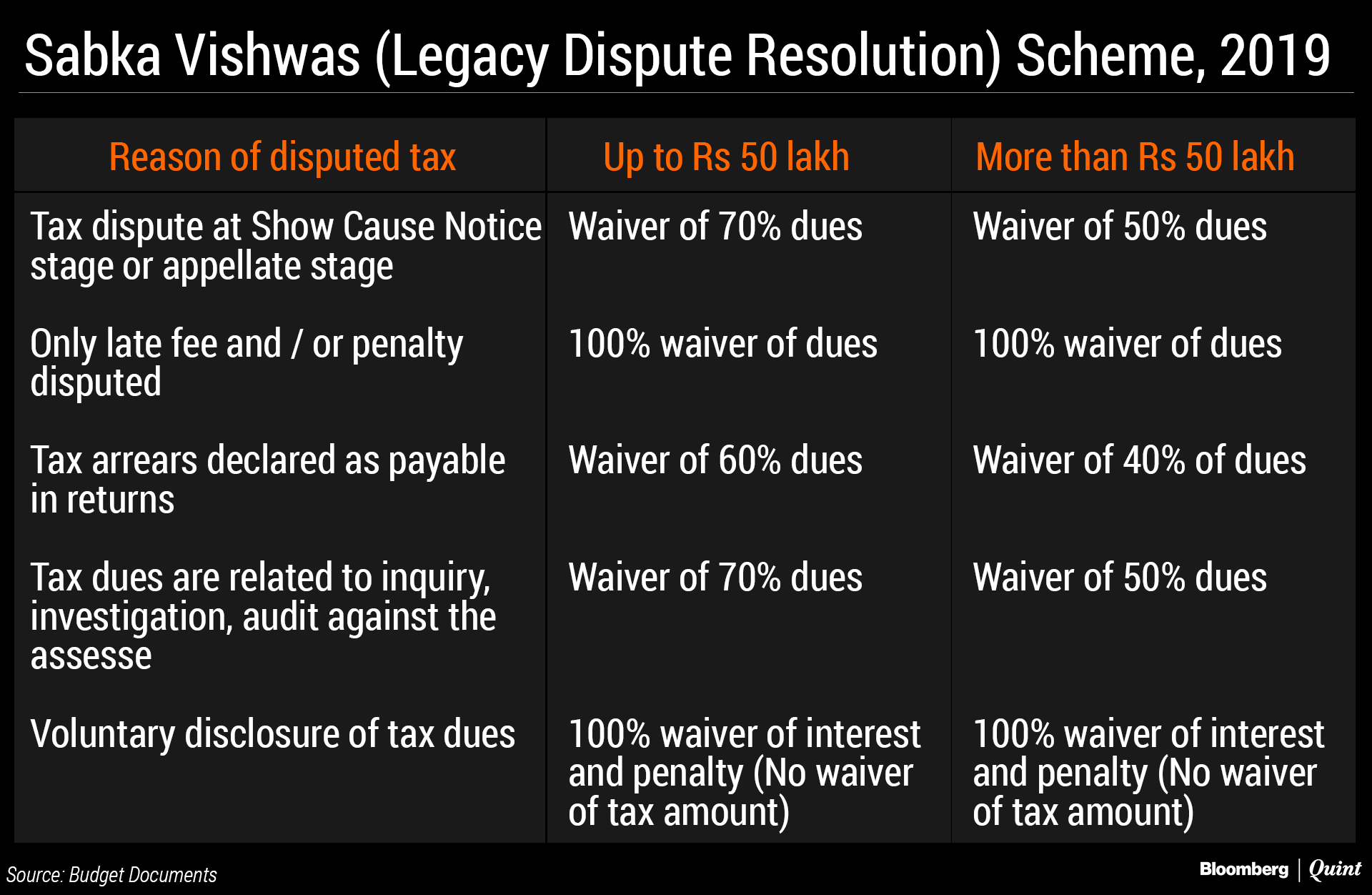
While the scheme does not make it explicit that the interest and penalty would be fully waived, the budget speech and the press note does mention it and without such relief the scheme would not be effective. It would be good for the government to issue a clarification in this respect. There are certain excluded categories such as erroneous refunds, cases pending before Settlement Commission, cases where conviction has taken place and cases where final hearing has been completed if pending before an appellate forum or for adjudication. It is interesting to note that the disputed tax cannot be paid through any tax credits available nor can any other taxpayer avail any tax credit of the amount so paid in settlement. The brief procedural steps are summarised below:
- Taxpayer files declaration of disputed tax online.
- The designated committee verifies the correctness of the declaration made.
- If satisfied, the designated committee issues a statement in electronic form indicating the amount payable by the declarant, within a period of sixty days.
- If the amount estimated by the committee exceeds the amount declared by the applicant, it shall issue a statement indicating the amount payable within thirty days of the date of receipt of the declaration.
- An opportunity of being heard may be provided and after that an online statement indicating the amount payable shall be issued within a period of sixty days from the date of receipt of the declaration.
- Taxpayer to pay amount online within a period of thirty days from the date of issue of such statement.
The key question is what the taxpayers should do – whether they should or should not avail this scheme. It is recommended that the taxpayers do the following:
- Take a stock of all the pending litigations under Excise and Service Tax.
- Review the strength of the position and do an exercise to evaluate the likely outcome of the case.
- In case the grounds are strong and the likelihood of the final decree being in the taxpayers favour is high, then availing the scheme would not be recommended.
- In case the grounds of appeal appear weak and litigation costs are high, then availing the scheme would be recommended to eliminate uncertainty.
Needless to say, the legal proceedings in the said matter shall come to an end and any appeals pending shall be withdrawn/deemed to be withdrawn. It can be anticipated that there will be a rush on the part of taxpayers to avail this opportunity who are looking to end uncertainty in business. It will be interesting to watch how well the scheme is implemented and the response of the taxpayers. If this indeed becomes a success, the government can be said to truly claim the tagline of ‘sabka vishwas' of the honest as well as the not so honest taxpayers.
Jigar Doshi is Executive Director and Shivendra Dwivedi is Senior Manager at SKP Business Consulting LLP and the view are personal.
The views expressed here are those of the authors, and do not necessarily represent the views of BloombergQuint or its Editorial team.

-
One El Nino, India Can Handle. Two Could Break The Granary

India's grain stocks can absorb one bad year, but a second El Nino could drain the buffer in two to three years, economists say.
-
India's Troika Of Good Luck | Joining The Dots
As Jensen Huang's exit drags Nvidia down, a cooling AI trade and resilient earnings have revived investor interest in India. A likely RBI rate hike looms.
-
Talking Points This Week: Leadership Shock At Nvidia, Earnings Strength, And The Fog Over Hormuz
The Anthropic IPO pricing and first trading day, Nvidia's upcoming earnings, and any fresh signals from Iran will set the tone for the following week.
-
Signature Play: The Classic Cocktail Is Dead. Or Is It?
Classic cocktails are disappearing from India's cocktail menus. But they're still being ordered, taught to bartenders and borrowed from. So, who's really having the last drink?
-
A New Samvat Wishlist: Inclusive Prosperity And Human Development
India has strengthened its economic foundations through infrastructure, digital access and enterprise. Its next growth chapter must deepen productivity, create better livelihoods and widen participation in prosperity.
-
Love, Sex Aur Dhokha: The Audacious Plot To Spy On Jensen Huang
A Taipei dinner, a Singapore chip buyer and a suspected Chinese asset: inside the alleged spy operation that got close to NVIDIA's Jensen Huang.
-
Ten Things I Learnt This Samvat
Patience can be a trap. Cheap stocks can stay cheap. Leverage can wipe you out. What did Samvat 2082 teach us? Niraj Shah writes on 10 lessons from the year gone by.
-
Talking Points This Week: Tech Nerves, FII Buying, And A Faraway Banking Shock
The global markets are not shining this Diwali. The exception in the large markets is, India.
-
Midterm Rally Lasted A Day. The Hard Reality Of A Divided US May Last Two Years | Opinion
Between a contested AI boom, a debt ceiling that arrives in 2027 and a president with every incentive to act alone, the next two years may prove more volatile than the first day's rally suggests.
-
Blue Wave Will Derail the AI Trade but Won't Dismantle the AI Era | Unhedged Position
The Democrats' sweep of the US Congress will see politics collide with economic forces both over the long and short term.