Budget 2019: Aggressive Batswoman, Cautious Plodder, Erratic Accountant

When Finance Minister Nirmala Sitharaman picked up her elbow protection (aka red bahi khata), walked out of the pavilion (aka North Block) and took her debut guard at the striker's end (aka Parliament), she was staring at a treacherous pitch:
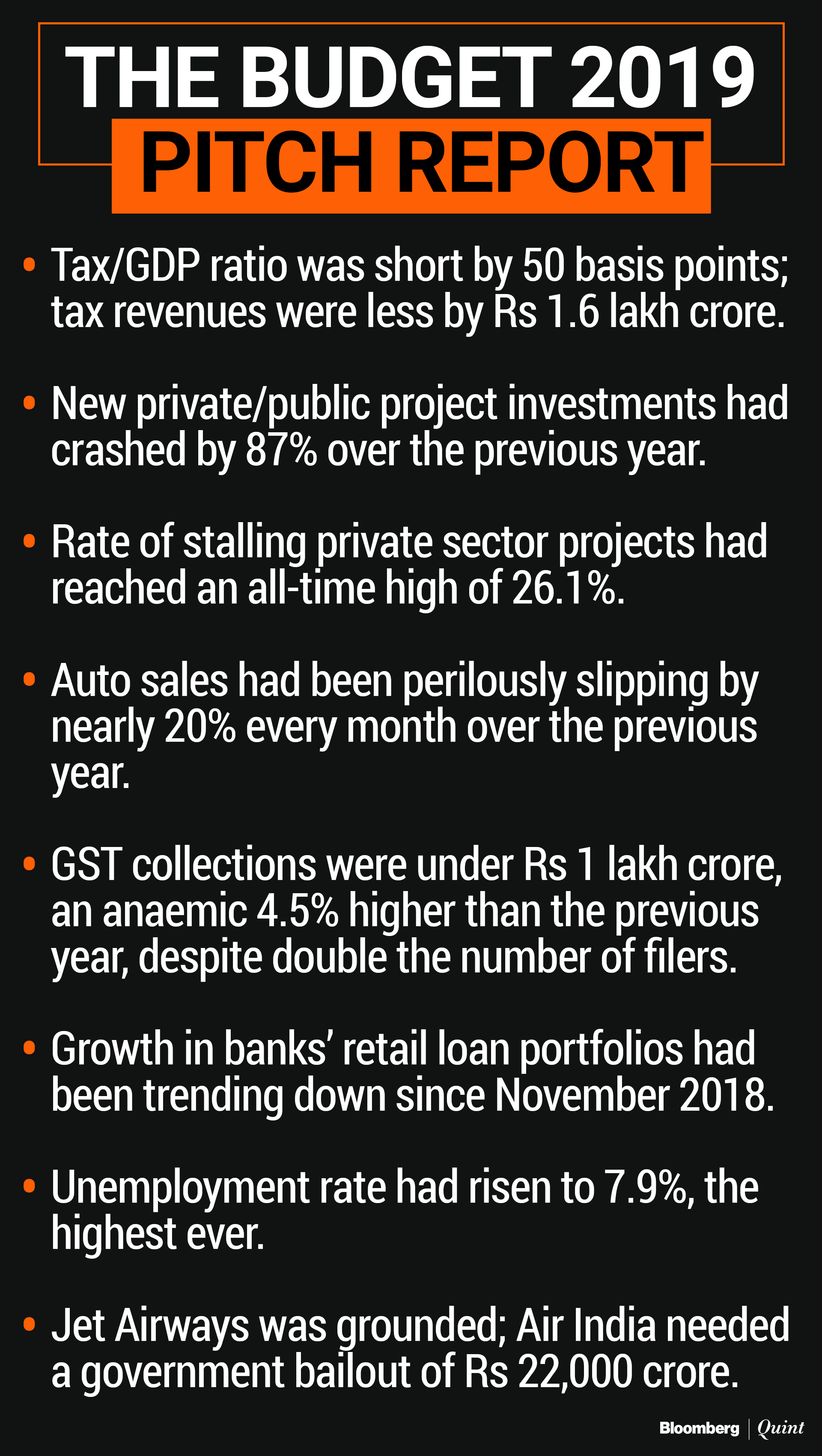
Her two-hour sojourn at the crease can be divided into three clear spells, as she went from an aggressive batswoman to an erratic accountant before finally walking back, cautiously, to the dressing room.

Aggressive Batswoman
One of the early bouncers she faced was hooked for six, when she announced that India would sell sovereign bonds in overseas markets. Whack! In one stroke, she moved the foreign currency risk on to her fiscal accounts, spread joy in domestic bond markets, and heralded lower local interest rates.
I was thrilled that she was taking an entrepreneurial risk, especially since our foreign debt to GDP ratio is at an unnecessarily safe 3.8 percent. Of course, her ministry will now have to develop sophisticated foreign risk management skills to hedge the dollar and launch nimble treasury operations in international currency markets. Be that as it may. At least she showed a bit of swag (aka Sehwag).
Next was a delectable square cut to the fence. Swoosh!
For over a year, India's infant bankruptcy code was bedeviled by a few ambiguous, and therefore crippling, tax rules.
These were holding up resolutions in court, scaring away prospective buyers, and inflating the purchase price by an uncertain, incalculable tax liability. Again, with one stroke, she fixed it:
- Acquirers under the bankruptcy provisions have been allowed to carry forward and set off earlier losses, an incentive which is not available when a company changes hands in the ordinary course of business.
- Similarly, unabsorbed depreciation and losses can be deducted by companies referred to the National Company Law Tribunal.
- Finally, if shares are received at a price below fair market value, tax will be waived for certain specified categories. While a detailed notification is to be issued, the intent seems to be clear, i.e. exempt cases where the sale consideration is outside the control of the parties to the transaction, as in a bankruptcy process
But honestly, she should have tried to hit a boundary here. Why not abolish Section 56(2) of the Income Tax Act for every company? Why only for a bunch of start-ups which are certified to be ‘high tech' by a group of IAS officers? I mean, can we really trust bureaucrats to understand why a car-pooling outfit may be ‘low tech' while a legacy battery-maker may be on to a really cutting edge technology? Isn't such discretion the fountainhead of high-handed, arbitrary, unfair sarkari (ie, government) calls?
Clearly, the aggressive batswoman was beginning to block on the front foot.
Cautious Plodder
Now she swiveled to the incrementalism that is Prime Minister Modi's hallmark. India's shadow banking (aka weak NBFCs) have been reeling under a cash crunch which is threatening to become a systemic crisis. She should have opened the throttle towards the ‘Troubled Assets Reconstruction Programme' that saved America's financial sector in 2008. Instead, she chose to do a defensive shuffle (aka half-measure). She offered a partial, six-month sovereign guarantee to commercial banks if a tenth of the assets that they acquired from shadow banks went bad. She did ease some debenture redemption reserve requirements against bonds issues by NBFCs, but frankly, the problem is a tad mightier than what such half-measures will solve. So this wound could continue to fester and hurt.
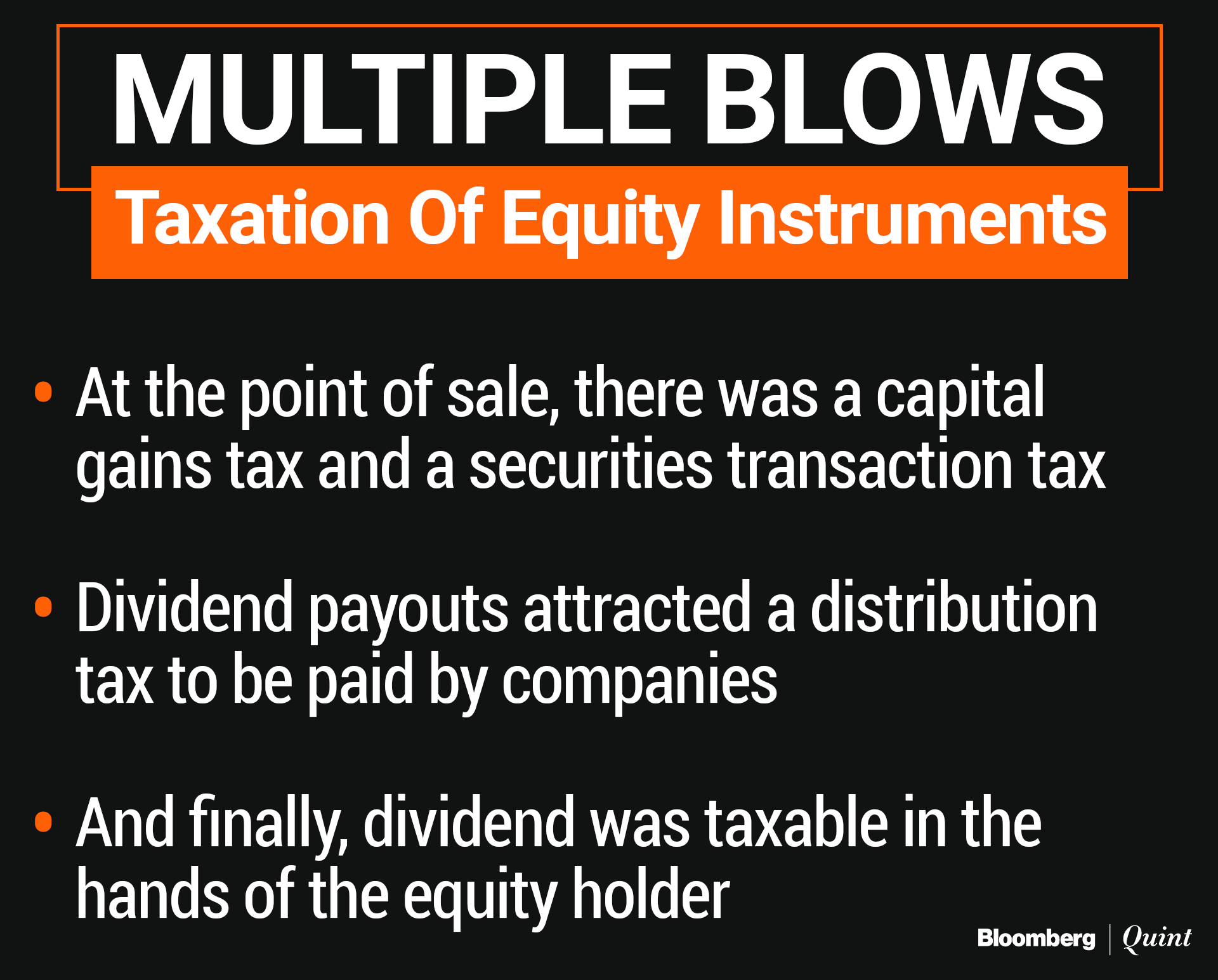
Four taxes on the same equity investment. But wait. She added a fifth one. Until now, companies could buy back their shares without paying any levy, even as the individual seller paid the capital gains tax or used the loss as a tax shelter. That's all over now. Companies will pay a 20 percent (plus 12 percent surcharge) ‘buyback tax', making the whole plan relatively unattractive, and thereby dampening equity values. As if this wasn't enough, there is a move to increase the mandatory float of listed companies by ten percentage points.
While this could create an overhang of Rs 4 lakh crores of potential equity sales—thereby again dampening equity prices— multinationals may use this ‘excuse' to delist altogether.
So who loses? You and me (aka ordinary shareholders), of course.
Now the ‘tip tip' (aka defensive) strokes just piled up:
- A two percent tax on cash transactions beyond one crore rupees every year, even by companies whose turnover is in lakhs of crores!
- A 42 percent tax on annual incomes of over five crore rupees, which is bound to exacerbate the already considerable flight of domestic millionaires to offshore tax havens, even as it discourages multinationals from paying top dollars to expatriates.
While the revenue potential of this ‘super-rich tax' is questionable, its wealth destroying impact is inarguable.
Erratic Accountant
In the twilight of her innings, the bad tax-master became an erratic accountant. Nominal GDP will grow by 12 percent, but tax revenues will leap by 18 percent, even as they have barely grown at the end of the first quarter. Which portends an expected growth of nearly 23 percent in the remaining three quarters. Pray how?
Net net, just as cricket is a game played by 11 ‘flannelled fools', the Union Budget is for those in white, starched khadi, not flannels.
Raghav Bahl is the co-founder and chairman of Quintillion Media, including BloombergQuint. He is the author of two books, viz ‘Superpower?: The Amazing Race Between China's Hare and India's Tortoise', and ‘Super Economies: America, India, China & The Future Of The World'.

-
The Economic Imperative: Analysing The Material Driving Force Behind India-Canada Strategic Reset

This economic complementarity is further reinforced by deep institutional investment ties and talent mobility, which form the bedrock of the bilateral framework.
-
Medicine Pricing: Where Must Profit Stop?
India must confront excessive margins, hidden incentives and regulatory gaps that threaten the integrity of medicine.
-
Why Amazon And Flipkart Are Struggling To Beat Meesho In India's Smaller Cities
With 274 million users and lowest-cost logistics, Meesho is defending its value commerce crown against giants like Amazon and Flipkart.
-
High US Salaries, No Green Card Certainty: The Financial Calculation Facing Indian H-1B Families
The suspension of PERM processing at eight technology employers does not cancel existing H-1B visas. What it does is force a question many Indian families have been avoiding: is the US salary worth tying your career and family plans to one employer?
-
Swiggy vs Eternal: Food Delivery's Two Rivals Are No Longer In The Same Race
Eternal is building a private AI assistant, dark.ai. Swiggy is still working out how to make Instamart pay, with an operating loss of Rs 895 crore in the July-September quarter while Blinkit stayed profitable.
-
Where You Live Shapes How You Get To Work | The Reason Why
Two-wheelers are the most popular way to get to work in India, accounting for nearly 43% of workplace commutes.
-
Unhedged Position: Can India See An Indonesia-Style Time Correction?
The Nifty is trading below levels it first clocked in 2024. Is there, then, as I have suggested in the headline, potential that the current time correction drags on painfully for the next three-five, even ten years?
-
Navigating Friction And Energy Realities: An Analysis Of Marco Rubio's October Visit To India
Occurring at a critical juncture marked by stalled trade negotiations and escalating geopolitical pressures over global energy supplies, the visit offers a profound window into modern US-India relations.
-
India Exports Capital. Why Not Export Trusteeship?
The big question, then, is whether India can build an institution that global borrowers, investors, banks, and lawyers can trust, even without an Indian connection.
-
France's Economy & Politics Are In Crisis | The Reason Why
Let's look at how the French economy and politics evolved under Nicolas Sarkozy, Franois Hollande and Emmanuel Macron.










