Budget 2017: India’s Missing Women Workers
The statistics are stark.
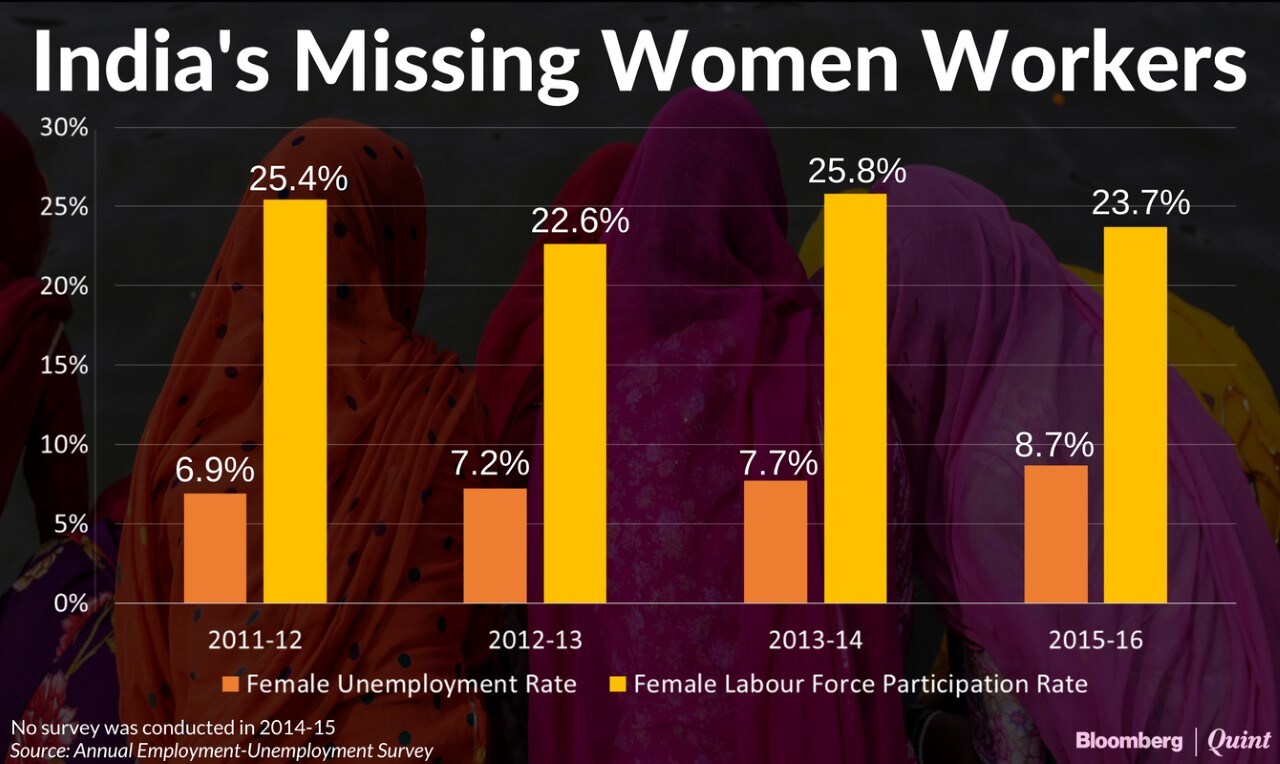
- Only 23.7 percent of eligible Indian women are part of the workforce. Compare that to 75 percent of men
- In urban areas, this number drops further to only 16 percent. For men, the comparable number is 69 percent
- Even for those women who are part of the workforce, the unemployment rate is high. 8.7 percent compared to 4 percent for men
The result - India ranks abysmally low in terms of economic participation of women. The Global Gender Report 2015 by the World Economic Forum ranked India at 139 out of 145 countries. Syria, Pakistan, Saudi Arabia and Yemen are among the few that rank below India.
The fifth annual Employment-Unemployment Survey published in September 2016 acknowledged the problem, noting that encouraging more women to join the workforce is critical to the nation's ability to benefit from the so-called demographic dividend.
Women will account for asubstantial proportion of theworking age population andtherefore participation of womenin the labour force is of utmostimportance to realize the fullbenefits of demographic dividend... Increasing the labour force participation rate (LFPR) for women is vital toachieving high growth ofemployment and overall economicgrowth. The Government is keento address the issue of low femaleLFPR and WPR (Worker Population Ratio) and has launchedvarious legislation-based schemesand other programmes/schemeswhere the emphasis is on femaleparticipation.Fifth Annual Employment-Unemployment Survey
Among the schemes that the government has used to push female employment are programmes like the Mahatma Gandhi National Rural Employment Guarantee Act (MGNREGA), where one-third of the employment opportunities are set aside for women. Successive governments have also long supported schemes like STEP, or Support To Training and Employment Programme for Women, which was launched in 1986-87.
Outside the government sector, organisations like SEWA, or Self Employed Women's Association, have tried to encourage women to earn a living by starting businesses of their own. Equally, self-help groups and microfinance firms have pushed lending to women, who end up using funds for more productive means.
Despite all this, the progress over the years has been limited.
Between the second employment-unemployment survey conducted in 2011-12 and the latest round in 2015-16, participation of women in the labour force has declined and unemployment has risen. The first such survey conducted in 2009-10 was not taken into account as it was conducted for a small sample set and was not representative.
According to Preet Rustagi, professor at the Institute of Human Development, as the education level among girls has improved and as aspirations have risen, more and more women want to be financially independent. However, not enough jobs are being created which can absorb more women workers, said Rustagi in a phone conversation with BloombergQuint.
There has been a shift from the earlier generation in that more women do want to get jobs but there is a demand-supply mismatch, which is reflected in the data. There aren't enough jobs of the kind that would be acceptable to women who tend to weigh factors like security, travel distance from home more carefully than men before accepting employment.Preet Rustagi, Professor, Institute For Human Development
Behind The Global Curve
That India's struggle to bring more women into the workforce is linked to deeply embedded societal beliefs is not news. Over the years, many studies and essays have documented the reluctance of Indian families to let their women work. This has meant that India is far behind peer countries in terms of the economic contribution of women.
According to a November 2015 report by McKinsey Global Institute, women contribute just 17 percent of India's GDP compared to the global average of 37 percent.
India is also far behind most countries like China and even lags regions like Sub-Saharan Africa and Latin America.
Women in India only represent 24 percent of the labour force that is engaged in any form of work in the market economy, compared with an average of 40 percent globally.
.png)
Given how far behind India lags, it would stand to gain the most if it were to achieve gender parity.
McKinsey estimated that complete gender parity in India could add $2.9 trillion to the country's annual gross domestic product (GDP) by 2025. This would be 60 percent more than the business-as-usual GDP by 2025, said the report.
However, it is unlikely that this scenario will materialise within a decade because the barriershindering women from participating in the labour market on a par with men are unlikely to befully addressed within that time frame and because, ultimately, such participation is a matterof personal choice.McKinsey Global Institute
Even if full parity is not achieved, the gains could be substantial. If India comes on a par with the “best-in-region” in terms of gender equality, $700 billion could be added to the country's annual GDP by 2025.
The enabling conditions to achieve this are daunting. From ensuring equality at work, to providing essential services and a supportive legal and political empowerment.
The Push For Change
In 2010, a working paper published by the International Labour Organisation (ILO) had suggested that India should have an employment policy with a specific focus on women and development of sectors that can absorb labour supplies of women.
Simultaneously, the government must focus on improving skill levels among the female workforce, along with pushing primary education, to make them more employable.
The paper also suggested a movement away from the concept of ‘family wages' by pushing society towards understanding that it is essential for women to participate and earn in their own right. A 2011 paper on ‘Labour Force Participation of Women in India', authored by Surjit Bhalla and Ravinder Kaur, had noted that while female education helps improve labour force participation, a factor that has the reverse effect is the education level of the spouse.
...There is one consistent factor operating in the opposite direction – education of the spouse (male). This has a larger negative effect (each extra year of male education means a drop in participation of 1 percentage point) than the positive effect of female education. Most likely this is because of the gap in earnings (or potential earnings) of men and women. Women tend not to work if married to highly educated males who earn a substantial incomeSurjit Bhalla & Ravinder Kaur In 2011 Working Paper For LSE Research Center
Finally, there are the intangibles that need to be addressed, perhaps through campaigns on the scale of the government's Swach Bharat drive. Such campaigns need to encourage women to be part of the productive workforce and push for equality in the share of unpaid care work (such as cooking and cleaning) that women do in India.
According to the McKinsey Global Institute report quoted above, Indian women do 9.8 times the care work that Indian men do.
Rustagi of the Institute for Human Development said that there has been no clear attempt to frame an employment policy in the context of women employment. “The whole issue of job creation is a black box, so first we need to address that and then within that we need to address women employment in particular,” said Rustagi while adding that you also need a social campaign which drives home the point that women need to work.
If we truly want women empowerment, then we do need a campaign. You need to create the thinking that women need to work. There has been improvement in education levels among girls. Over and above that, you need to reinforce the desire to be independent and reduce the focus on early marriage and reproduction.Preet Rustagi, Professor, Institute For Human Development

-
Getting To Work Costs Women More | The Reason Why

It is not just about women paying more than men. It is about women paying much more in cities than in villages.
-
AI Bias In Investing Cannot Be Eliminated, But It Can Be Governed
Framing is a particularly important example as identical financial information presented in terms of gains rather than losses can lead an LLM to reach a different assessment.
-
Joining The Dots | Dark Skies, Steady Diya: Why Hope Holds This Diwali
With war, a weak rupee and foreign outflows weighing on sentiment, policymakers at the NDTV World Summit and market veterans at NDTV Profit Ignite: Diwali Edition offered the same advice: stay invested and filter out the noise.
-
The Curious Case of Equitas Small Finance Bank And A CEO Who Quit For Stock
PN Vasudevan believes persistent investor concerns over a perceived conflict of interest had become a governance overhang on Equitas Small Finance Bank's stock, even as the lender improved profitability and asset quality.
-
Talking Points This Week: AI Cash Burn, A Tiger Comeback And An India That Still Finds Its Own Path
India is not immune to higher oil or tighter global liquidity, yet its earnings base is broader, its domestic policy levers are still available.
-
Foreign Investors Own Half Of HDFC Bank and ICICI Bank. An LTCG Cut Could Matter Most Here
Foreign portfolio investors have US$115 billion parked in HDFC Bank, ICICI Bank. If the government cuts long-term capital gains tax, Jefferies says returning foreign money could land here first.
-
'Never Seen This Level Of Negativity': Sandeep Tandon Says The Next Rally May Be Closer Than You Think
Veteran investor Sandeep Tandon says foreign selling is easing, large-caps are due a comeback and mid-caps are crowded, while he turns positive on gold, power and pharma this Diwali.
-
Indians Stay With Family, Not In Hotels | The Reason Why
India still lacks enough clean, reliable and affordable hotels for budget-conscious travellers.
-
The Economic Imperative: Analysing The Material Driving Force Behind India-Canada Strategic Reset
This economic complementarity is further reinforced by deep institutional investment ties and talent mobility, which form the bedrock of the bilateral framework.
-
Medicine Pricing: Where Must Profit Stop?
India must confront excessive margins, hidden incentives and regulatory gaps that threaten the integrity of medicine.










