Analysing Budget 2020’s Tax Targets
Tax revenue is the largest, most critical source of revenue for any government and yet in India these past few years it has also been most difficult to forecast given the many policy changes.
In the Union Budget presented on February 1, Finance Minister Nirmala Sitharaman estimates tax revenue will contribute 55.75 percent of the government's revised estimate of Rs 26.99 lakh crore total revenue for fiscal year 2019-20, and 52.85 percent of the budget estimate of Rs 30.95 lakh crore total revenue for fiscal year 2020-21. But both revenue estimates seem difficult to achieve, show past data.
Let's start with the tax targets for the ongoing fiscal year FY19-20.
Last Quarter, Big Hopes
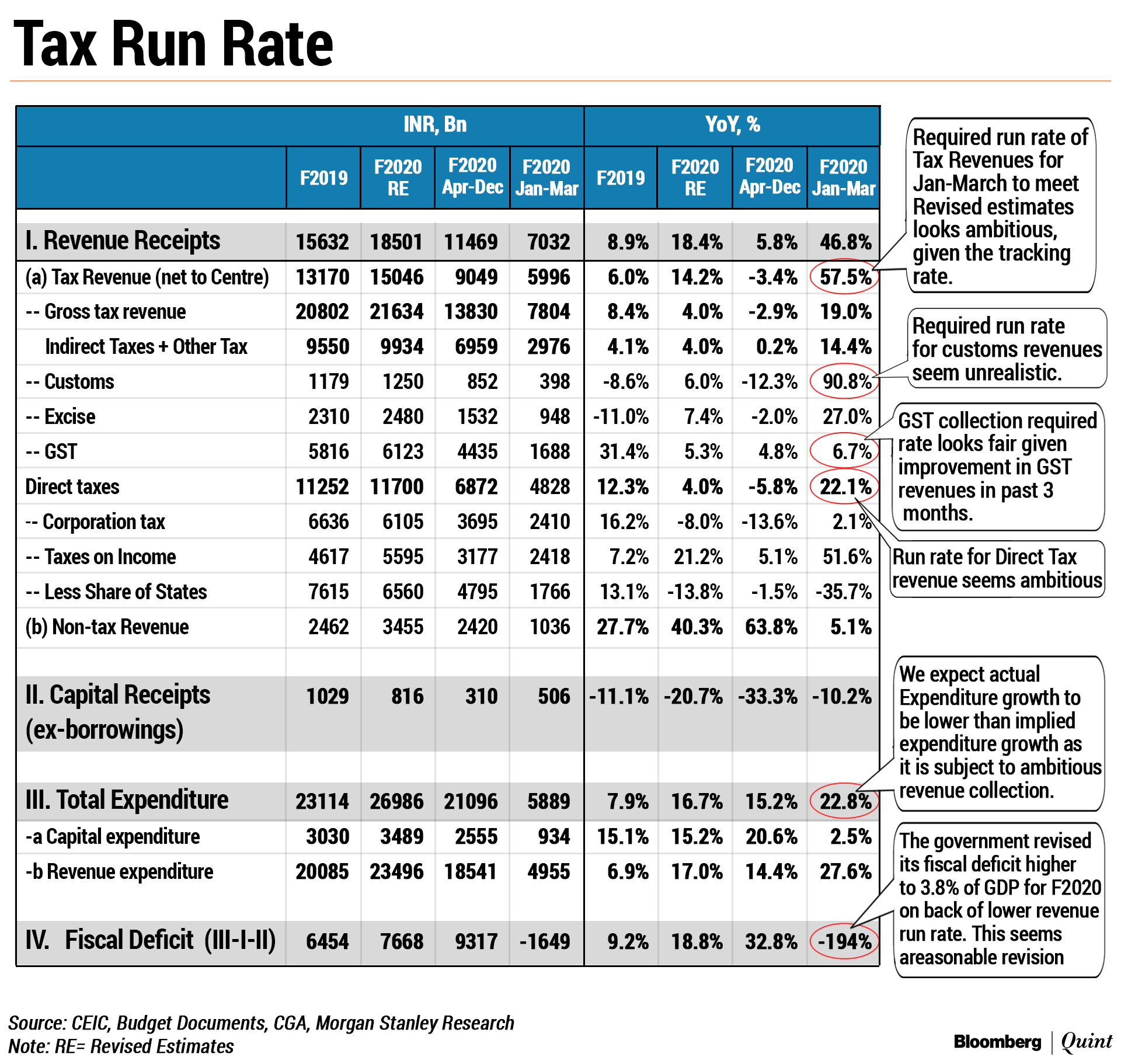
Acknowledging the economic slowdown and subsequent weakness in tax collection, as also the impact of corporate tax rate cuts in 2019, the government has revised downwards its gross tax revenue estimate for the fiscal year—from Rs 24.61 lakh crore in the July 2018 budget to Rs 21.63 lakh crore. But even that will be challenging to meet given that as of December end, as per CGA data, net tax collected amounts to just Rs 13.83 lakh crore or 64 percent of the revised estimate. The government hopes to collect the remaining 40 percent over three months (January-March) and while the last quarter does traditionally see an increase in tax collections, it is unlikely to be this high.
FY20 Revised Estimate: Rs 21,63,423 crore
As of December 2019: Rs 13,83,035 crore
January-March Target: Rs 7,80,388 crore.
In FY19, by December the government had collected 68 percent of the total gross tax revenue. But then growth in FY19 had not cratered the way it has in FY20.
Corporate Tax
FY20 RE: Rs 6,10,500 crore
As of December: Rs 3,69,533 crore
Achieved: 60.5%
December FY19: 64.4%
Income Tax
FY20 RE: Rs 5,59,500 crore
As of December: Rs 3,17,652 crore
Achieved: 56.8%
December FY19: 64%
CGST
FY20 RE: Rs 6,12,327 crore
As of December: Rs 3,68,838 crore
Achieved: 60%
December FY19: 74.4%
CGST Compensation Cess
FY20 RE: Rs 98,327 crore
As of December: Rs 70,499 crore
Achieved: 71.7%
December FY19: 74%
Customs
FY20 RE: Rs 1,25,000 crore
As of Dec: Rs 8,51,54 crore
Achieved: 68%
December FY19: 82%
Excise
FY20 RE: Rs 2,48,012 crore
As of December: Rs 1,53,199 crore
Achieved: 62%
December FY19: 67.4%
When compared to December collections for FY19, the data show that income tax revenue, customs and corporate tax are lagging the most.
FY21 Estimates: Ambitious
The budget estimates for the oncoming fiscal year 2020-21 are even more challenging to achieve, for three reasons.
- Base Uncertain
- Aggressive Nominal GDP Growth Estimate
- Tax Revenue Growth Targets Ambitious
Base Uncertain
As explained above, FY20 tax revenue targets look tough to achieve. And if the Rs 21.63 lakh crore revised target for this fiscal is not met, then the FY21 budgeted target of Rs 24.23 lakh crore in gross tax revenue will become a steeper climb.
Aggressive Nominal GDP Growth Estimate
The budget estimates 10 percent nominal GDP growth in FY21, compared to 7.5 percent estimated in FY20 and over 11 percent in FY19. But, ratings agency Moody's sees GDP growth rising to around 8.7 percent in the next financial year, on the back of real GDP growth of 5.5 percent. India's Economic Survey last week pegged FY21 GDP growth at 6-6.5 percent.
Several economists and brokerages also believe the government's estimate is “optimistic”.
This growth number seems to be a bit on the optimistic side, given the real GDP growth continue to moderate and inflation is expected to cool-off below 4% in the second half of 2020-21 as food inflation spikes moderate and a high base effect kicks-in.HDFC Bank Report
Tax Revenue Growth Targets Ambitious
Topping the GDP optimism are ambitious growth estimates for tax revenue - gross tax revenue growth has been estimated at 12 percent versus a 4 percent revised target for FY20.
The budget assumes a tax buoyancy of 1.2 for 2020-21 compared to 0.5 (FY20 RE) and 0.8 (FY19) over the last two years.HDFC Bank Report
Both direct and indirect tax growth targets are lofty. Direct taxes are expected to grow at 12.7 percent, whereas indirect taxes at 11.1 percent, over the revised target for FY20, show the budget documents.
So, the Finance Minister needs all three factors to work in her favour to meet next year's tax targets.
To be sure, there are believers too. Nomura says in its budget analysis that “the nominal GDP growth basis for FY21 at 10 percent is reasonable, in our view. The tax assumptions are also reasonable, with the direct tax buoyancy coefficient pegged at ~1.3 and the indirect tax buoyancy coefficient at ~1.1 – modest by historical standards. However, these may seem a tad ambitious compared to the sharp plummet in tax buoyancy in FY20, especially in the cases of corporate taxes, GST and custom duties, which were impacted by the growth slowdown and the corporate tax cut”.
The trouble with making an emphatic assertion regarding the success or failure of these estimates is that continuous policy change has made the last few years' data difficult to compare and draw conclusions. First the impact of demonetisation, then GST, the frequent changes to GST rates, the increase in import duties over the past two years, the many tax settlement schemes in the past three years, the corporate tax rate cut (optional)...and now the personal income tax rate, also optional.
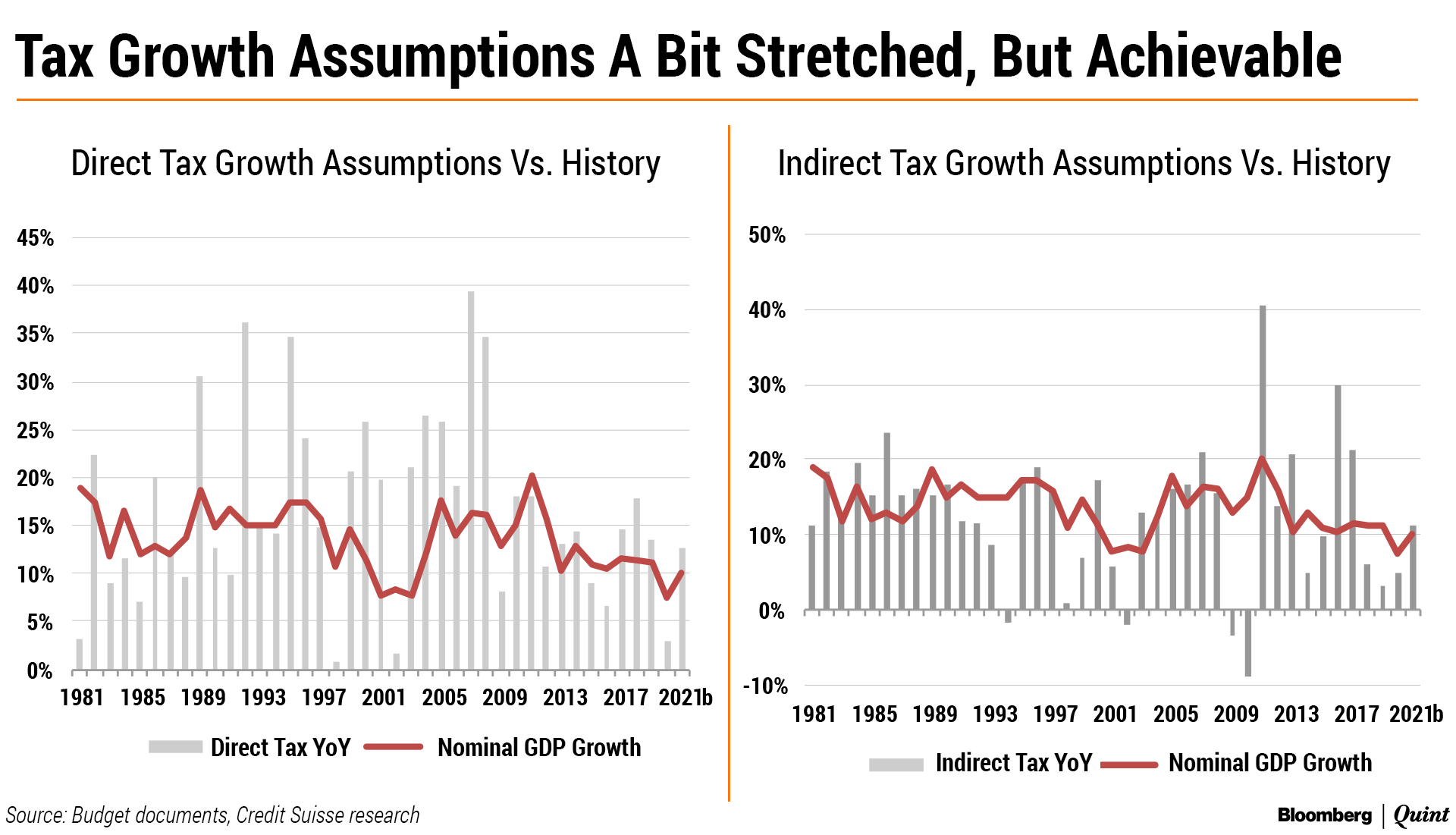
When viewed alongside nominal GDP growth the tax revenue targets are stretched but achievable, a Credit Suisse report says. It points out that “direct tax growth can differ significantly from nominal GDP growth both on up and downside”.
On the indirect tax front, Credit Suisse says the tax assumptions imply an improvement in compliance in GST.
A clearer picture will emerge in a few months when the provisional data for the January to March quarter is available, to gauge if yet another budget has misjudged income potential, and by what margin. In FY19, the budget estimated an 18 percent increase in gross tax revenues, the year ended with just over 8 percent.
Related Stories
New Tax Structure Gives Option To Save Tax, Says Revenue Secretary
Markets Misreading Extent Of Stimulus In Budget 2020, Says JPMorgan's Jahangir Aziz
Fall In Central Transfers To States A Risk To Growth, Say Economists

-
Signature Play: The Classic Cocktail Is Dead. Or Is It?

Classic cocktails are disappearing from India's cocktail menus. But they're still being ordered, taught to bartenders and borrowed from. So, who's really having the last drink?
-
A New Samvat Wishlist: Inclusive Prosperity And Human Development
India has strengthened its economic foundations through infrastructure, digital access and enterprise. Its next growth chapter must deepen productivity, create better livelihoods and widen participation in prosperity.
-
Love, Sex Aur Dhokha: The Audacious Plot To Spy On Jensen Huang
A Taipei dinner, a Singapore chip buyer and a suspected Chinese asset: inside the alleged spy operation that got close to NVIDIA's Jensen Huang.
-
Ten Things I Learnt This Samvat
Patience can be a trap. Cheap stocks can stay cheap. Leverage can wipe you out. What did Samvat 2082 teach us? Niraj Shah writes on 10 lessons from the year gone by.
-
Talking Points This Week: Tech Nerves, FII Buying, And A Faraway Banking Shock
The global markets are not shining this Diwali. The exception in the large markets is, India.
-
Midterm Rally Lasted A Day. The Hard Reality Of A Divided US May Last Two Years | Opinion
Between a contested AI boom, a debt ceiling that arrives in 2027 and a president with every incentive to act alone, the next two years may prove more volatile than the first day's rally suggests.
-
Blue Wave Will Derail the AI Trade but Won't Dismantle the AI Era | Unhedged Position
The Democrats' sweep of the US Congress will see politics collide with economic forces both over the long and short term.
-
It's Time To Take The GST Council's Bet On Trust Global
Payment records can prove India's services exports, and clear, proportionate rules can bring foreign digital sellers into the tax net.
-
Opinion | India at 38: From Innovation Overperformer to Innovation Powerhouse
India now has 453 VC-backed deep science startups, 18 of them late-stage, after 117 percent growth since 2020. Laurus Labs, at USD 9.3 billion, is the most valuable deep science company in any middle-income economy outside China.









