Alibaba’s $25 Billion Buyback Fails To Assuage Nervous Investors
(Bloomberg) -- Alibaba Group Holding Ltd. green-lit another $25 billion in stock repurchases, aiming to assuage investors worried about plateauing growth at a Chinese e-commerce and cloud pioneer struggling to fend off new rivals such as PDD Holdings Inc.
The internet company's board approved the expansion of an existing buyback program that was already among the country's largest, encompassing about $9.5 billion last year alone. But its shares fell more than 4%, giving up an initial spurt in part because investors remain concerned about crumbling Chinese consumption and a drop in per-user spending because of a nationwide downturn.
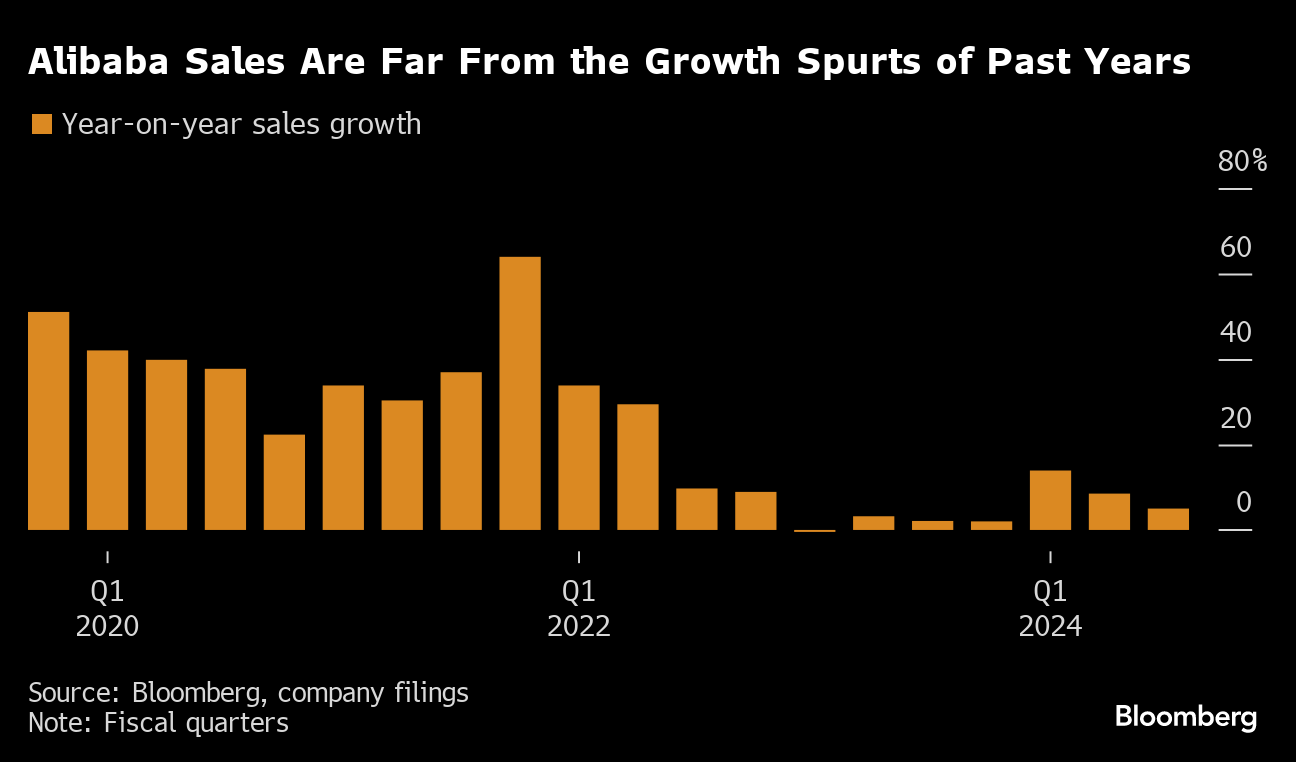
Alibaba is still grappling with fundamental questions surrounding the once-dominant internet company — a barometer of Chinese demand. Its performance underscored a loss of market share to rivals such as PDD and ByteDance Ltd. It posted a lower-than-projected 5% rise in December quarter revenue to 260.3 billion yuan ($36.2 billion), well off the pace of previous years. Net income fell 70%.
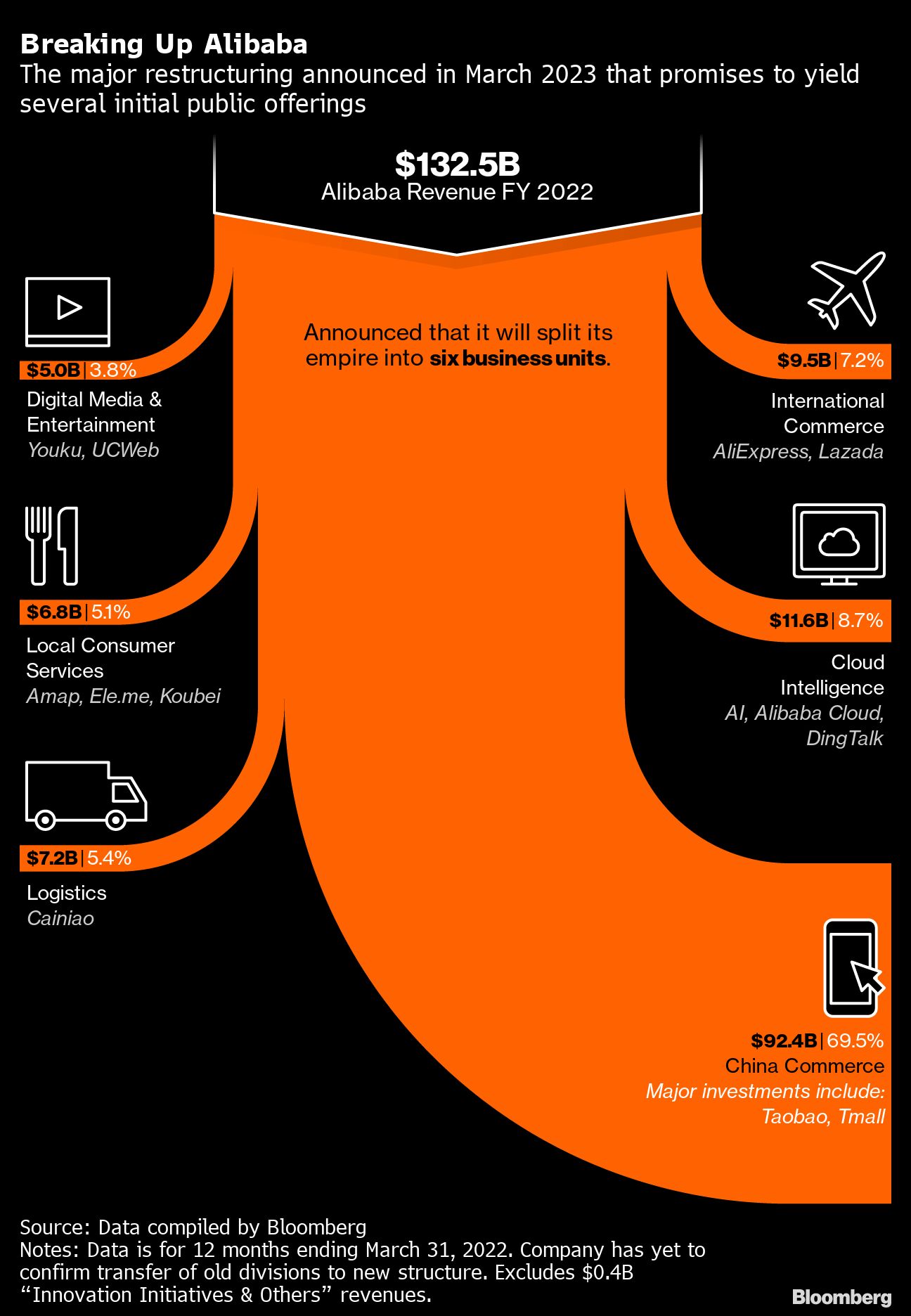
Fueling the uncertainty, the company is going through a complicated multi-way split intended to create several independent businesses and rejuvenate the national icon. The company last year outlined plans to float its Freshippo grocery chain and Cainiao logistics arm, but Chairman Joseph Tsai on Wednesday backed away from those plans because challenging market conditions would prevent it from reaping fair value for those businesses. Alibaba — which after years of frenetic investment now controls a vast portfolio of assets — is now actively looking to sell off some of those non-core holdings, he added. It's exploring ways to offload the InTime department store chain and other retail operations, Bloomberg News has reported.
“We have a number of traditional physical retail businesses on our balance sheet. And these are not our core focus. It will make sense for us to exit these businesses,” Tsai told analysts on a conference call. “This will take time given the challenging market conditions, but we'll continue to work on it.”
Alibaba is trying to stage a comeback from years of brutal government punishment and strategic missteps that cost the e-commerce operator its place as leader of the country's tech industry. Co-founder Jack Ma in November urged the company to correct its course.
It's going through a thorough retrenchment after its glory days. As it tries to sell off assets or spin off adjacent businesses, it will retreat to a much more modest strategy of focusing on its core e-commerce business and the cloud computing operation. Executives repeatedly stressed that dual focus on Wednesday's call.
“If you buy Alibaba stock, it's like you bought a 10-year Treasury bond with the upside of stock price appreciation,” Tsai said.
Click here for a liveblog of the numbers and conference call.
Chief Executive Officer Eddie Wu and Tsai, two of Ma's longest-standing confidantes, took the helm as former chief Daniel Zhang abruptly quit, and are now charged with effecting the multi-way split. The ultimate goal is to beat back upstarts like ByteDance's Douyin and PDD, while charting a new course for Alibaba to become a major player in artificial intelligence and the cloud.
That entails streamlining and big moves. Wu is promoting a younger cohort of executives to revive its core Taobao and Tmall platforms, while exploring ways to unload assets and dial back Zhang's years-long “new retail” ambition. At the same time, Alibaba must find an answer to Douyin, which has won shoppers over and grew sales faster during last year's Singles' Day shopping festival.
In addition to the latest buyback, Alibaba's executives pledged to aggressively return money to shareholders. They will target buying back 3% of outstanding stock every year — at a cost of roughly $12 billion annually. That will reduce the number of shares and push up the earnings per share.
“It's about buying time, as Alibaba figures out how to rejuvenate the core commerce business, and as it ramps up AIDC growth,” said Ivy Yang, founder of consultancy Wavelet Strategy and a former manager at Alibaba. “Especially after the news that the cloud business will not be spun out, investor confidence in the restructuring is shaken.”
Competition “is likely to continue to center on building market share at low prices,” Kenneth Fong, head of China internet research at UBS, said before the results. “Even if macroeconomic recovery occurs, price wars between platforms are likely to continue.”
What Bloomberg Intelligence Says
Alibaba's stronger-than-expected fiscal 3Q Taobao-Tmall Group margin, which slid 19 bps year over year vs. consensus for a drop of more than 2 percentage points, suggests the company won't sacrifice profit as it attempts to fend off e-commerce rivals in China this year. The unit's 3Q adjusted Ebita exceeded estimates by 2% even after a 3% revenue miss.
- Catherine Lim and Trini Tan, analysts
Click here for the research.
Alibaba is also keen to shore up its foothold in overseas markets. Units such as Lazada and Aliexpress underpin the global e-commerce operation, now among its fastest-growing divisions despite up-and-comers such as PDD's Temu and Shein.
As with most major tech firms, Alibaba counts AI among its longer-term priorities. It's developing its own ChatGPT-like services, while making multiple investments in startups such as Zhipu AI and Baichuan.
That AI effort has stuttered initially. Last year, Alibaba nixed the spinoff and IPO of its $11 billion cloud arm, surprising investors while citing US curbs that cut off access to Nvidia Corp.'s essential AI accelerator chips. It's unclear what steps executives plan to take to rejuvenate a business that once counted among its growth engines, but has lost market share to state-owned players in recent years.
“That's still in early testing but we see potential there,” Wu said on the call.
--With assistance from Vlad Savov, Sarah Zheng, Debby Wu and Peter Elstrom.
More stories like this are available on bloomberg.com
©2024 Bloomberg L.P.

-
Gold Is Rs 22,000 Cheaper Than A Month Ago. Should You Buy Amid The Wedding Season?

Gold's potential slide to $3,500 could save around Rs 4,700 per 10 grams, but a soft inflation print could just as easily push prices back up. One way to split the risk is to buy in parts, some now and the rest after the Fed's Dec. 9 decision.
-
AI Agents Are Gaining Power. Who Governs Them?
Artificial intelligence agents promise to transform productivity by moving machines from assisting decisions to executing them. But as organisations delegate greater authority to these AI-agents, they must first establish who controls that authority and who remains accountable when things go wrong.
-
Why Swapping Your Old Gold Can Trigger A Rs 5 Lakh Tax Bill, And How You Can Avoid It Legally
Swapping old gold for new is taxed as a sale and a fresh purchase. Getting your own gold remade can cut most of that bill, though it has its own costs.
-
The AI Trade is Done. The Real Opportunity for Investors Starts in 2027 | Unhedged Position
As pureplay AI stocks plunge and circular, capex-led financing unwinds, 2027 is set to be a year of reckoning for AI companies. Yet the bust clears the way for a better opportunity for investors in 2027 -- shifting the spotlight from AI builders to the companies using AI.
-
Leadership As Mission: Why The Age Of AI Demands More Human Leadership
Debjani Ghosh examines how AI is changing leadership, arguing that its success must be measured by its impact on people and the accountability of those guiding its use.
-
We May Need Another Tukaram Mundhe To Fight Air Pollution | The Reason Why
Developers may install basic measures such as sprinklers and green nets, resume work, and continue violating rules when this equipment stops working.
-
Extracting Value From Battery Scrap Could Be Challenging For India | The Reason Why
A discarded lithium-ion battery still contains valuable materials such as lithium, nickel and cobalt. These can be recovered and reused. When such batteries are crushed and shredded, they produce a dark powder called black mass.
-
One El Nino, India Can Handle. Two Could Break The Granary
India's grain stocks can absorb one bad year, but a second El Nino could drain the buffer in two to three years, economists say.
-
India's Troika Of Good Luck | Joining The Dots
As Jensen Huang's exit drags Nvidia down, a cooling AI trade and resilient earnings have revived investor interest in India. A likely RBI rate hike looms.
-
Talking Points This Week: Leadership Shock At Nvidia, Earnings Strength, And The Fog Over Hormuz
The Anthropic IPO pricing and first trading day, Nvidia's upcoming earnings, and any fresh signals from Iran will set the tone for the following week.









