A Return To State Debt Restructuring May Be A Non-Option

Tamil Nadu's new finance minister PTR Palanivel Thiagarajan may have knowingly or unknowingly brought to the fore an issue that has been simmering beneath the surface — a deterioration in state finances.
While split unequally across states, the burden of debt and interest costs is starting to tell on sub-national balance sheets. Covid-19 may have added to the problem but certainly didn't start it.
In a conversation with Quintillion Media's editorial director Sanjay Pugalia, PTR, as he has come to be known, spoke of the need to reduce the state's debt burden.
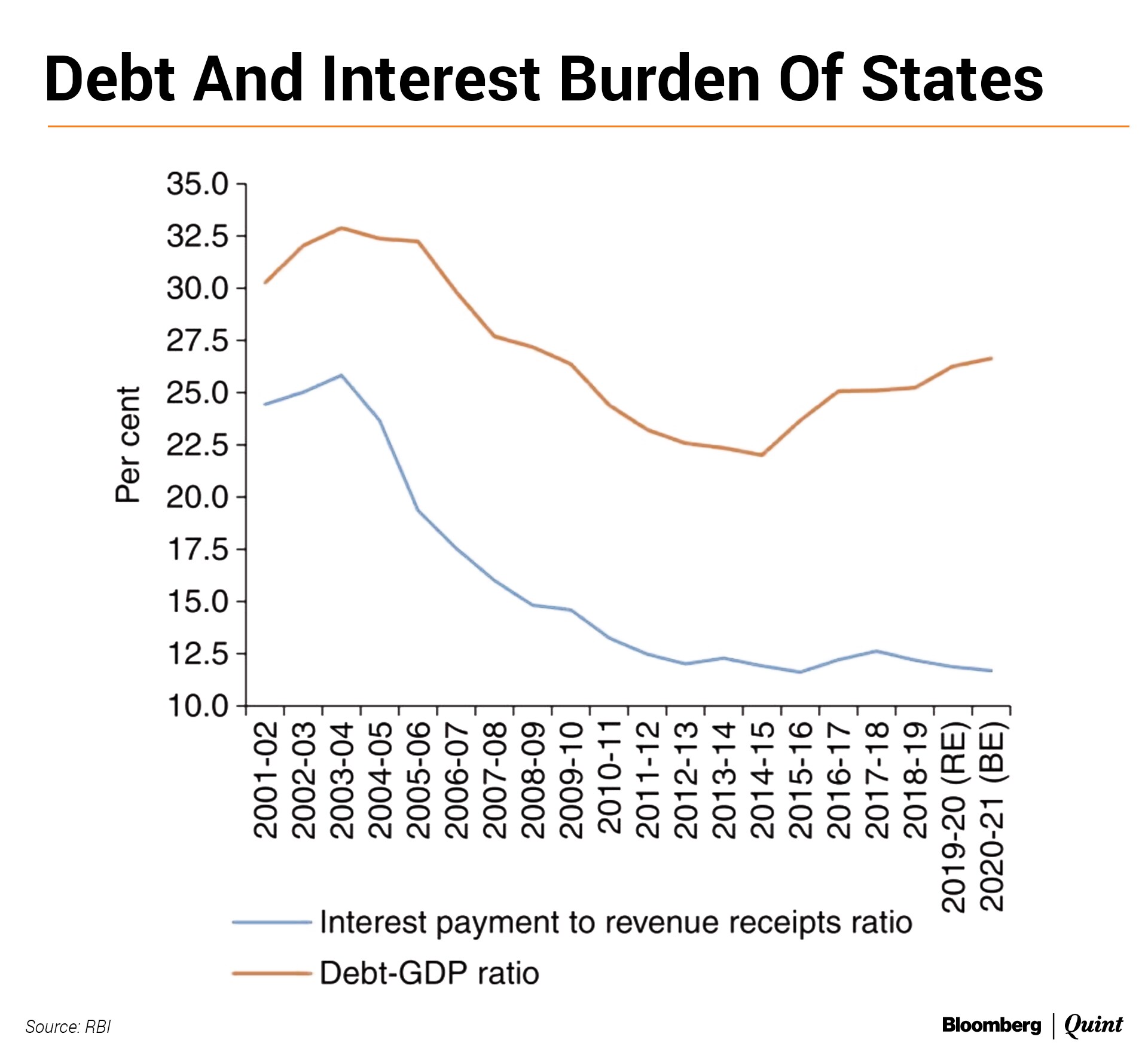
“We are at a point where the interest burden has become onerous. Let's start from the basics. The debt which used to be 16-17% of GDP has now shot to 26-27% of GSDP. It was already scraping 25% before Covid. The interest payments which were 11% of revenue have shot up to 20%,” he says. “It is unsustainable.”
A former banker of the vintage of Lehman Brothers and Standard Chartered, PTR believes it may be time to refinance or restructure debt in a way to bring down interest costs. The fact that the world is awash with liquidity should make it easier, he says. “We cannot pay 20% of revenue in interest. It leads to a vicious cycle.”
Committed expenditure—which includes interest costs, salaries and pensions—has steadily risen, prompting states to cut back on capital expenditure to meet their deficit goals. Eventually, the economy hurts.
Something has to give, and PTR believes this something is interest cost.
There is only two ways to do this, first is to refinance your loans at lower rates of interest. We are doing a lot of that. We can done that for the Tamil Nadu Electricity Board and affiliated entities. And we are talking to a lot of people to refinance state debt to bring the total interest burden down.PTR Palanivel Thiagarajan, Tamil Nadu Finance Minister
While, in the longer term, options such as asset sales can be used to bring down debt, in the near term, the interest cost burden can be reduced via “re-couponing”, he says. The state has to “restructure the interest payments and for that, if need be, restructure the debt”.
The History
PTR's thoughts lay down an intent. The execution is yet to be detailed. If any such restructuring were to go through, it would be a relatively rare but not a first.
In 2003-04, then Union Finance Minister Jaswant Singh had announced a “debt-swap” scheme for states.
“Out of the total stock of debt of Rs. 2,44,000 crore owed by the States to the Government of India, a little over Rs. 1,00,000 crore bear coupon rates in excess of 13% per annum, a rate that is far in excess of the current market rates,” Singh had said. “In consequence the interest burden of the States now constitutes a major item of expenditure for them; leaving little for even routine purposes.”
As part of the scheme, the central government allowed states to swap loans from the central government with borrowings from the country's pool of small savings and open market loans. As an aside, most states have now opted out of borrowings from the National Small Savings Fund because, in the present scheme of things, these borrowings cost more than open market borrowings.
Twenty-six of the 28 states had agreed to participate in the debt swap scheme at the time.
The 12th Finance Commission had taken this thinking further and suggested that the central government reschedule state debt over a 20-year period. It also suggested that a debt write-off scheme be put in place, where states that move towards reducing their revenue deficit be rewarded with a debt write-off of an equivalent amount.
The Commission had also pushed states towards direct market borrowings, which are now the norm.
When these recommendations were made, the consolidated debt-to-GSDP ratio of states was above 32% and the interest payments took up about a quarter of revenue receipts.
Different Problem? Different Times?
Fast forward about two decades and PTR's remarks raise the question – are we facing a problem similar to the early-2000s?
Before we get to that, it must be said that state finances have worsened for a number of reasons and the blame has to be shared by the states themselves as well as the centre. On the part of states, policies such as free or subsidised power, debt waivers and a focus on revenue expenditure has done damage. On the part of the centre, the UDAY power discom debt restructuring scheme led to additional burden for states. Recent borrowings to pay out GST compensation, while being accounted for on the books of states, will not impact the share of interest payments in state budgets since this money is to be repaid out of future cess collections.
While leaving a broader analysis on the reason for weakening state finances for another time, a look at the data tells us that the problem, and any likely solution, is different from the past.
First off, the interest burden is not yet as acute as it was back then. As the previous chart shows, on aggregate in FY20, net interest payments were at 11% of total revenue, according to the RBI's latest report on state finances.
Did the Covid crisis take that a notch higher? Aggregated data for FY21 and budget estimates for FY22 is not yet available. But you can judge the extent of impact by looking at the ten states which have the highest ratios of interest costs to revenue receipts. This data, detailed in the table below, suggests that after a rough year in FY21, states are expecting to move back to pre-Covid trajectories.
That's not to say we don't have a problem on hand at all.
While the interest burden on aggregate may be well below peaks, it is slowly turning unsustainable for at least some states.
So yes, some states, if not all, have a problem. But it will be tough to pin down a broad solution to the problem like in the past.
This is because 60% of state debt, or nearly Rs 39 lakh crore, is now in the form of market loans or state development loans. In 2004, only a fifth of state debt was market-linked. Back then, loans from the central government made up 21% of state liabilities, now they are at 3.3%. Direct bank or financial institution borrowings make up just 4.5% of state liabilities now.
Besides, the holding of state-issued market debt is also diverse. Banks and insurance companies hold a third each of this debt and provident funds about a fifth.
Restructuring or re-couponing such a large quantum of market debt, while theoretically possible, will be challenging task given that this debt will be held across a number of institutions.
You could buyback more expensive debt and replace it with cheaper borrowings if interest rates are low, but that would be a piecemeal effort dictated by the market‘s mood. A similar attempt by the central government to extend the maturity of borrowings has seen limited success.
Perhaps, PTR's past experience as a banker will come in handy in devising an innovative solution. But, for now, chipping away at the problem the long, hard way — cutting down on wasteful expenditure, selling assets, finding ways to improve revenue collections — seems a more likely solution.
The author would like to thank IDFC Institute's Niranjan Rajadhyaksha and @athreya49 for an online chat which sparked the idea for this column.
Ira Dugal is Executive Editor at BloombergQuint.

-
AI Bias In Investing Cannot Be Eliminated, But It Can Be Governed

Framing is a particularly important example as identical financial information presented in terms of gains rather than losses can lead an LLM to reach a different assessment.
-
Joining The Dots | Dark Skies, Steady Diya: Why Hope Holds This Diwali
With war, a weak rupee and foreign outflows weighing on sentiment, policymakers at the NDTV World Summit and market veterans at NDTV Profit Ignite: Diwali Edition offered the same advice: stay invested and filter out the noise.
-
The Curious Case of Equitas Small Finance Bank And A CEO Who Quit For Stock
PN Vasudevan believes persistent investor concerns over a perceived conflict of interest had become a governance overhang on Equitas Small Finance Bank's stock, even as the lender improved profitability and asset quality.
-
Talking Points This Week: AI Cash Burn, A Tiger Comeback And An India That Still Finds Its Own Path
India is not immune to higher oil or tighter global liquidity, yet its earnings base is broader, its domestic policy levers are still available.
-
Foreign Investors Own Half Of HDFC Bank and ICICI Bank. An LTCG Cut Could Matter Most Here
Foreign portfolio investors have US$115 billion parked in HDFC Bank, ICICI Bank. If the government cuts long-term capital gains tax, Jefferies says returning foreign money could land here first.
-
'Never Seen This Level Of Negativity': Sandeep Tandon Says The Next Rally May Be Closer Than You Think
Veteran investor Sandeep Tandon says foreign selling is easing, large-caps are due a comeback and mid-caps are crowded, while he turns positive on gold, power and pharma this Diwali.
-
Indians Stay With Family, Not In Hotels | The Reason Why
India still lacks enough clean, reliable and affordable hotels for budget-conscious travellers.
-
The Economic Imperative: Analysing The Material Driving Force Behind India-Canada Strategic Reset
This economic complementarity is further reinforced by deep institutional investment ties and talent mobility, which form the bedrock of the bilateral framework.
-
Medicine Pricing: Where Must Profit Stop?
India must confront excessive margins, hidden incentives and regulatory gaps that threaten the integrity of medicine.
-
Why Amazon And Flipkart Are Struggling To Beat Meesho In India's Smaller Cities
With 274 million users and lowest-cost logistics, Meesho is defending its value commerce crown against giants like Amazon and Flipkart.










