Bihar's Poll-Time Paradox: Home To Industry Giants, But No Major Factories Of Its Own
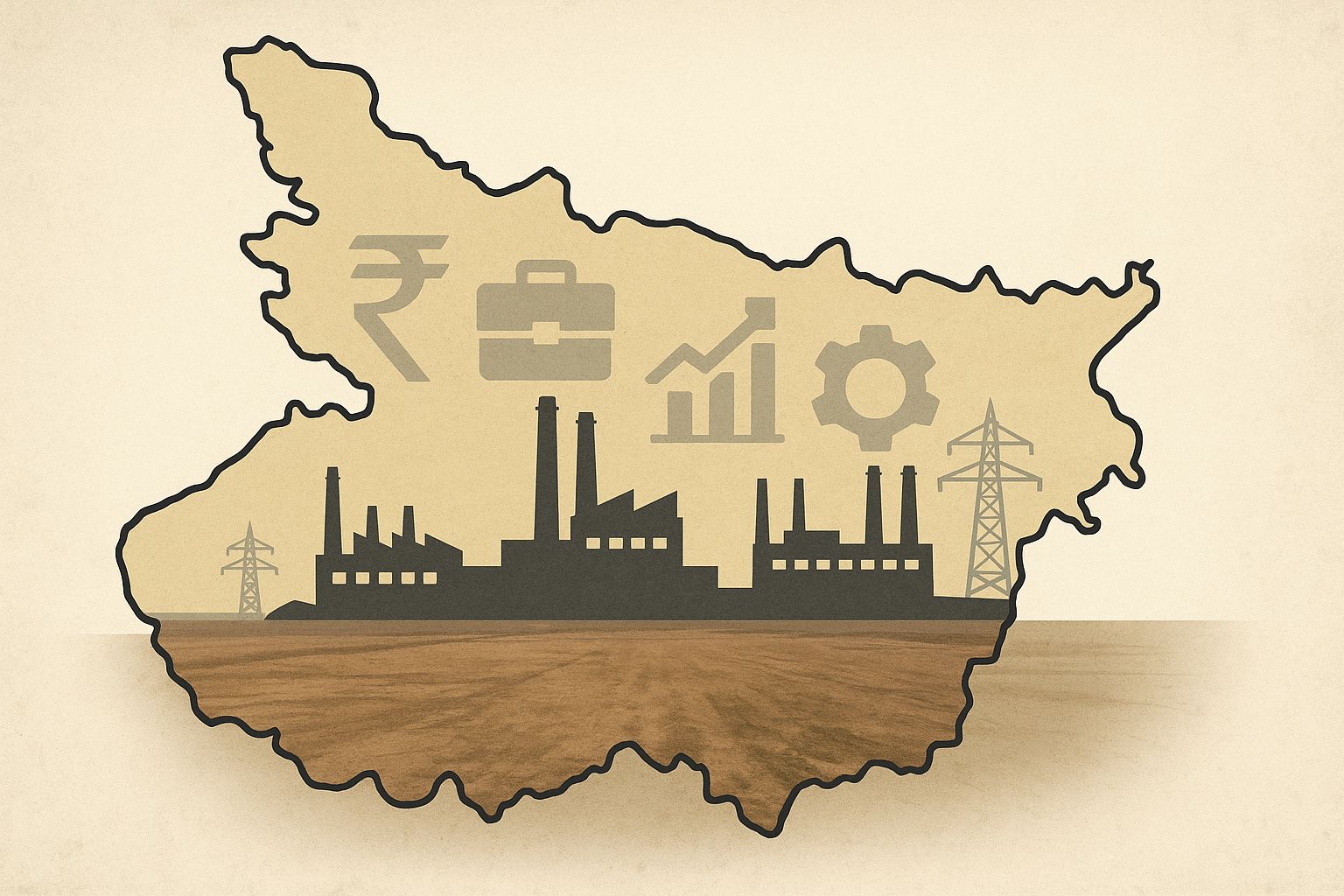
Bihar, India's third most populous state, is powering ahead on the growth charts but remains hollow on the industrial front. Manufacturing accounts for barely 5% to 6% of its GDP, a surprisingly low share for a state with such scale and enterprise.
Despite its size, Bihar does not have a single major listed manufacturing company. The lone outlier, Aditya Vision — a Patna-based retail chain — stands as an isolated example in an otherwise empty corporate landscape.
The irony is hard to miss. The state has produced some of India's most prominent names in business — from Vedanta's Anil Agrawal to Alkem's Sampada Singh — yet their factories and operations are rooted far from Bihar.
Economists and industry experts trace this industrial silence to decades of poor policy consistency, unreliable power, and a broken land and logistics system that turn away investors. The state's entrepreneurs have never been short on ambition, but the enabling architecture has lagged far behind.
"Bihar has only two listed companies on stock exchanges, reflecting its history rather than its entrepreneurial capability. Traditionally, Bihar's entrepreneurs-built assets rather than brands, often incorporating their firms in Delhi, Kolkata, or Mumbai for better market access and regulatory advantages," said Gaurav Sah, Chair of CII Bihar. He added that the industry is now witnessing reverse flow of confidence where local investors and entrepreneurs are returning, establishing businesses in the state, and tapping public markets.
Even so, Bihar is among India's top ten states for retail market participation, outpacing several more industrially advanced regions. According to latest BSE data, as of Oct. 28, 2025, Bihar has nearly 9.95 million registered clients participating in the stock market. This represents a 1.71% increase over the previous month, a 4.92% increase over the previous quarter, and a substantial 23.53% increase compared to the previous year, showing strong and growing investor participation.
The industry is pinning its hope on new generation who is digitally savvy, capital-aware, and creating investor-ready, brand-conscious enterprises. "In the coming years, as transparency and governance improve, more Bihar-based companies are expected to go public, showcasing the state's growth on national exchanges, Sah underlined.
Industry experts are of the view that Policy support is also beginning to take hold. The state's Industrial Investment Promotion Policy and new plug-and-play parks under BIADA are cutting red tape and offering easier land access. Focus sectors like agro-processing, food, textiles, ethanol, and renewables are shaping what some call a distinctly “Bihar brand” of manufacturing.
The government's Industrial Investment Promotion Package 2025 adds further incentives — tax breaks, capital subsidies, and fast-track land allotments. Early momentum in garments and food processing shows promise, but the challenge lies in execution.
As the state heads for elections, industrial policy is set to take center stage. Voters and investors alike will be watching whether Bihar can turn its economic paradox into real production strength. If it succeeds, the state could finally shed its image as an industrial afterthought and emerge as the East's most unexpected growth story.

-
The Economic Imperative: Analysing The Material Driving Force Behind India-Canada Strategic Reset

This economic complementarity is further reinforced by deep institutional investment ties and talent mobility, which form the bedrock of the bilateral framework.
-
Medicine Pricing: Where Must Profit Stop?
India must confront excessive margins, hidden incentives and regulatory gaps that threaten the integrity of medicine.
-
Why Amazon And Flipkart Are Struggling To Beat Meesho In India's Smaller Cities
With 274 million users and lowest-cost logistics, Meesho is defending its value commerce crown against giants like Amazon and Flipkart.
-
High US Salaries, No Green Card Certainty: The Financial Calculation Facing Indian H-1B Families
The suspension of PERM processing at eight technology employers does not cancel existing H-1B visas. What it does is force a question many Indian families have been avoiding: is the US salary worth tying your career and family plans to one employer?
-
Swiggy vs Eternal: Food Delivery's Two Rivals Are No Longer In The Same Race
Eternal is building a private AI assistant, dark.ai. Swiggy is still working out how to make Instamart pay, with an operating loss of Rs 895 crore in the July-September quarter while Blinkit stayed profitable.
-
Where You Live Shapes How You Get To Work | The Reason Why
Two-wheelers are the most popular way to get to work in India, accounting for nearly 43% of workplace commutes.
-
Unhedged Position: Can India See An Indonesia-Style Time Correction?
The Nifty is trading below levels it first clocked in 2024. Is there, then, as I have suggested in the headline, potential that the current time correction drags on painfully for the next three-five, even ten years?
-
Navigating Friction And Energy Realities: An Analysis Of Marco Rubio's October Visit To India
Occurring at a critical juncture marked by stalled trade negotiations and escalating geopolitical pressures over global energy supplies, the visit offers a profound window into modern US-India relations.
-
India Exports Capital. Why Not Export Trusteeship?
The big question, then, is whether India can build an institution that global borrowers, investors, banks, and lawyers can trust, even without an Indian connection.
-
France's Economy & Politics Are In Crisis | The Reason Why
Let's look at how the French economy and politics evolved under Nicolas Sarkozy, Franois Hollande and Emmanuel Macron.










