Xi’s Covid Policy Crosses a Line With Invasive Home Disinfection
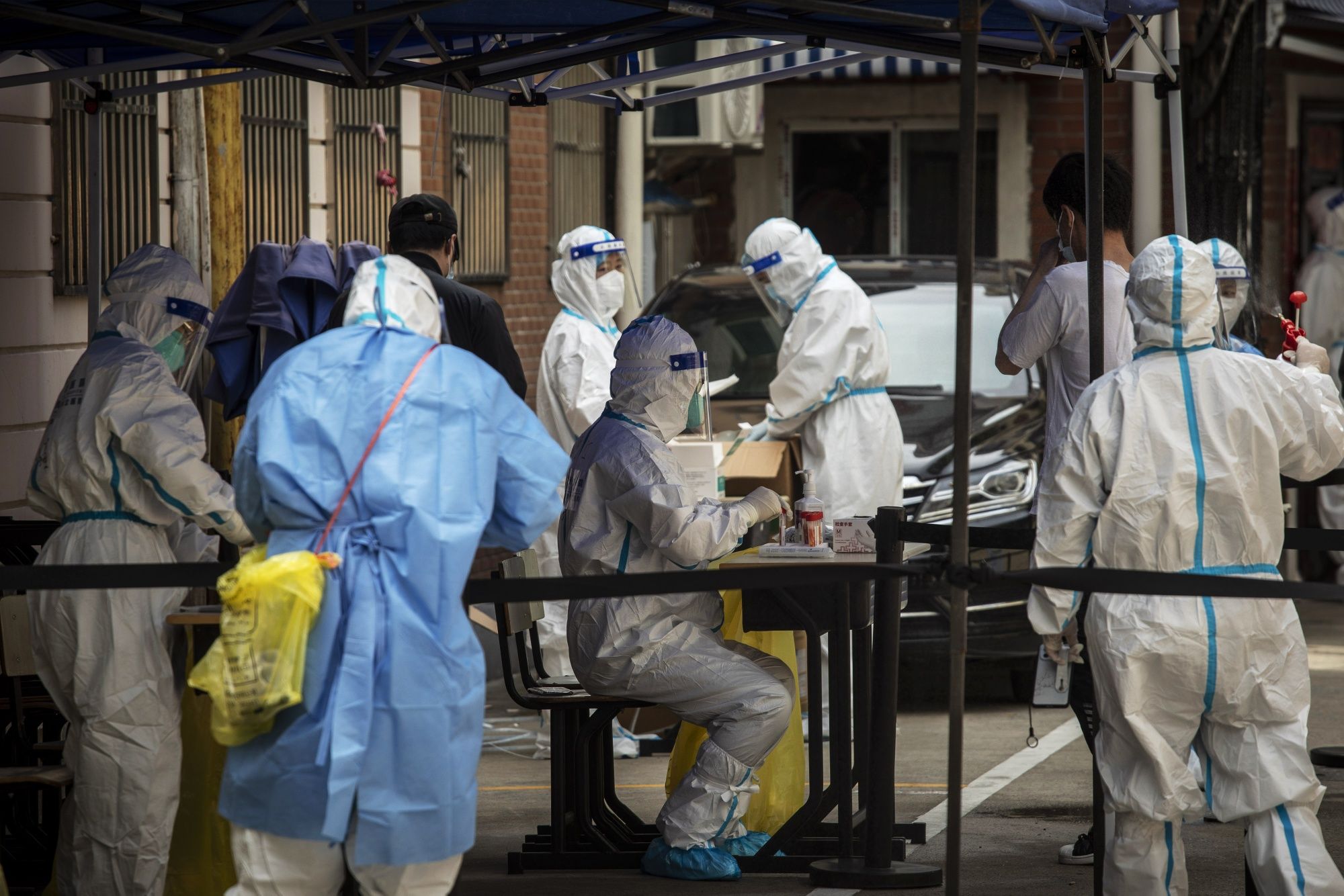
(Bloomberg) -- President Xi Jinping's punishing Covid Zero policy has angered Chinese citizens by invading the one place they've retained some small bit of privacy: their homes.
A video of “Big White” hazmat pandemic enforcers dousing disinfectant over an apartment in the eastern Chinese city of Xuzhou — even emptying the refrigerator for sterilization — sparked outrage on China's Twitter-like Weibo. The clip was shared 50,000 times and clocked 10 million views before being censored.
“Home is the last frontier for the Chinese,” a blogger who goes by the name West Slope wrote afterward, in an essay viewed 100,000 times on messaging app WeChat. “Videos of unruly household invasions break the last psychological line of defense for many.”
READ MORE: Anger Erupts at Xi's ‘Big White' Army of Lockdown Enforcers
China has some of the world's harshest anti-epidemic controls. In Shanghai, authorities put its 25 million residents under lockdown for nearly two months, erecting metal barriers outside residential compounds, as the city tried with military precision to achieve zero infections in the community.

Disinfecting the home and clothes of any confirmed case is a key part of that strategy, Shanghai officials confirmed May 10. But even citizens used to near-constant surveillance online and in public by closed circuit cameras have questioned the legality and scientific value of the practice. Not only might it damage private property, they say, but it's also an unusual violation of personal space.
China's Covid Zero strategy is hitting waves of resistance as the rest of the world reopens. Shanghai residents have pushed back against food shortages in lockdown and the isolation of all cases and close contacts in government quarantine. Students at Beijing's prestigious Peking University earlier this month protested pandemic prevention measures on campus.
That unrest comes in a pivotal political year in which Xi had instructed the ruling Communist Party to maintain stability as he prepares to clinch a landmark third term in office. Instead, Covid Zero is devastating the economy, leading to speculation there are divergent views within his government.
“If the procedures continue to be inadequately handled, the discontent could spread and lead to doubts about Xi's leadership at a sensitive time,” said Chen Shih-Min, an associate political science professor at National Taiwan University.
“Party cadres including Shanghai chief Li Qiang are probably aware and trying to tame the practice,” he added. “But as with all policies, there are bound to be slips in execution.”
READ MORE: Video Shows Beijing College Students Protesting Covid Curbs

Home sterilizations have drawn comparisons with the practice of ransacking private property during the Cultural Revolution, a decade of political and social chaos driven by Mao Zedong's desire for complete control — a period that Chinese internet users euphemistically refer to as “those 10 years.”
“Have those 10 years started again without us noticing? Or will this one last more than 10 years?” one user wrote.
“If the dynamic clearance lasts for 10 years, then you probably can understand our father generation's feelings in those 10 years,” another wrote. “In fact, the misfortunes they experienced were not limited to those 10 years — they lasted a lifetime.”
In a Weibo post with 32,000 shares, fantasy novelist Dun Huang cited anxiety felt by the older generation around the destruction of artwork, a target of the Cultural Revolution.
“Many people's life's work and emotions are in these books and paintings,” he wrote. “If these things were indiscriminately sprayed with disinfectant, once, twice or even three times, just imagine — someone could have a heart attack. And that's something that could really happen and would really kill them.”
While Chinese people have drawn historical parallels to darker times for centuries, there are parallels between some Mao-era campaigns and current problems arising from Xi's Covid Zero policy, said Tuvia Gering, a research fellow at the Jerusalem Institute for Strategy and Security.
Locked-down people going hungry due to a lack of food distribution had faint echoes of the Great Leap Forward, while the sporadic culling of pets by health workers recalled the “Four Pests” campaign that eliminated millions of sparrows.
READ MORE: Xi in a Bind Over Who to Blame for Shanghai's Covid Outbreak
“It's a case of disinfect everything, even if it doesn't make sense from a public health perspective,” Gering said.

Adam Ni, the Shanghai-born publisher of the China Neican newsletter on politics, said analogies to Mao-era campaigns were extreme but represented a fundamental concern among Chinese people over how the guiding principles of the top leadership are changing.
“In the reform and opening era, the Communist Party loosened its grip on the private lives of the Chinese people and the focus was on economic development,” he said. “But under Xi, the trend has gone the other way: the Party-state has tightened control over many aspects of Chinese society.”
“Many Chinese see Beijing's stringent Covid measures in light of this regression,” he added.
Since taking power a decade ago, the leader of the world's second-largest economy has led China into a new era of personality-driven rule, incorporating “Xi Jinping Thought” into the constitution and holding so many titles he's been called the Chairman of Everything. His bid at a leadership congress later this year to become the first leader since Mao to rule for more than two terms only stands to strengthen his grip on society.
Still, various local districts have responded to the pushback over wantonly sterilizing people's homes. The Shanghai Municipal Health Commission said in a statement that cooperation has to be obtained before entering a property and that home disinfection is an important virus-control step.
READ MORE: China's Economic Activity Collapses Under Xi's Covid Zero Policy

“Disinfection of the homes of those infected with the new coronavirus is agreed upon, but the implementation should be meticulous and steady, not undifferentiated and crude,” the Swordsman Island, an overseas media channel run by Communist Party mouthpiece the People's Daily, wrote in an editorial responding to the Xuzhou video.
But in Dandong, a city bordering North Korea, authorities said the home must be disinfected even if the resident is absent because the virus can linger. If the apartment cannot be entered easily, they said, technicians will pick the lock.
Blogger West Slope summed up why that policy had left such a bad taste in people's mouths.
“We can choose not to go to a park that is full of litter,” he wrote. “We can choose to avoid walking through places where people spit. We can choose not to read about injustices online. But you can always comfort yourself with this: I still have a home.”
More stories like this are available on bloomberg.com
©2022 Bloomberg L.P.

-
The Curious Case of Equitas Small Finance Bank And A CEO Who Quit For Stock

PN Vasudevan believes persistent investor concerns over a perceived conflict of interest had become a governance overhang on Equitas Small Finance Bank's stock, even as the lender improved profitability and asset quality.
-
Talking Points This Week: AI Cash Burn, A Tiger Comeback And An India That Still Finds Its Own Path
India is not immune to higher oil or tighter global liquidity, yet its earnings base is broader, its domestic policy levers are still available.
-
Foreign Investors Own Half Of HDFC Bank and ICICI Bank. An LTCG Cut Could Matter Most Here
Foreign portfolio investors have US$115 billion parked in HDFC Bank, ICICI Bank. If the government cuts long-term capital gains tax, Jefferies says returning foreign money could land here first.
-
'Never Seen This Level Of Negativity': Sandeep Tandon Says The Next Rally May Be Closer Than You Think
Veteran investor Sandeep Tandon says foreign selling is easing, large-caps are due a comeback and mid-caps are crowded, while he turns positive on gold, power and pharma this Diwali.
-
Indians Stay With Family, Not In Hotels | The Reason Why
India still lacks enough clean, reliable and affordable hotels for budget-conscious travellers.
-
The Economic Imperative: Analysing The Material Driving Force Behind India-Canada Strategic Reset
This economic complementarity is further reinforced by deep institutional investment ties and talent mobility, which form the bedrock of the bilateral framework.
-
Medicine Pricing: Where Must Profit Stop?
India must confront excessive margins, hidden incentives and regulatory gaps that threaten the integrity of medicine.
-
Why Amazon And Flipkart Are Struggling To Beat Meesho In India's Smaller Cities
With 274 million users and lowest-cost logistics, Meesho is defending its value commerce crown against giants like Amazon and Flipkart.
-
High US Salaries, No Green Card Certainty: The Financial Calculation Facing Indian H-1B Families
The suspension of PERM processing at eight technology employers does not cancel existing H-1B visas. What it does is force a question many Indian families have been avoiding: is the US salary worth tying your career and family plans to one employer?
-
Swiggy vs Eternal: Food Delivery's Two Rivals Are No Longer In The Same Race
Eternal is building a private AI assistant, dark.ai. Swiggy is still working out how to make Instamart pay, with an operating loss of Rs 895 crore in the July-September quarter while Blinkit stayed profitable.










