China Injects $50 Billion Into Policy Banks In Stimulus Push
(Bloomberg) -- The People's Bank of China injected nearly $50 billion worth of low-cost funds into policy-oriented banks last month, suggesting the central bank may be ramping up financing for housing and infrastructure projects to support the economy.
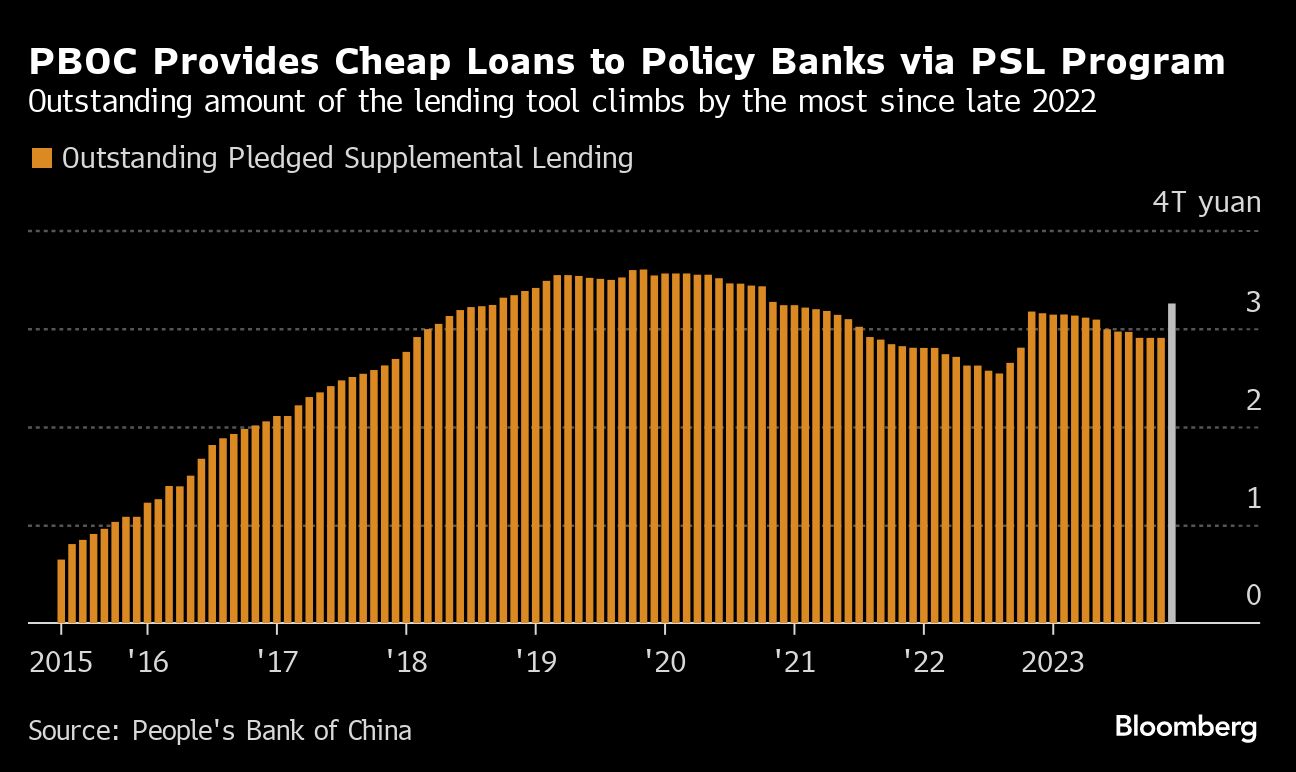
The outstanding amount of the PBOC's Pledged Supplemental Lending program to policy banks climbed to 3.25 trillion yuan ($456 billion) at the end of December from 2.9 trillion yuan in the previous month, the central bank said in a Tuesday statement. The net injection of 350 billion yuan was the largest increase via the tool since November 2022.
The PSL program is seen as an important tool in Beijing's arsenal, which the government can use to shore up the property sector and stabilize growth this year. Markets have been expecting the central bank to use the money to drive construction of public housing in a bid to alleviate a multi-year property slump that's hammered consumer confidence.

Bloomberg News reported in November that policymakers were planning to provide 1 trillion yuan in low-cost central bank funding in phases to help programs focused on affordable housing and the renovation of urban villages. Officials were considering using the PSL program or special loans.
“The PSL program is the most direct and efficient way to transmit funds to the economy,” said Xing Zhaopeng, senior China strategist at Australia & New Zealand Banking Group Ltd. “It will be significant to the economy if its size can expand” from the reported 1 trillion yuan, he said.
The use of PSL may replace some other forms of stimulus, according to Xing. He sees a “very slim” chance of a cut to banks' reserve requirement ratio by the PBOC in the first quarter due to ample injections via PSL and one-year policy loans.
He also predicts an official budget deficit of only 3% for this year — lower than market expectations of above 3.5%. The PSL funds can be seen as “quasi-fiscal” spending off the government's official budget, Xing added.
The PSL tool has a controversial history. It was last used heavily between 2014 and 2019 for the rebuilding of shantytowns, as it helped halt a property slump but at the same time inflated home price bubbles. Some economists called it “helicopter money” or “Chinese-style quantitative easing” back then.
The program was again briefly used at the end of 2022 to help policy banks like China Development Bank provide funding to infrastructure projects, which totaled 740 billion yuan and drove even more investment. The PBOC provided about 500 billion yuan in PSL loans over the last three months of 2022.
China Development Bank — one of the policy banks, which are driven by government priorities more than profits — extended a loan to an affordable housing construction project in the southeastern province of Fujian last month. The lender issued a 10 million yuan loan to support the construction of a 700-unit project, and committed an overall credit line of 202 million yuan, according to local media reports.
The interest rate on the PSL loans was 2.4% at the end of September, lower than the one-year policy rate and the benchmark lending rate of banks.
(Updates with analyst comment and additional details.)
More stories like this are available on bloomberg.com
©2024 Bloomberg L.P.

-
Getting To Work Costs Women More | The Reason Why

It is not just about women paying more than men. It is about women paying much more in cities than in villages.
-
AI Bias In Investing Cannot Be Eliminated, But It Can Be Governed
Framing is a particularly important example as identical financial information presented in terms of gains rather than losses can lead an LLM to reach a different assessment.
-
Joining The Dots | Dark Skies, Steady Diya: Why Hope Holds This Diwali
With war, a weak rupee and foreign outflows weighing on sentiment, policymakers at the NDTV World Summit and market veterans at NDTV Profit Ignite: Diwali Edition offered the same advice: stay invested and filter out the noise.
-
The Curious Case of Equitas Small Finance Bank And A CEO Who Quit For Stock
PN Vasudevan believes persistent investor concerns over a perceived conflict of interest had become a governance overhang on Equitas Small Finance Bank's stock, even as the lender improved profitability and asset quality.
-
Talking Points This Week: AI Cash Burn, A Tiger Comeback And An India That Still Finds Its Own Path
India is not immune to higher oil or tighter global liquidity, yet its earnings base is broader, its domestic policy levers are still available.
-
Foreign Investors Own Half Of HDFC Bank and ICICI Bank. An LTCG Cut Could Matter Most Here
Foreign portfolio investors have US$115 billion parked in HDFC Bank, ICICI Bank. If the government cuts long-term capital gains tax, Jefferies says returning foreign money could land here first.
-
'Never Seen This Level Of Negativity': Sandeep Tandon Says The Next Rally May Be Closer Than You Think
Veteran investor Sandeep Tandon says foreign selling is easing, large-caps are due a comeback and mid-caps are crowded, while he turns positive on gold, power and pharma this Diwali.
-
Indians Stay With Family, Not In Hotels | The Reason Why
India still lacks enough clean, reliable and affordable hotels for budget-conscious travellers.
-
The Economic Imperative: Analysing The Material Driving Force Behind India-Canada Strategic Reset
This economic complementarity is further reinforced by deep institutional investment ties and talent mobility, which form the bedrock of the bilateral framework.
-
Medicine Pricing: Where Must Profit Stop?
India must confront excessive margins, hidden incentives and regulatory gaps that threaten the integrity of medicine.










