Yum's China Rebound Dimmed by India, Pizza Hut Weakness
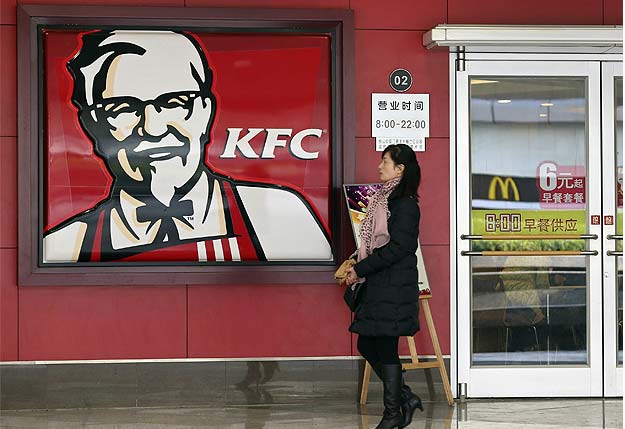
Yum Brands Inc. on Wednesday said its KFC business bounced back in China, its No. 1 market, but its stock fell more than 2 per cent in extended-hours trading on disappointing quarterly results from its India, Taco Bell and Pizza Hut divisions.
Yum's sales at established restaurants in China increased 15 per cent in the second quarter, including a 21 per cent jump at KFC and flat results at Pizza Hut Casual Dining.
Analysts polled by Consensus Metrix had forecast that Yum's China sales would climb 11.4 per cent.
An avian flu outbreak and a food-safety scare last year battered Yum's restaurant results in China, which contributes more than half of the company's overall sales. Yum's China division same-restaurant sales tumbled 20 per cent in the second quarter last year.
Yum recently revamped its KFC China product lineup to attract more diners.
Yum's China Division, which had 6,387 mostly KFC restaurants at the end of the second quarter, contributed 35 per cent of the company's total operating profit last year.
The India division's same-restaurant sales fell 2 per cent, versus the 1.6 per cent gain that analysts expected.
Yum is not alone. Jubilant Foodworks Ltd, which operates Domino's Pizza Inc restaurants in India, saw same-store sales growth slow sharply to 1.6 per cent in the fiscal year that ended March 31 from 16.2 per cent a year ago.
Jubilant blamed the slowdown on the "overall strenuous macro-economic situation" and a drop in discretionary spending.
The company has yet to report its June-quarter earnings, but analysts say growth in the fast food sector as a whole is unlikely to pick up before at least another nine months as India's newly elected government tries to kick start an economy that is battling the longest spell of below 5 per cent growth in quarter of a century.
"Consumer sentiment has not shown any signs of improvement," said Saloni Nangia, president at retail consultancy Technopak.
"The expectations were that post-elections it will improve but that hasn't happened," she added. Prime Minister Narendra Modi won May elections with a pledge to revive Asia's third-largest economy.
Fast food in India is largely a middle-class luxury. Both Yum and Jubliant are rapidly expanding their store network, anticipating an increase in the number of more affluent Indians in the next few years. The fast food restaurant market is set to triple in 2018 from $1 billion last year, Technopak said.
Yum has been in India for more than a decade. It had 714 total units in the country at the end of the second quarter, including KFC, Pizza Hut and Taco Bell restaurants.
India is a competitive environment and Yum is "investing aggressively" in that market, spokesman Jonathan Blum told Reuters.
Same-restaurant sales were up 2 per cent for Taco Bell and down 3 per cent for Pizza Hut. Analysts polled by Consensus Metrix expected a 3.6 per cent gain for Taco Bell and a 0.1 per cent rise for Pizza Hut.
Chief executive officer David Novak said the company was pleased with initial results from Taco Bell's breakfast launch in the United States, adding that it was working to improve results at Pizza Hut.
"We are taking significant actions in our US (Pizza Hut) business to reignite sales and expect to make substantial progress" for the rest of the year, Novak said in a statement.
Louisville, Kentucky-based Yum also reported net income of $334 million, or 73 cents per share, for the second quarter that ended June 14, compared with $281 million, or 61 cents per share, a year earlier.
The company, which will hold a conference call with financial analysts on Thursday morning, said it is on its way to hitting its forecast of full-year earnings-per-share growth of at least 20 per cent.
Yum's stock fell 2.3 per cent to $80.81 in after-hours trading on Wednesday, but it remains near its 52-week high.
Copyright: Thomson Reuters 2014

-
Signature Play: The Classic Cocktail Is Dead. Or Is It?

Classic cocktails are disappearing from India's cocktail menus. But they're still being ordered, taught to bartenders and borrowed from. So, who's really having the last drink?
-
A New Samvat Wishlist: Inclusive Prosperity And Human Development
India has strengthened its economic foundations through infrastructure, digital access and enterprise. Its next growth chapter must deepen productivity, create better livelihoods and widen participation in prosperity.
-
Love, Sex Aur Dhokha: The Audacious Plot To Spy On Jensen Huang
A Taipei dinner, a Singapore chip buyer and a suspected Chinese asset: inside the alleged spy operation that got close to NVIDIA's Jensen Huang.
-
Ten Things I Learnt This Samvat
Patience can be a trap. Cheap stocks can stay cheap. Leverage can wipe you out. What did Samvat 2082 teach us? Niraj Shah writes on 10 lessons from the year gone by.
-
Talking Points This Week: Tech Nerves, FII Buying, And A Faraway Banking Shock
The global markets are not shining this Diwali. The exception in the large markets is, India.
-
Midterm Rally Lasted A Day. The Hard Reality Of A Divided US May Last Two Years | Opinion
Between a contested AI boom, a debt ceiling that arrives in 2027 and a president with every incentive to act alone, the next two years may prove more volatile than the first day's rally suggests.
-
Blue Wave Will Derail the AI Trade but Won't Dismantle the AI Era | Unhedged Position
The Democrats' sweep of the US Congress will see politics collide with economic forces both over the long and short term.
-
It's Time To Take The GST Council's Bet On Trust Global
Payment records can prove India's services exports, and clear, proportionate rules can bring foreign digital sellers into the tax net.
-
Opinion | India at 38: From Innovation Overperformer to Innovation Powerhouse
India now has 453 VC-backed deep science startups, 18 of them late-stage, after 117 percent growth since 2020. Laurus Labs, at USD 9.3 billion, is the most valuable deep science company in any middle-income economy outside China.









