Youngest Female Leader Blazes Trail for Women With Baby Due
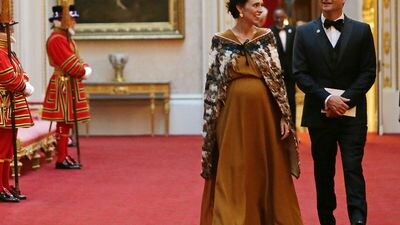
(Bloomberg) -- When New Zealand Prime Minister Jacinda Ardern gives birth to her first child in coming days, she'll be showing the world that women don't need to sacrifice their careers to become mothers.
The 37-year-old isn't stopping at symbolism. Behind the scenes her government is forging ahead with plans to change the way women are treated in society, including an ambitious goal to eliminate the gender pay gap.
“We were the first country where women fought for and won the right to vote, so I don't see any reason why we shouldn't continue to be a leader,” Minister for Women Julie Anne Genter said in an interview. “The new government has demonstrated a real commitment to prioritizing gender equality because it's the right thing to do.”
With her baby due on June 17, Ardern will become just the second world leader to give birth in office after former Pakistan Prime Minister Benazir Bhutto. Because Ardern's partner, television fishing show host Clarke Gayford, can stay at home to care for their child, she intends to return to work in six weeks.
That's much sooner than most women in New Zealand, where only 61 percent are back at work within 12 months of giving birth. Furthermore, women on average take a 4.4 percent pay cut when they become parents while men see little change in their salaries, according to a study published by the Motu economic and public policy research institute last month.
‘Ethically Indefensible'
“It's ethically indefensible to pay people less simply because of gender discrimination,” said Genter, 38, who is also pregnant and expecting her first child in August. “Addressing flexible working arrangements is critical to making sure that there aren't barriers to women, particularly when they have family duties.”
While New Zealand's gender pay gap has narrowed to 9.4 percent from 16.2 percent in 1998, progress on closing it has stalled in the past decade. The country ranked ninth out of 144 countries in the World Economic Forum's Global Gender Gap Report for 2017, which measures progress toward gender parity, but has fallen from fifth in 2009.
Genter's Ministry for Women has developed a roadmap for closing the gap in the public sector by the end of 2021. The goal is not only to eliminate the gap between like-for-like jobs, but also to get more women into higher-paying jobs. While the plan hasn't been published yet, she indicated likely measures include:
- Making jobs more flexible for working parents
- Involving workers on parental leave in remuneration rounds so they don't fall behind
- Addressing unconscious bias through training
- Shortlisting more women for senior roles
- Closing the gap between starting salaries in like-for-like jobs within a year
She has her work cut out.
The gender pay gap in the public service, which employs 47,000 people, currently stands at 12.5 percent, even though 60 percent of civil servants are women and nearly half of the 31 government departments are led by women.
‘More Clarke Gayfords'
Equal Employment Opportunities Commissioner Jackie Blue said part of the battle is to change gender stereotypes, such as the negative ones associated with working mothers or men who take the primary childcare role. In that respect, Ardern and Gayford were sending an important signal.
“Of course we need more Jacinda Arderns as role models to our younger women, but we absolutely need more Clarke Gayfords stating loudly and proudly that they will take on the major caring role,” Blue said. “We need to change parenthood from a low status job to one that is important and meaningful.”
Since coming to power in October, Genter said the government has made several changes that should help to close the pay gap.
These included raising the minimum wage because the majority of people on it were women, backing pay equity settlements for industries dominated by women and legislating to extend paid parental leave from 18 weeks currently to 22 weeks from July and 26 weeks from July 2020.
The government on Friday set a minimum wage for the lowest-paid public servants that it said would affect roles mostly occupied by women.
Private Sector
Genter said the government is also “actively investigating” requiring private sector companies to measure and publish their pay gaps, a policy already adopted by Australia and the U.K.
New Zealand companies don't stack up favorably when it comes to female representation on boards, with stock exchange operator NZX finding only 19 percent of directors at listed companies are women. That compares with 30 percent for firms in Australia's ASX 100 index.
“If we don't have diversity and gender balance on boards, we're less likely to have it in CEOs and senior managers, and then they're less likely to pursue policies that would close the gender pay gap,” Genter said.
A prime minister and a minister having children at the same time was “probably quite useful symbolically” and “hopefully this will demonstrate to young women today that being a woman is no barrier to being a leader, even at a young age,” she said.
For her part, Ardern has spoken of the pressure of giving birth as prime minister but also stressed that she's in a privileged position and has a lot of support.
“I do not want to create a false impression that all women should be superhuman or superwoman,” she told Television New Zealand on June 10. “I'm able to do what I'm doing because I have enormous support around me. I wouldn't want to be held up as some kind of exemplar because it's not easy, and I'm lucky.”
To contact the reporters on this story: Matthew Brockett in Wellington at mbrockett1@bloomberg.net;Tracy Withers in Wellington at twithers@bloomberg.net
To contact the editors responsible for this story: Matthew Brockett at mbrockett1@bloomberg.net, Edward Johnson
©2018 Bloomberg L.P.

-
We May Need Another Tukaram Mundhe To Fight Air Pollution | The Reason Why

Developers may install basic measures such as sprinklers and green nets, resume work, and continue violating rules when this equipment stops working.
-
Extracting Value From Battery Scrap Could Be Challenging For India | The Reason Why
A discarded lithium-ion battery still contains valuable materials such as lithium, nickel and cobalt. These can be recovered and reused. When such batteries are crushed and shredded, they produce a dark powder called black mass.
-
One El Nino, India Can Handle. Two Could Break The Granary
India's grain stocks can absorb one bad year, but a second El Nino could drain the buffer in two to three years, economists say.
-
India's Troika Of Good Luck | Joining The Dots
As Jensen Huang's exit drags Nvidia down, a cooling AI trade and resilient earnings have revived investor interest in India. A likely RBI rate hike looms.
-
Talking Points This Week: Leadership Shock At Nvidia, Earnings Strength, And The Fog Over Hormuz
The Anthropic IPO pricing and first trading day, Nvidia's upcoming earnings, and any fresh signals from Iran will set the tone for the following week.
-
Signature Play: The Classic Cocktail Is Dead. Or Is It?
Classic cocktails are disappearing from India's cocktail menus. But they're still being ordered, taught to bartenders and borrowed from. So, who's really having the last drink?
-
A New Samvat Wishlist: Inclusive Prosperity And Human Development
India has strengthened its economic foundations through infrastructure, digital access and enterprise. Its next growth chapter must deepen productivity, create better livelihoods and widen participation in prosperity.
-
Love, Sex Aur Dhokha: The Audacious Plot To Spy On Jensen Huang
A Taipei dinner, a Singapore chip buyer and a suspected Chinese asset: inside the alleged spy operation that got close to NVIDIA's Jensen Huang.
-
Ten Things I Learnt This Samvat
Patience can be a trap. Cheap stocks can stay cheap. Leverage can wipe you out. What did Samvat 2082 teach us? Niraj Shah writes on 10 lessons from the year gone by.
-
Talking Points This Week: Tech Nerves, FII Buying, And A Faraway Banking Shock
The global markets are not shining this Diwali. The exception in the large markets is, India.









