Customers Withdrew Rs 18,110 Crore Deposits From Yes Bank During March-September 2019
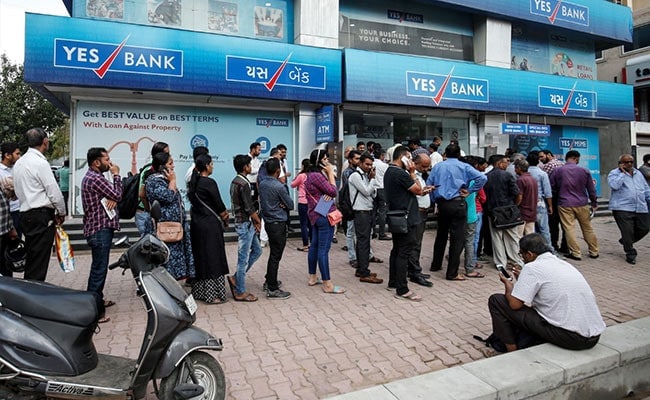
Deposits at Yes Bank witnessed a steady decline during the March-September period last year as customers withdrew over Rs 18,100 crore, in a reflection of falling confidence in the bank. Yes Bank, which has been put under a moratorium by the Reserve Bank till April 3, during which customers are not allowed to withdraw more than Rs 50,000, had deposits worth Rs 2,27,610 crore at the end of March 2019 (or end of 2018-19 fiscal).
However, it fell to Rs 2,25,902 crore by the end of the first quarter ended June of the current fiscal year (2019-20) and further to Rs 2,09,497 crore by the end of the second quarter ended September of FY20. The difference in deposits between March 2019 to September 2019, reflects withdrawals to the tune of Rs 18,110 crore.
Data beyond September is not available as the cash-strapped bank had announced that there will be a delay in publishing its results for the third quarter.
A Delhi-based customer said that he sensed that all was not good with the private sector lender and withdrew his majority of deposits beforehand, leaving only with the minimum balance to keep the account active.
"We kept hearing that there was some problem with the bank, therefore we took out our money well before the withdrawal restriction was imposed on the bank," he said on the condition of anonymity.
During the many months in the past, the bank battled hard to keep the rumour mongering at the bay, issuing statements that everything was fine and customers need not to worry about their deposits.
"Over the past few weeks, there has been a lot of unfounded speculation about Yes Bank''s board and management stability, asset portfolio, future growth prospects amongst other things.
"We strongly refute such speculations which we suspect is a deliberate and malicious attempt to create instability in the institution by undermining investor and client confidence. We have apprised the authorities of these developments. The financial position of Yes Bank is sound and stable and its liquidity and operating performance continue to be robust," the bank said in a statement issued on July 8, 2019.
Another customer said he had limited deposits in Yes Bank and was not really worried much as the insurance amount has now been raised to Rs 5 lakh.
"Even as I could withdrew Rs 50,000 through cheque, I am not really worrying much as my account has limited cash. Moreover, the deposit insurance now covers up to Rs 5 lakh from Rs 1 lakh earlier, so there is not any such problem to me," said Lalit Kumar, a Delhi based Yes Bank customer.
A couple of other customers said they have pulled out all their money from the bank so there is nothing to worry for them.
However, a female customer reposed confidence and looked calmed, saying the government and the Reserve Bank have swung into action very swiftly and there is no need to worry. She said she had come to the bank to withdraw the stipulated Rs 50,000 through cheque and there was no such problem in doing that.
Even as the customers were hassled since last Thursday late evening, queuing up before the Yes Bank ATMs across the country, the bank has assured that their deposits are safe and they can withdraw the money both for their own and other banks ATMs.
During the moratorium period, Yes Bank will not be able to grant or renew any loan or advance, make any investment, incur any liability or agree to disburse any payment.
As per the RBI's draft reconstruction scheme, State Bank of India will pick up 49 per cent stake in the crisis-ridden Yes Bank under a government-approved bailout plan by infusing capital of Rs 2,450 crore.
Bank''s financial health is not sound as it has failed to raise enough capital under the new leadership of Ravneet Singh Gill, who took charge and Managing Director & CEO from March 1, 2019.
Troubles at new generation private sector started brewing up ever since the Reserve Bank denied extension to its co-founder Rana Kapoor -- who now is in the custody of the Enforcement Directorate for financial mismanagement and money laundering charges -- to continue as MD and CEO in September 2018 and had asked the lender to find a new successor.
The bank has a pan-India presence with branches in over 29 states and Union Territories. There were 1,450 ATMs, and 1,120 branches by end of March 2019.

-
One El Nino, India Can Handle. Two Could Break The Granary

India's grain stocks can absorb one bad year, but a second El Nino could drain the buffer in two to three years, economists say.
-
India's Troika Of Good Luck | Joining The Dots
As Jensen Huang's exit drags Nvidia down, a cooling AI trade and resilient earnings have revived investor interest in India. A likely RBI rate hike looms.
-
Talking Points This Week: Leadership Shock At Nvidia, Earnings Strength, And The Fog Over Hormuz
The Anthropic IPO pricing and first trading day, Nvidia's upcoming earnings, and any fresh signals from Iran will set the tone for the following week.
-
Signature Play: The Classic Cocktail Is Dead. Or Is It?
Classic cocktails are disappearing from India's cocktail menus. But they're still being ordered, taught to bartenders and borrowed from. So, who's really having the last drink?
-
A New Samvat Wishlist: Inclusive Prosperity And Human Development
India has strengthened its economic foundations through infrastructure, digital access and enterprise. Its next growth chapter must deepen productivity, create better livelihoods and widen participation in prosperity.
-
Love, Sex Aur Dhokha: The Audacious Plot To Spy On Jensen Huang
A Taipei dinner, a Singapore chip buyer and a suspected Chinese asset: inside the alleged spy operation that got close to NVIDIA's Jensen Huang.
-
Ten Things I Learnt This Samvat
Patience can be a trap. Cheap stocks can stay cheap. Leverage can wipe you out. What did Samvat 2082 teach us? Niraj Shah writes on 10 lessons from the year gone by.
-
Talking Points This Week: Tech Nerves, FII Buying, And A Faraway Banking Shock
The global markets are not shining this Diwali. The exception in the large markets is, India.
-
Midterm Rally Lasted A Day. The Hard Reality Of A Divided US May Last Two Years | Opinion
Between a contested AI boom, a debt ceiling that arrives in 2027 and a president with every incentive to act alone, the next two years may prove more volatile than the first day's rally suggests.
-
Blue Wave Will Derail the AI Trade but Won't Dismantle the AI Era | Unhedged Position
The Democrats' sweep of the US Congress will see politics collide with economic forces both over the long and short term.









