World Stocks Put Aside US Growth Setback
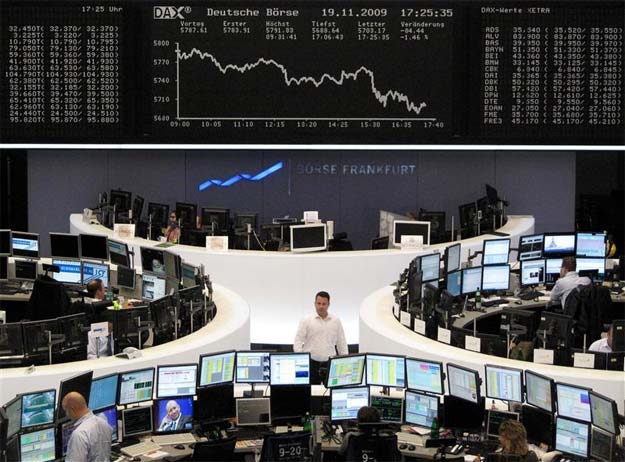
Stock markets in Europe and Asia looked past gains by Iraqi militants and poor first-quarter growth in the United States on Thursday, with some investors raising their forecasts for a US economic bounce in coming months.
A Sunni insurgency in Iraq has driven oil prices as high as $115 a barrel, threatening to raise costs for businesses around the world. Prices eased on Thursday but remain close to levels not seen since the start of 2013.
The surge in oil prices is the latest setback for a global economy still trying to get back on its feet. In that light, Wednesday's final estimate of US gross domestic product in the first quarter was only the latest argument that the Federal Reserve will keep interest rates at record lows into next year.
Most investment houses are also much more optimistic about the future. Some responded to the US figures by raising their estimates of second-quarter growth.
"There's a storm in the rear-view mirror, but much brighter sunshine ahead," said Kit Juckes, a strategist with French bank Societe Generale in London. "The storm does matter, though. There is every reason to be optimistic about upcoming US data, and equally, every reason to expect policy to remain easy."
European stock markets had retreated after the US figures on Wednesday, then rebounded. Shares in Barclays sank 3 per cent, though, after New York's attorney general filed a lawsuit against the UK lender.
Longer-dated bond yields fell and the dollar suffered as funds were forced to move out the yield curve. Investors were willing to accept just 1.26 percent to lend to Germany for 10 years.
US crude added 4 cents to $106.54 a barrel, while Brent was unchanged at $114.00.
Stability Counts
Top of the bill in Europe was the British pound and the impact on it of a Bank of England report on financial stability.
The report is expected to provide the bank's newly founded Financial Policy Committee with a vehicle to announce more measures to curb a booming British housing market, which some worry may be overheating again, six years after the 2008 crash.
Such "macroprudential" steps, particularly if aggressive, might push back expectations of a rise in interest rates that have driven sterling 10 per cent higher in a year.
"There's quite a lot of uncertainty because this is all quite new for UK assets," said Paul Robson, a currency strategist with RBS in London.
"The devil will be in the detail, but the rule of thumb is that the tighter macroprudential policy becomes, the looser conventional monetary policy can be - i.e., interest rates might not have to be raised quite as early or aggressively as they would have otherwise been."
The prospect of the Fed keeping rates low for longer encouraged equity investors, though some were cautious in case a key measure of US inflation due later Thursday surprised on the high side.
The price index for personal consumption expenditures is the Fed's favoured measure of inflation and looks likely to have reached its highest since late 2012 in May.
Most Asian markets ended in the black with MSCI's broadest index of Asia-Pacific shares outside Japan up 1.08 per cent. Japan's Nikkei gained 0.3 per cent and Australia 1.15 per cent.
"You can make the argument that the weaker the number for Q1, the more that Q2 is going to pay back in terms of growth," said Alessandro Tentori, global head of rates strategy at Citi.
"This is on the assumption that Q1 has been influenced by emerging markets weakness and weather related factors."
Copyright: Thomson Reuters 2014

-
Extracting Value From Battery Scrap Could Be Challenging For India | The Reason Why

A discarded lithium-ion battery still contains valuable materials such as lithium, nickel and cobalt. These can be recovered and reused. When such batteries are crushed and shredded, they produce a dark powder called black mass.
-
One El Nino, India Can Handle. Two Could Break The Granary
India's grain stocks can absorb one bad year, but a second El Nino could drain the buffer in two to three years, economists say.
-
India's Troika Of Good Luck | Joining The Dots
As Jensen Huang's exit drags Nvidia down, a cooling AI trade and resilient earnings have revived investor interest in India. A likely RBI rate hike looms.
-
Talking Points This Week: Leadership Shock At Nvidia, Earnings Strength, And The Fog Over Hormuz
The Anthropic IPO pricing and first trading day, Nvidia's upcoming earnings, and any fresh signals from Iran will set the tone for the following week.
-
Signature Play: The Classic Cocktail Is Dead. Or Is It?
Classic cocktails are disappearing from India's cocktail menus. But they're still being ordered, taught to bartenders and borrowed from. So, who's really having the last drink?
-
A New Samvat Wishlist: Inclusive Prosperity And Human Development
India has strengthened its economic foundations through infrastructure, digital access and enterprise. Its next growth chapter must deepen productivity, create better livelihoods and widen participation in prosperity.
-
Love, Sex Aur Dhokha: The Audacious Plot To Spy On Jensen Huang
A Taipei dinner, a Singapore chip buyer and a suspected Chinese asset: inside the alleged spy operation that got close to NVIDIA's Jensen Huang.
-
Ten Things I Learnt This Samvat
Patience can be a trap. Cheap stocks can stay cheap. Leverage can wipe you out. What did Samvat 2082 teach us? Niraj Shah writes on 10 lessons from the year gone by.
-
Talking Points This Week: Tech Nerves, FII Buying, And A Faraway Banking Shock
The global markets are not shining this Diwali. The exception in the large markets is, India.
-
Midterm Rally Lasted A Day. The Hard Reality Of A Divided US May Last Two Years | Opinion
Between a contested AI boom, a debt ceiling that arrives in 2027 and a president with every incentive to act alone, the next two years may prove more volatile than the first day's rally suggests.









