World Stocks Hold Near 16-Month Highs After Strong Week
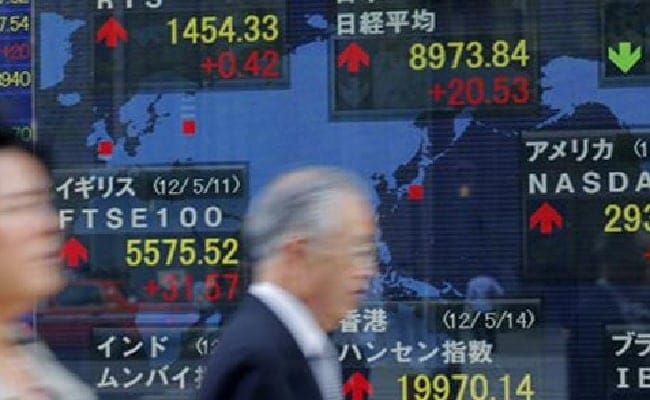
London: World stocks were set for a weekly gain and held near 16-month highs on Friday, while the euro steadied after swings following the European Central Bank's decision to extend its stimulus programme.
The MSCI World index was up 0.1 per cent, on track for a gain of 2.7 per cent for the week. The index was just 0.1 per cent below Thursday's peak, which was its highest level since August 2015.
European shares hit their highest level for 11 months, and were set for their best week since February, following the ECB's decision to trim the size of its asset purchase program while also extending it for longer than many analysts had expected.
The ECB said it would reduce its monthly asset buys to 60 billion euros ($63.68 billion) as of April, from the current 80 billion euros, and extend purchases to December from March - three months longer than what some analysts had forecast.
That dragged down two-year yields across Europe and sharply steepened the yield curve, a gift for banks that typically borrow short maturities and lend long.
European bank stocks pulled back on Friday, dropping 1 per cent, but were still up 9.2 per cent for the week, with the sector set for its biggest weekly rise since December 2011.
One month on from November's US presidential election, world stocks have gained 3.8 per cent, with Wall Street spurred to all time highs on hopes of higher growth and inflation as a result of President-elect Donald Trump's planned fiscal stimulus.
Analysts said that signs the ECB would continue to provide monetary support for as long as needed complemented the promise of fiscal stimulus in a welcome cocktail for investors.
"Markets already excited by the prospect of a fiscal stimulus wave via a Trump election look in-line to get more of both fiscal and monetary stimulus from next year," said Mike van Dulken, head of research at Accendo Markets.
"(That's) the best of both worlds for investors."
In all, Europe's STOXX 600 was up 0.1 per cent.
The euro recovered a foothold on Friday, after an extension of the European Central Bank's programme of money-printing till the end of next year drove its biggest daily loss against the dollar since Britain's vote to leave the European Union in June.
It was flat against the dollar, spiking as high $1.0875 on Thursday before tumbling as ECB President Mario Draghi said the unexpected move was not an outright winding-down of the central bank's quantitative easing (QE) program, and the central bank reserved the right to increase the size of purchases again if the Eurozone economy falters.
The dovish tone of the ECB also saw a fall in Eurozone borrowing costs, led by Southern Europe.
The ECB's bond purchase changes came less than a week before the Federal Reserve's policy meeting next Tuesday and Wednesday.
Interest rate futures, implied traders saw a 98 per cent chance the US central bank would raise interest rates by a quarter point next week, and about a 50 per cent chance it would raise rates by at least another quarter point by June 2017, according to CME Group's FedWatch program.
The dollar index, which tracks the greenback against a basket of six major rival currencies, was steady on the day at 101.13, up 0.4 per cent for the week.
The dollar was up 0.4 per cent at 114.42 yen, moving back toward last week's 10-month high of 114.83 yen.
Asian shares edged down on Friday but were on track for weekly gains. MSCI's broadest index of Asia-Pacific shares outside Japan dipped 0.2 per cent, and was poised for a weekly gain of 2 per cent.
Japan's Nikkei stock index ended 1.2 per cent up at its highest closing level since December 2015. The Nikkei earlier topped the 19,000-level for the first time in a year, as investors saw both the weak yen and prospects of US President-elect Donald Trump adopting reflationary policies benefiting Japan's major exporters.
"The US market's strength is giving a boost to Japanese shares," said Eiji Kinouchi, chief technical analyst at Daiwa Securities.
Oil built on its gains after rebounding overnight on growing optimism that non-OPEC producers might follow the cartel's lead by agreeing to cut output.
US crude added 0.9 per cent to $51.31 a barrel. Brent crude rose 0.7 per cent to $54.24.
Spot gold was flat at $1,170.4 an ounce and was set for a weekly decline of about 0.5 per cent, pressured by the stronger US dollar and expectations that the Fed will raise interest rates next week.

-
Gold Is Rs 22,000 Cheaper Than A Month Ago. Should You Buy Amid The Wedding Season?

Gold's potential slide to $3,500 could save around Rs 4,700 per 10 grams, but a soft inflation print could just as easily push prices back up. One way to split the risk is to buy in parts, some now and the rest after the Fed's Dec. 9 decision.
-
AI Agents Are Gaining Power. Who Governs Them?
Artificial intelligence agents promise to transform productivity by moving machines from assisting decisions to executing them. But as organisations delegate greater authority to these AI-agents, they must first establish who controls that authority and who remains accountable when things go wrong.
-
Why Swapping Your Old Gold Can Trigger A Rs 5 Lakh Tax Bill, And How You Can Avoid It Legally
Swapping old gold for new is taxed as a sale and a fresh purchase. Getting your own gold remade can cut most of that bill, though it has its own costs.
-
The AI Trade is Done. The Real Opportunity for Investors Starts in 2027 | Unhedged Position
As pureplay AI stocks plunge and circular, capex-led financing unwinds, 2027 is set to be a year of reckoning for AI companies. Yet the bust clears the way for a better opportunity for investors in 2027 -- shifting the spotlight from AI builders to the companies using AI.
-
Leadership As Mission: Why The Age Of AI Demands More Human Leadership
Debjani Ghosh examines how AI is changing leadership, arguing that its success must be measured by its impact on people and the accountability of those guiding its use.
-
We May Need Another Tukaram Mundhe To Fight Air Pollution | The Reason Why
Developers may install basic measures such as sprinklers and green nets, resume work, and continue violating rules when this equipment stops working.
-
Extracting Value From Battery Scrap Could Be Challenging For India | The Reason Why
A discarded lithium-ion battery still contains valuable materials such as lithium, nickel and cobalt. These can be recovered and reused. When such batteries are crushed and shredded, they produce a dark powder called black mass.
-
One El Nino, India Can Handle. Two Could Break The Granary
India's grain stocks can absorb one bad year, but a second El Nino could drain the buffer in two to three years, economists say.
-
India's Troika Of Good Luck | Joining The Dots
As Jensen Huang's exit drags Nvidia down, a cooling AI trade and resilient earnings have revived investor interest in India. A likely RBI rate hike looms.
-
Talking Points This Week: Leadership Shock At Nvidia, Earnings Strength, And The Fog Over Hormuz
The Anthropic IPO pricing and first trading day, Nvidia's upcoming earnings, and any fresh signals from Iran will set the tone for the following week.









