World Bank Cuts China Growth Forecasts On Covid Worries
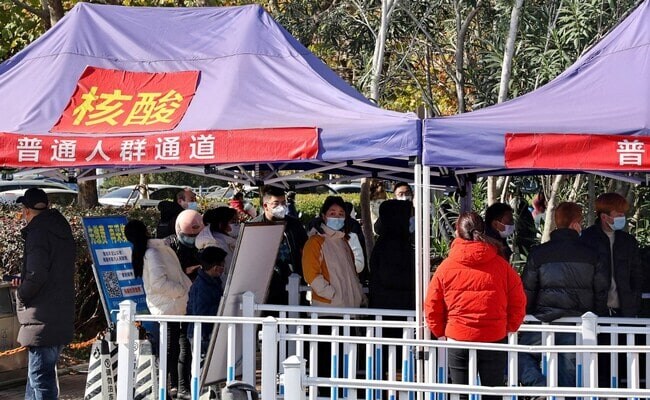
The World Bank today slashed its China growth forecast for the year as the pandemic and weaknesses in the property sector hit the world's second largest economy.
In a statement, the institution slashed its forecast to 2.7 percent from 4.3 percent predicted in June. It also revised its forecast for next year from 8.1 percent down to 4.3 percent.
Both figures are well below Beijing's GDP growth target of around 5.5 percent for the year, a figure many analysts believe is now unattainable.
"Economic activity in China continues to track the ups and downs of the pandemic -- outbreaks and growth slowdowns have been followed by uneven recoveries," the World Bank said.
"Real GDP growth is projected to reach 2.7 percent this year, before recovering to 4.3 percent in 2023, amid a reopening of the economy."
After years of sudden lockdowns, mass testing, long quarantines and travel restrictions, China this month abruptly abandoned its zero-Covid policy.
But disruption to businesses has continued as cases surge and some restrictions remain in place.
Health authorities have admitted that official figures no longer capture the full picture of domestic infections now that mass testing requirements have been dropped.
"Continued adaptation of China's Covid-19 policy will be crucial, both to mitigate public health risks and to minimise further economic disruption," Mara Warwick, World Bank Country Director for China, Mongolia and Korea, said.
Last week the IMF warned it too would likely downgrade its projections for China again, blaming a predicted continued rise in cases.
The fund cut its growth projection for China in October to 3.2 percent this year -- the lowest in decades -- while expecting growth to rise to 4.4 percent next year.
But "very likely, we will be downgrading our growth projections for China, both for 2022 and for 2023", IMF chief Kristalina Georgieva told AFP.
Other stresses
Experts fear China is ill-equipped to manage the exit wave of infections as it presses ahead with reopening, with millions of vulnerable elderly people still not fully vaccinated.
"Accelerated efforts on public health preparedness, including efforts to increase vaccinations especially among high-risk groups, could enable a safer and less disruptive reopening," Warwick said.
The economy is under pressure on other fronts, too.
"Persistent stress" in the real estate sector -- which accounts for about a quarter of annual GDP -- could have wider macroeconomic and financial effects, the World Bank noted.
And it added that youth unemployment, the risks from extreme weather caused by climate change and the wider global slowdown also threatened growth.
The world economy is being battered by surging interest rates aimed at fighting runaway inflation that has been triggered by Russia's war in Ukraine as well as global supply chain snarls.
Beijing has sought to mitigate low growth with a series of easing measures to provide support, slashing key interest rates and pumping cash into the banking system.
"Directing fiscal resources towards social spending and green investment would not only support short-term demand but also contribute to more inclusive and sustainable growth in the medium term," said the World Bank's Lead Economist for China Elitza Mileva.
(Except for the headline, this story has not been edited by NDTV staff and is published from a syndicated feed.)

-
Getting To Work Costs Women More | The Reason Why

It is not just about women paying more than men. It is about women paying much more in cities than in villages.
-
AI Bias In Investing Cannot Be Eliminated, But It Can Be Governed
Framing is a particularly important example as identical financial information presented in terms of gains rather than losses can lead an LLM to reach a different assessment.
-
Joining The Dots | Dark Skies, Steady Diya: Why Hope Holds This Diwali
With war, a weak rupee and foreign outflows weighing on sentiment, policymakers at the NDTV World Summit and market veterans at NDTV Profit Ignite: Diwali Edition offered the same advice: stay invested and filter out the noise.
-
The Curious Case of Equitas Small Finance Bank And A CEO Who Quit For Stock
PN Vasudevan believes persistent investor concerns over a perceived conflict of interest had become a governance overhang on Equitas Small Finance Bank's stock, even as the lender improved profitability and asset quality.
-
Talking Points This Week: AI Cash Burn, A Tiger Comeback And An India That Still Finds Its Own Path
India is not immune to higher oil or tighter global liquidity, yet its earnings base is broader, its domestic policy levers are still available.
-
Foreign Investors Own Half Of HDFC Bank and ICICI Bank. An LTCG Cut Could Matter Most Here
Foreign portfolio investors have US$115 billion parked in HDFC Bank, ICICI Bank. If the government cuts long-term capital gains tax, Jefferies says returning foreign money could land here first.
-
'Never Seen This Level Of Negativity': Sandeep Tandon Says The Next Rally May Be Closer Than You Think
Veteran investor Sandeep Tandon says foreign selling is easing, large-caps are due a comeback and mid-caps are crowded, while he turns positive on gold, power and pharma this Diwali.
-
Indians Stay With Family, Not In Hotels | The Reason Why
India still lacks enough clean, reliable and affordable hotels for budget-conscious travellers.
-
The Economic Imperative: Analysing The Material Driving Force Behind India-Canada Strategic Reset
This economic complementarity is further reinforced by deep institutional investment ties and talent mobility, which form the bedrock of the bilateral framework.
-
Medicine Pricing: Where Must Profit Stop?
India must confront excessive margins, hidden incentives and regulatory gaps that threaten the integrity of medicine.










