New World Bank Chief Hails COP Momentum As Climate Pledges Mount

(Bloomberg) --
Six months after becoming president of the World Bank, Ajay Banga is seizing all the momentum he can at COP28.
World leaders spent the first three days at the climate conference unveiling a string of announcements from cutting methane emissions to ramping up the flow of money to poorer countries. The World Bank has been involved in many of those deals.
“There is a lot of energy,” said Banga in an interview in Dubai on Sunday. “There seems to be political alignment. I'm going to take all the tailwind I can get.”
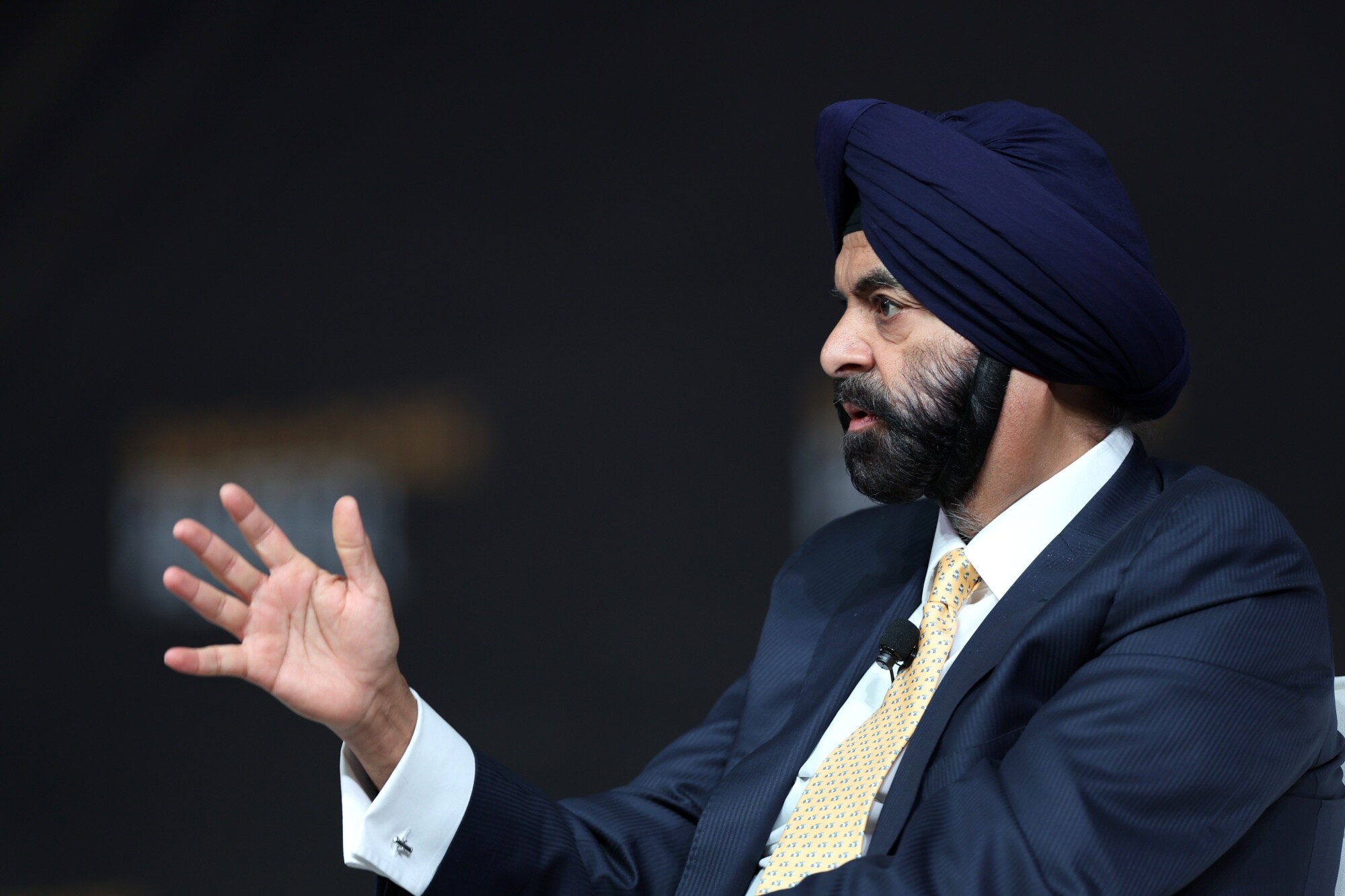
The World Bank has for years struggled to mobilize the vast sums of money needed to help the developing world adapt to climate change and transition to renewables. Critics have said it has been too slow to get cash out the door and too focused on country-specific lending rather than addressing broader challenges like climate change.
Banga, who was nominated by US President Joe Biden, was put in charge to change that. The former chief executive of Mastercard Inc. last week raised the bank's target for climate lending to 45 percent of its financing by 2025, up from its previous goal of 35 percent. He wants half of it to help countries adapt to the ravages of rising temperatures and the other half to help them fund their transition to renewable energy.
Asked about his first COP, Banga said “I'm most proud of the 45% as it's putting $40 billion to work every year.”
A key part of Banga's mission is to work with the private sector to unlock billions of dollars. Speaking at the Bloomberg Business Forum on Sunday, he said he's working with a club of 15 bankers to lower the risk of investing in climate projects and attract capital. The World Bank has also stepped up action on other fronts, including allowing some vulnerable countries to potentially pause debt repayments, hosting a loss and damage fund for climate damages and supporting the COP Presidency's methane push by helping countries like Vietnam and Indonesia address emissions in agriculture and waste management.
However, the problem that most intrigues Banga is carbon markets. He's keen to restore credibility in the much-criticized sector as a way to channel money to poorer countries, especially given how hard it will be to implement carbon taxes around the world. The World Bank wants to sponsor forestry projects in 15 countries over the next 18 months in a push that could generate 125 million carbon credits. If priced at $20 per credit, that would amount to $2.5 billion for the participating communities.
The goal, he said, is to create a virtuous circle that will bring more people into the market.
“You need prices to go up and more credits to kick in,” Banga said. “It will be hard. It will be challenging but if we don't do it, who will try?”
Challenges remain. Restoring faith in carbon markets will be fiendishly difficult and it's almost inevitable mistakes will be made, he said. The bank is notoriously bureaucratic and Banga accepts that it will be difficult to speed up the flow of lending out of the bank. And there are still many questions hanging over one of the most eye-catching announcements at COP — how the newly established loss and damage Fund will actually work.
The darkest shadow hanging over this COP is the prospect of Donald Trump returning to the White House in 2025. The war in Ukraine has already prompted a dash for fossil fuels as countries fret about energy security and the cost of living crisis has prompted many countries to roll back their net-zero commitments. With polls showing that the former president running neck and neck with Biden, the concern is that all the progress made at this year's COP will eventually be upended.
Banga said he's focused on the here and now.
“I never worry about something like that, said Banja. “I control what I can control. What's the point?”
More stories like this are available on bloomberg.com
©2023 Bloomberg L.P.

-
Indians Stay With Family, Not In Hotels | The Reason Why

India still lacks enough clean, reliable and affordable hotels for budget-conscious travellers.
-
The Economic Imperative: Analysing The Material Driving Force Behind India-Canada Strategic Reset
This economic complementarity is further reinforced by deep institutional investment ties and talent mobility, which form the bedrock of the bilateral framework.
-
Medicine Pricing: Where Must Profit Stop?
India must confront excessive margins, hidden incentives and regulatory gaps that threaten the integrity of medicine.
-
Why Amazon And Flipkart Are Struggling To Beat Meesho In India's Smaller Cities
With 274 million users and lowest-cost logistics, Meesho is defending its value commerce crown against giants like Amazon and Flipkart.
-
High US Salaries, No Green Card Certainty: The Financial Calculation Facing Indian H-1B Families
The suspension of PERM processing at eight technology employers does not cancel existing H-1B visas. What it does is force a question many Indian families have been avoiding: is the US salary worth tying your career and family plans to one employer?
-
Swiggy vs Eternal: Food Delivery's Two Rivals Are No Longer In The Same Race
Eternal is building a private AI assistant, dark.ai. Swiggy is still working out how to make Instamart pay, with an operating loss of Rs 895 crore in the July-September quarter while Blinkit stayed profitable.
-
Where You Live Shapes How You Get To Work | The Reason Why
Two-wheelers are the most popular way to get to work in India, accounting for nearly 43% of workplace commutes.
-
Unhedged Position: Can India See An Indonesia-Style Time Correction?
The Nifty is trading below levels it first clocked in 2024. Is there, then, as I have suggested in the headline, potential that the current time correction drags on painfully for the next three-five, even ten years?
-
Navigating Friction And Energy Realities: An Analysis Of Marco Rubio's October Visit To India
Occurring at a critical juncture marked by stalled trade negotiations and escalating geopolitical pressures over global energy supplies, the visit offers a profound window into modern US-India relations.
-
India Exports Capital. Why Not Export Trusteeship?
The big question, then, is whether India can build an institution that global borrowers, investors, banks, and lawyers can trust, even without an Indian connection.










