Work Out Strategies To Draw Global Businesses To India: Finance Minister To Indian Industry
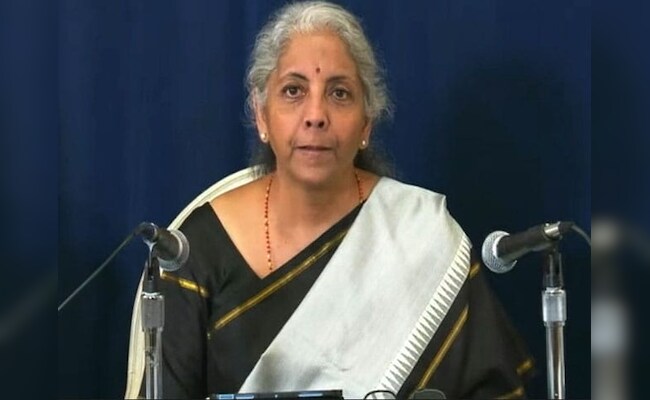
Finance Minister Nirmala Sitharaman today asked Indian industry to work out strategies as to how businesses operating in developed countries can look at India as a production or sourcing hub amid recession fears in the western countries.
India has brought in a lot of facilitation and tweaking of rules to attract foreign investment into India and is also engaging with industries who want to co-locate in the country, the minister said.
"As much you are preparing yourself for a long-drawn recession in the Western world, in the developed world, I think it is also the best time for you to work out strategies for drawing those manufacturers from there to India. Even as they are headquartered there, it might be useful for them to think of sourcing many things from here and producing from here at least for markets in this part of the globe," Nirmala Sitharaman said at an event.
She said the suspected long-drawn recession, which is likely to affect Europe, is not just going to affect exports by Indian businesses.
"(But) it gives an opportunity for many of the investments which are there, which are now looking for a different place from where activities can continue to happen," she noted.
On the diplomatic front, she said, India has been acting on China plus one and it's also going to be Europe plus one.
"So, plus one is becoming now plus two. So, for us not to just talk, the government is acting and brought in a lot of facilitation, tweaking of the rules, making sure that we sit and engage with those investors or industries which are wanting to move out, in the sense remain there and search for one more destination or completely move out," she said.
Vietnam, the Philippines or Indonesia are drawing a lot of attention and India is also going to draw attention and many of the industries are co-locating themselves, she said.
She prodded India Inc to focus also on manufacturing, while rejecting the hypothesis that the country should not follow China's model of manufacturing-led growth.
"If there are voices suggesting that India should not be focussing on manufacturing, but it should focus only on services, I am sorry, no. We should be focussing on manufacturing...we should be focussing on newer areas of services," she said.
It is to be noted that many economists and experts have opined that India should focus on services instead of blindly following the China model of manufacturing-led growth.
The service sector, particularly the IT-driven service segment, has already made a big impact, to the extent that today 60 per cent of the GDP is contributed by the sector, she said while addressing Ficci's 95th annual general meeting.
She underlined the need to strengthen manufacturing and asked the industry to look at innovations by startups and find ways to scale them.
As the world transitions into clean energy, the domestic industry could face higher tariffs by the developed countries, Sithraman said.
She also asked India Inc to tell the government how climate change is affecting them and suggest ways to reduce the burden of cost falling on them.
"A common concern for all of us is climate. Only recently, a few days ago, I am sure all of you would have read in the media, that there are countries who want to fund their transition from not-so-green to green production of materials, items like steel...they want to fund their transition by raising tariff walls against countries, which send their products as a matter of normal exports," she said.
So, Nirmala Sitharaman said, when Indian companies are going to export steel, they will be facing tariff walls in the name of climate action tax.
"This is going to affect us. And this is not something I am speculating on. There are measures announced by countries. For India, therefore, both for meeting our nationally determined commitments and also for the industry to quickly understand the necessity for resetting yourselves so that the tariff walls, which are coming up in the name of climate change, is something which we should face and be ready for," she said.
Talking about the upcoming Budget, she said it would follow the spirit of earlier Budgets to prepare India for the next 25 years.
(Except for the headline, this story has not been edited by NDTV staff and is published from a syndicated feed.)

-
We May Need Another Tukaram Mundhe To Fight Air Pollution | The Reason Why

Developers may install basic measures such as sprinklers and green nets, resume work, and continue violating rules when this equipment stops working.
-
Extracting Value From Battery Scrap Could Be Challenging For India | The Reason Why
A discarded lithium-ion battery still contains valuable materials such as lithium, nickel and cobalt. These can be recovered and reused. When such batteries are crushed and shredded, they produce a dark powder called black mass.
-
One El Nino, India Can Handle. Two Could Break The Granary
India's grain stocks can absorb one bad year, but a second El Nino could drain the buffer in two to three years, economists say.
-
India's Troika Of Good Luck | Joining The Dots
As Jensen Huang's exit drags Nvidia down, a cooling AI trade and resilient earnings have revived investor interest in India. A likely RBI rate hike looms.
-
Talking Points This Week: Leadership Shock At Nvidia, Earnings Strength, And The Fog Over Hormuz
The Anthropic IPO pricing and first trading day, Nvidia's upcoming earnings, and any fresh signals from Iran will set the tone for the following week.
-
Signature Play: The Classic Cocktail Is Dead. Or Is It?
Classic cocktails are disappearing from India's cocktail menus. But they're still being ordered, taught to bartenders and borrowed from. So, who's really having the last drink?
-
A New Samvat Wishlist: Inclusive Prosperity And Human Development
India has strengthened its economic foundations through infrastructure, digital access and enterprise. Its next growth chapter must deepen productivity, create better livelihoods and widen participation in prosperity.
-
Love, Sex Aur Dhokha: The Audacious Plot To Spy On Jensen Huang
A Taipei dinner, a Singapore chip buyer and a suspected Chinese asset: inside the alleged spy operation that got close to NVIDIA's Jensen Huang.
-
Ten Things I Learnt This Samvat
Patience can be a trap. Cheap stocks can stay cheap. Leverage can wipe you out. What did Samvat 2082 teach us? Niraj Shah writes on 10 lessons from the year gone by.
-
Talking Points This Week: Tech Nerves, FII Buying, And A Faraway Banking Shock
The global markets are not shining this Diwali. The exception in the large markets is, India.









