Women Workers To Be Hurt More Than Men by AI Wave, McKinsey Says
(Bloomberg) -- Women have more to worry about than men from a coming wave of automation and artificial intelligence that could replace almost a third of hours worked across the US economy.
That's one of the takeaways from a new report by the research arm of consultants McKinsey & Co. that examines US labor-market trends through the end of 2030.
It calculated that women are 1.5 times more likely to need to move into a new occupation than men during that period. The reason: They're over-represented in the industries with lower-wage jobs the report reckons will be most impacted by automation, including office support and customer service. Blacks and Hispanics will also be adversely affected as demand for food and production workers shrinks.
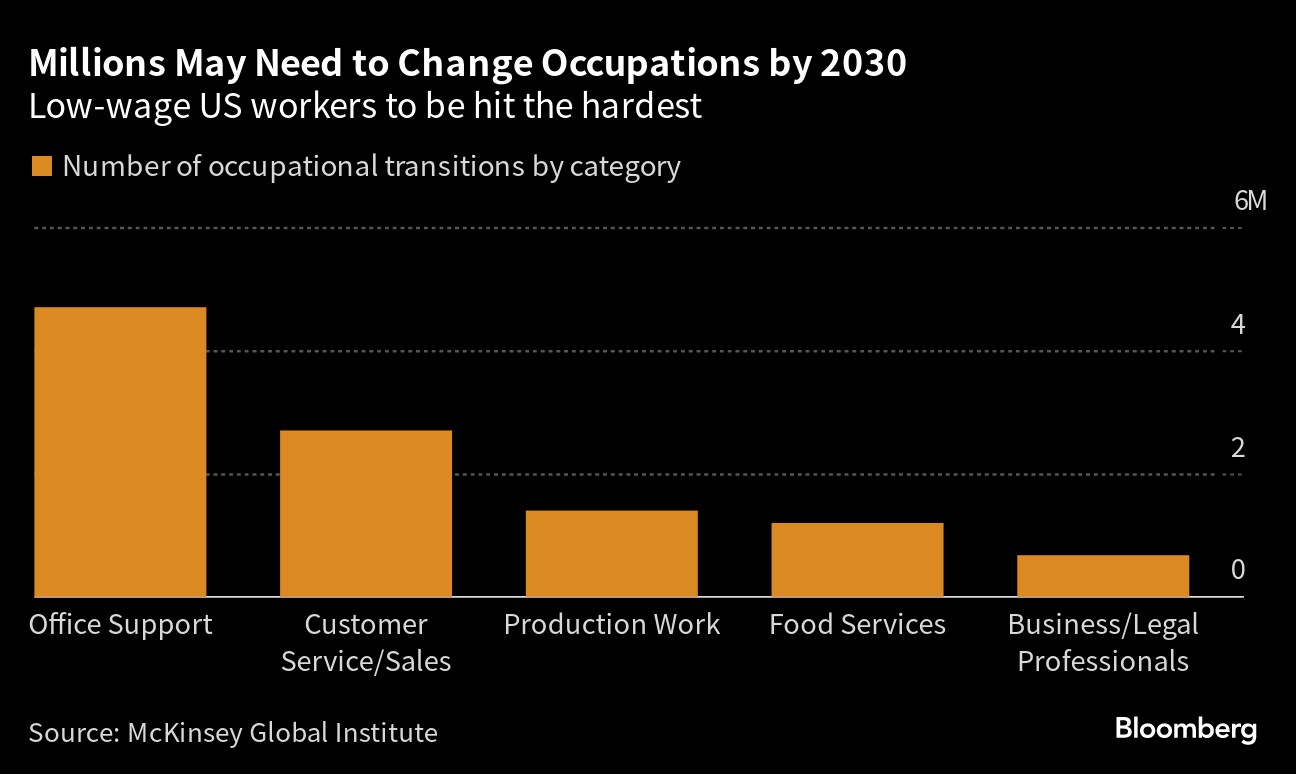
In all, the McKinsey Global Institute said that at least 12 million workers in the US will need to change occupations by the end of 2030. Some of that turnover will stem from the drive for net-zero emissions, which will disrupt millions of jobs.
What's concerning, said Institute director Kweilin Ellingrud, is that the churn will be concentrated among low-wage workers. They're up to 14 times more likely to need to change occupations than those in the highest-wage positions, and most will need additional skills to do so successfully.
White-collar workers – everything from lawyers and teachers to financial advisers and architects — will be among those most affected by the spread of generative artificial intelligence such as OpenAI's ChatGPT, according to the report. But McKinsey argued that will largely result in changes in how those jobs are carried out, rather than in the destruction of huge swathes of positions.
It “probably won't be that kind of catastrophic thing,” institute partner Michael Chui said. But “it is going to change almost every job.”
Some 3.5 million positions could be wiped out as the US seeks to end emissions of greenhouse gases, with workers in oil and gas production and automotive manufacturing taking the hit, according to the report.
But McKinsey argued that will be more than offset – to the tune of about 700,000 jobs — by gains stemming from the build-up of renewable energy, primarily though capital investments in new plants, charging stations and the like.
The energy transition, coupled with stepped-up government spending on infrastructure, will increase demand for construction workers who are already in short supply. McKinsey sees construction employment growing 12% from 2022 through 2030.
If the reshuffling of jobs in coming years is handled correctly, it could result in a huge increase in US productivity and prosperity, according to the institute. In what Ellingrud admitted was a “pretty optimistic” scenario, the report posits an eventual rise in annual productivity growth to 3% to 4%. It's about 1% now.
To get there, though, “the US will need workforce development on a far larger scale,” McKinsey said.
More stories like this are available on bloomberg.com
©2023 Bloomberg L.P.

-
Signature Play: The Classic Cocktail Is Dead. Or Is It?

Classic cocktails are disappearing from India's cocktail menus. But they're still being ordered, taught to bartenders and borrowed from. So, who's really having the last drink?
-
A New Samvat Wishlist: Inclusive Prosperity And Human Development
India has strengthened its economic foundations through infrastructure, digital access and enterprise. Its next growth chapter must deepen productivity, create better livelihoods and widen participation in prosperity.
-
Love, Sex Aur Dhokha: The Audacious Plot To Spy On Jensen Huang
A Taipei dinner, a Singapore chip buyer and a suspected Chinese asset: inside the alleged spy operation that got close to NVIDIA's Jensen Huang.
-
Ten Things I Learnt This Samvat
Patience can be a trap. Cheap stocks can stay cheap. Leverage can wipe you out. What did Samvat 2082 teach us? Niraj Shah writes on 10 lessons from the year gone by.
-
Talking Points This Week: Tech Nerves, FII Buying, And A Faraway Banking Shock
The global markets are not shining this Diwali. The exception in the large markets is, India.
-
Midterm Rally Lasted A Day. The Hard Reality Of A Divided US May Last Two Years | Opinion
Between a contested AI boom, a debt ceiling that arrives in 2027 and a president with every incentive to act alone, the next two years may prove more volatile than the first day's rally suggests.
-
Blue Wave Will Derail the AI Trade but Won't Dismantle the AI Era | Unhedged Position
The Democrats' sweep of the US Congress will see politics collide with economic forces both over the long and short term.
-
It's Time To Take The GST Council's Bet On Trust Global
Payment records can prove India's services exports, and clear, proportionate rules can bring foreign digital sellers into the tax net.
-
Opinion | India at 38: From Innovation Overperformer to Innovation Powerhouse
India now has 453 VC-backed deep science startups, 18 of them late-stage, after 117 percent growth since 2020. Laurus Labs, at USD 9.3 billion, is the most valuable deep science company in any middle-income economy outside China.









