Air Travel Is Improving. Why Isn’t Passengers’ Behavior?
(Bloomberg Opinion) -- So, you're really going to fly on Labor Day weekend? The typical advice is to arm yourself with patience and prepare for the worst. After all, you'll be joining a record number of about 17 million passengers seeking to cram onto aircraft for this last long weekend of the summer.
Despite widely held attitudes that airlines and airports provide terrible service and that it's only becoming worse, the odds are that your flight will go off without a hitch and you will arrive on time. When adjusted for inflation, the cost of a ticket is much less than it was 30 years ago. The amenities at airports and aboard aircrafts have improved over time, driven by new technology and competition.
Overall, the system works. In the first five months of this year, less than 1.5% of flights were canceled, and 21% were delayed. Cancellations are lower than in 2019, the pre-Covid benchmark year, and delays are a couple of percentage points higher. Weather is usually a main factor for cancellations and delays. Fortunately for travelers and the airlines, no significantly disruptive storms are brewing for this weekend's forecast.
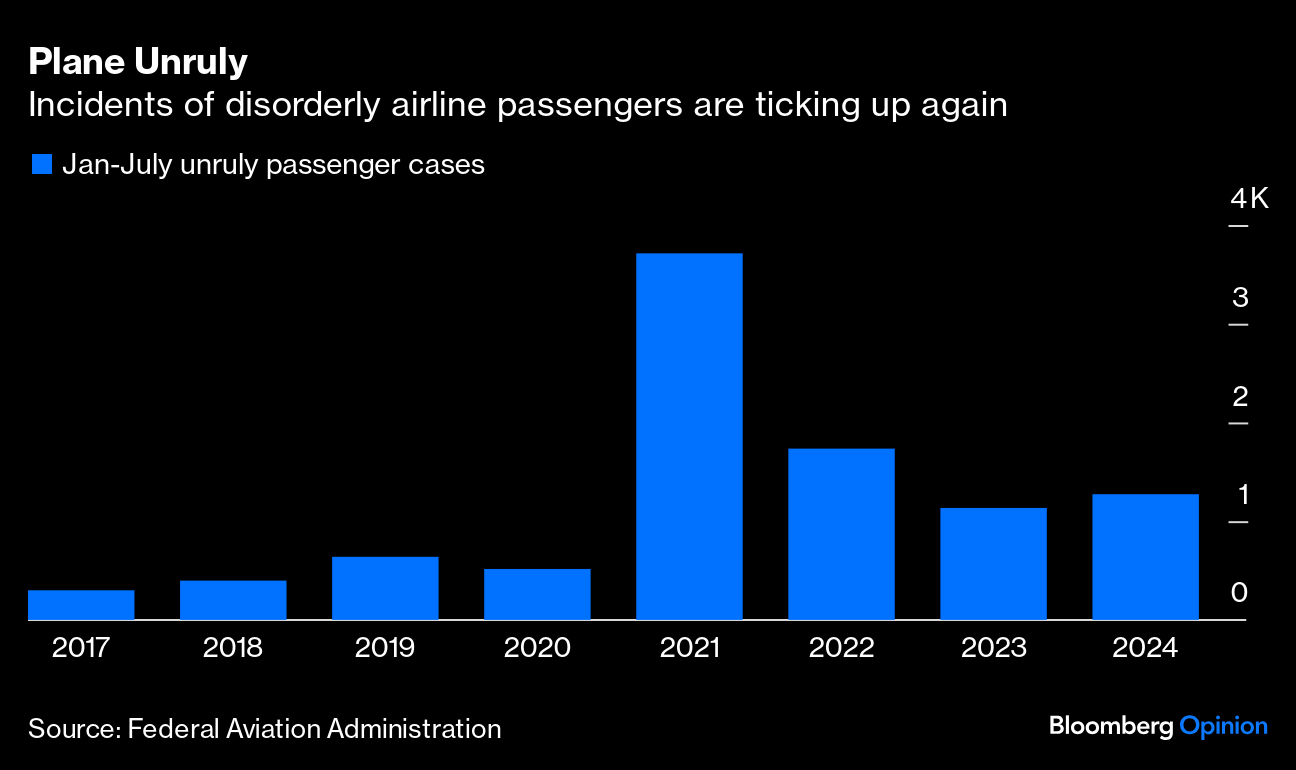
What hasn't improved is passenger behavior. In fact, it's much worse. The number of unruly passengers that the Federal Aviation Administration investigates is rising again this year after spiking during 2021, when the policies of mask mandates caused almost 6,000 flyers to go berserk. The number had been dropping from that peak, but this year is on the rise again. What's going on? Why are more people losing their cool on planes?
If anything, the pressure-filled process of getting in and out of airports is smoother with new scanning technology and programs such as TSA PreCheck. If you find yourself removing your shoes, belt and laptop at the Transportation Security Administration checkpoint while silently judging the confused family holding up the line, it's because you didn't shell out the $80 to enroll in TSA PreCheck. The TSA says that 99% of those enrolled wait less than 10 minutes to clear security. That wait time jumps to 30 minutes for the regular line.
The airline industry, especially in the US, is the most complicated among the different passenger networks. It combines private-sector airline competition with federal government management of the air traffic control system. Airports are often owned by cities. All must function well together. The industry's infrastructure got a shot in the arm with overwhelming bipartisan support of the FAA Reauthorization Act in May, which hires more air traffic controllers and rolls out more technology to improve efficiency and safety at airports. The law also forces airlines to make fees more transparent and refunds quicker for canceled flights.
Even in the most acrimonious of political times, lawmakers agreed on the need to fly and do it safer and faster. That's because the US is a flying nation. High-speed trains never had a chance in such vast, rural expanses dotted with large cities. Hands down, the US has the busiest skies in the world. The FAA oversees more than 350 air traffic facilities, and there are almost 20,000 public and private airports. Most of the action to manage 45,000 flights and 2.9 million passengers every day in the US takes place behind the scenes.
The competition among US airlines is healthy and fierce. The consolidation of the industry hasn't reached a point where customers are lacking choice. There are four large airlines and a couple of others knocking on that door, such as JetBlue Airways and Alaska Air Group. A few low-cost carriers, including Frontier Group Holdings and Spirit Airlines, as well as several regional airlines help keep airfares down.
The average inflation-adjusted US fare last year was $389, according to the Bureau of Transportation Statistics. That's the lowest level ever and compares with $520 a decade ago and $502 in 2004. Of course, this isn't adjusted for the costs that airlines have pushed to their customers, such as bag fees.
Still, the heated competition has tamped down fares and has driven airlines to offer more amenities and improve service. On-time arrival is still the best service indicator. This is why the Frontier and Spirit are struggling so much. They have dismal on-time records that make their bare-bones offerings that much more painful.
Expect more passenger records to be broken because of the convenience and affordability of flying. Frontier is offering one-way fares as low as $29, making this truly a transportation mode for the masses. That doesn't excuse the rise in bad behavior. Perhaps the increased availability of alcohol on the airplane and throughout the airport — even right amid boarding gates — is creating this combustible cocktail for conflict.
The FAA adopted a permanent zero-tolerance policy against unruly passengers and backed it up with fines, flying bans and even criminal charges for the most egregious cases. The FAA has come up with ads, signs and internet memes to spread the word on the consequences of disorderly behavior. There needs to be more of this, and maybe even slip in a recorded message on the plane before takeoff. I would suggest one of those pithy signs be hung above that kiosk bar near the gates.So, enjoy your getaway this long weekend. Take in how the airline industry can handle such an influx of passengers, mostly without a hitch. Even have a cold one while waiting for your flight. But, please follow the rules and be on your best behavior. Maybe we can get through this Labor Day weekend without yet another viral video of an unruly passenger.
More From Bloomberg Opinion:
- Tourism Protesters May Get What They Wish For: Andrea Felsted
- America's Vacation Culture Is Broken: Sarah Green Carmichael
- Airfare War Is Ending Quickly as Carriers Retreat: Thomas Black
This column does not necessarily reflect the opinion of the editorial board or Bloomberg LP and its owners.
Thomas Black is a Bloomberg Opinion columnist writing about the industrial and transportation sectors. He was previously a Bloomberg News reporter covering logistics, manufacturing and private aviation.
More stories like this are available on bloomberg.com/opinion
©2024 Bloomberg L.P.

-
We May Need Another Tukaram Mundhe To Fight Air Pollution | The Reason Why

Developers may install basic measures such as sprinklers and green nets, resume work, and continue violating rules when this equipment stops working.
-
Extracting Value From Battery Scrap Could Be Challenging For India | The Reason Why
A discarded lithium-ion battery still contains valuable materials such as lithium, nickel and cobalt. These can be recovered and reused. When such batteries are crushed and shredded, they produce a dark powder called black mass.
-
One El Nino, India Can Handle. Two Could Break The Granary
India's grain stocks can absorb one bad year, but a second El Nino could drain the buffer in two to three years, economists say.
-
India's Troika Of Good Luck | Joining The Dots
As Jensen Huang's exit drags Nvidia down, a cooling AI trade and resilient earnings have revived investor interest in India. A likely RBI rate hike looms.
-
Talking Points This Week: Leadership Shock At Nvidia, Earnings Strength, And The Fog Over Hormuz
The Anthropic IPO pricing and first trading day, Nvidia's upcoming earnings, and any fresh signals from Iran will set the tone for the following week.
-
Signature Play: The Classic Cocktail Is Dead. Or Is It?
Classic cocktails are disappearing from India's cocktail menus. But they're still being ordered, taught to bartenders and borrowed from. So, who's really having the last drink?
-
A New Samvat Wishlist: Inclusive Prosperity And Human Development
India has strengthened its economic foundations through infrastructure, digital access and enterprise. Its next growth chapter must deepen productivity, create better livelihoods and widen participation in prosperity.
-
Love, Sex Aur Dhokha: The Audacious Plot To Spy On Jensen Huang
A Taipei dinner, a Singapore chip buyer and a suspected Chinese asset: inside the alleged spy operation that got close to NVIDIA's Jensen Huang.
-
Ten Things I Learnt This Samvat
Patience can be a trap. Cheap stocks can stay cheap. Leverage can wipe you out. What did Samvat 2082 teach us? Niraj Shah writes on 10 lessons from the year gone by.
-
Talking Points This Week: Tech Nerves, FII Buying, And A Faraway Banking Shock
The global markets are not shining this Diwali. The exception in the large markets is, India.









