"Will Make India Manufacturing Hub": Industry Hails Curb On Laptop Imports
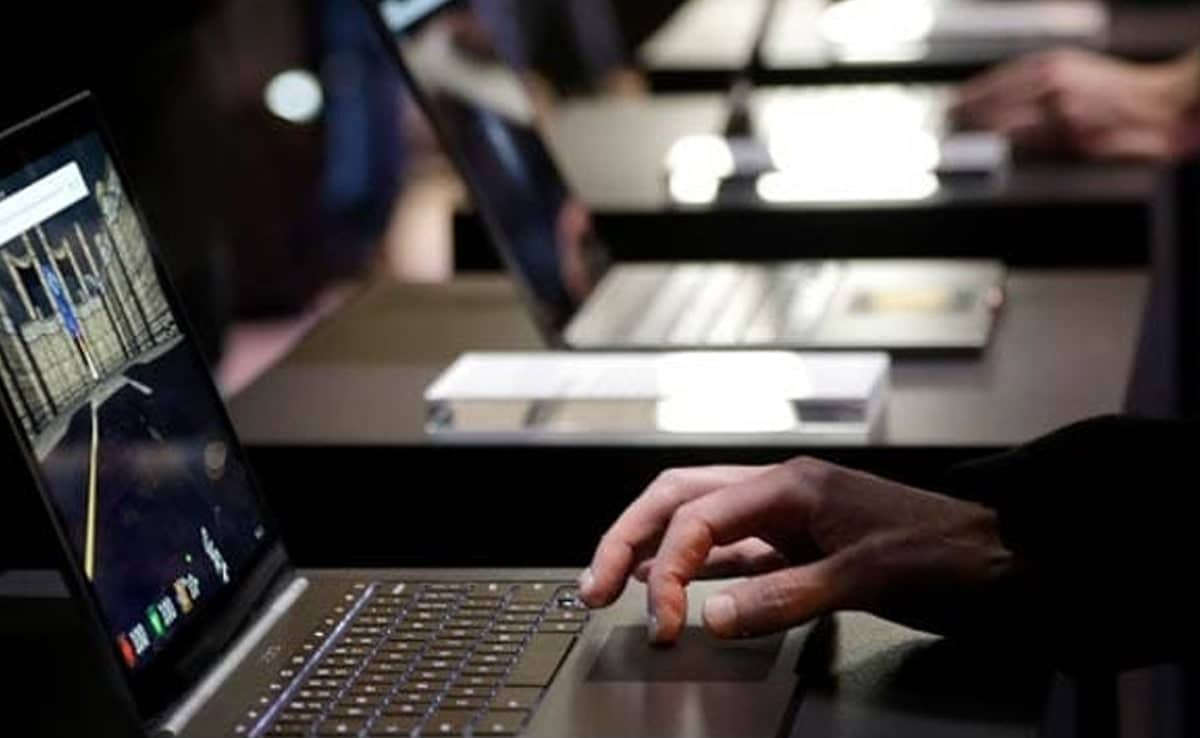
Industry leaders have hailed the restrictions imposed on the import of laptops, tablets and other IT hardware into the country.
The import restrictions, notified by the Directorate General of Foreign Trade (DGFT), has garnered positive responses from industry leaders and is expected to position India as a major global hub for electronics production.
The move aims to bolster domestic manufacturing and promote self-reliance in the technology sector.
Founder and Chairman of Noida-headquartered Dixon Technologies, Sunil Vachani, hailed the "landmark" move, which he said would pave the way for India's emergence as one of the largest manufacturing centres for IT products.
"This is a landmark decision to put the import of IT hardware in the restricted category. This will translate to India emerging as one of the largest hubs for manufacturing IT products. I see a time where Indian manufacturers and India as a country will be catering for global requirements for IT hardware products. This will translate to massive employment, new factories created to cater to this requirement," Vachani said.
He expressed optimism about the future, envisioning a time when Indian manufacturers would cater to global requirements for IT hardware products, leading to a surge in employment opportunities and the establishment of new factories.
Hari Om Rai, Chairman and Co-founder of Lava International, praised the government's leadership in making India a global electronics manufacturing hub.
He emphasized that the restrictions would not disrupt the supply chain, and consumers would not suffer, assuring a seamless transition toward self-sufficiency.
"The restriction on import of laptops and tablets is truly a leadership move by the Government of India. It is a step forward for making India the global hub for electronics production. The government of India has ensured that there is no disruption in the supply chain and that the consumer does not suffer", said Rai.
"India will generate a huge number of jobs and have a large component ecosystem and one day become a great electronics manufacturing hub. It is now a new India that is working for its industry, consumers and citizens. The electronics industry truly welcomes this move," Rai said.
The DGFT notification, effective immediately, restricts the import of laptops, tablets, all-in-one personal computers and ultra-small form factor computers and servers.
Such imports will now be allowed only with a valid license. However, to accommodate existing global supply chain arrangements and long-term commitments of industry stakeholders, liberal transitional arrangements have been put in place until October 31 this year.
During this period, import consignments can be cleared without the need for a license for restricted imports. From November 1, 2023, a valid license will be mandatory for import clearance.
Asked about the reasons that prompted the imposition of these restrictions, ICEA (India Cellular and Electronics Association) chairman Pankaj Mahindroo told ANI, "India's digital footprint is growing very aggressively. We have nearly 90 crore, mobile users, we have almost 15 crore consumers who are using tablets and laptops. It is very important that the devices are secure and are from trusted sources. There is a large illegal and legal import of refurbished products which are not giving good services to the consumers. So the idea is that by restricting the open general license, the government is trying to ensure that the products are available from trusted sources."
On being asked how this decision will impact companies who import laptops and computers, Mahindroo said, "PLI 2.0 (production-linked incentive), is a very robust policy. You have seen the magic in mobile phone manufacturing which has grown almost 1800 per cent from 19,000 crores to 3,50,000 crores and similar magic is trying to be rubbed off on the IT hardware also. The companies are setting up manufacturing here."
He further said, "There are 44 participants in PLI 2.0. So we are going to see massive growth in manufacturing from the current level of 25-30,000 crore to more than 100,000 crore. The category has got restricted, it has not got banned. There will be very good coordination between domestic manufacturing and import so that consumers can get full supply and at the same time domestic manufacturing keeps growing rapidly."
"I would like to assure the consumers, trade and industry that there will be no disruption in supply. In fact, the last year has been muted in IT, and hardware because during the covid there was robust demand and after that, the demand fell by 15-20 per cent", said ICEA chairman, Mahindroo
Mahindroo said, "There will be no shortage and this policy which has just come in will not impact it in any which way and the government is also determent that there should be no supply shortage."
Despite the restriction, the government has granted exemptions for certain categories, including imports as part of baggage allowance, limited imports for research and development (R&D), testing, benchmarking and evaluation.
Additionally, imports for repair and re-export, product development purposes, re-import of goods repaired abroad, and essential capital goods are also exempted from the restriction.
The government has emphasized that the restriction aims to protect the security interests of the country and its citizens.
Union Minister for Electronics and IT, Rajeev Chandrasekhar, took to Twitter to clarify the government's objective, emphasizing that the move is not about a return to a license raj system.
"It is the government's objective to ensure trusted hardware n systems, reduce import dependence and increase domestic manufacturing of this category of products (sic)," Chandrasekhar tweeted.
"This is not at all about license raj - It is about regulating imports to ensure trusted and verifiable systems AND ensuring India tech eco-system uses trusted n verified systems only that are imported and/or domestically manufactured trusted systems/products (sic)," he wrote.
To facilitate the licensing process, the DGFT has introduced a portal where companies and traders can apply for licenses.
The government aims to issue licenses within three-to-four days if all necessary details are provided promptly.
Furthermore, the government's production-linked incentive (PLI) scheme for IT hardware, introduced on May 29, 2023, has already seen registration from 44 companies.
The scheme provides additional incentives to eligible manufacturers, further encouraging domestic production and making India an attractive destination for investment in the electronics manufacturing sector.
Interested companies can still submit applications until August 30 to participate in the PLI scheme.
(Except for the headline, this story has not been edited by NDTV staff and is published from a syndicated feed.)

-
We May Need Another Tukaram Mundhe To Fight Air Pollution | The Reason Why

Developers may install basic measures such as sprinklers and green nets, resume work, and continue violating rules when this equipment stops working.
-
Extracting Value From Battery Scrap Could Be Challenging For India | The Reason Why
A discarded lithium-ion battery still contains valuable materials such as lithium, nickel and cobalt. These can be recovered and reused. When such batteries are crushed and shredded, they produce a dark powder called black mass.
-
One El Nino, India Can Handle. Two Could Break The Granary
India's grain stocks can absorb one bad year, but a second El Nino could drain the buffer in two to three years, economists say.
-
India's Troika Of Good Luck | Joining The Dots
As Jensen Huang's exit drags Nvidia down, a cooling AI trade and resilient earnings have revived investor interest in India. A likely RBI rate hike looms.
-
Talking Points This Week: Leadership Shock At Nvidia, Earnings Strength, And The Fog Over Hormuz
The Anthropic IPO pricing and first trading day, Nvidia's upcoming earnings, and any fresh signals from Iran will set the tone for the following week.
-
Signature Play: The Classic Cocktail Is Dead. Or Is It?
Classic cocktails are disappearing from India's cocktail menus. But they're still being ordered, taught to bartenders and borrowed from. So, who's really having the last drink?
-
A New Samvat Wishlist: Inclusive Prosperity And Human Development
India has strengthened its economic foundations through infrastructure, digital access and enterprise. Its next growth chapter must deepen productivity, create better livelihoods and widen participation in prosperity.
-
Love, Sex Aur Dhokha: The Audacious Plot To Spy On Jensen Huang
A Taipei dinner, a Singapore chip buyer and a suspected Chinese asset: inside the alleged spy operation that got close to NVIDIA's Jensen Huang.
-
Ten Things I Learnt This Samvat
Patience can be a trap. Cheap stocks can stay cheap. Leverage can wipe you out. What did Samvat 2082 teach us? Niraj Shah writes on 10 lessons from the year gone by.
-
Talking Points This Week: Tech Nerves, FII Buying, And A Faraway Banking Shock
The global markets are not shining this Diwali. The exception in the large markets is, India.









