Why India’s Largest Solar Tender Got Tepid Response
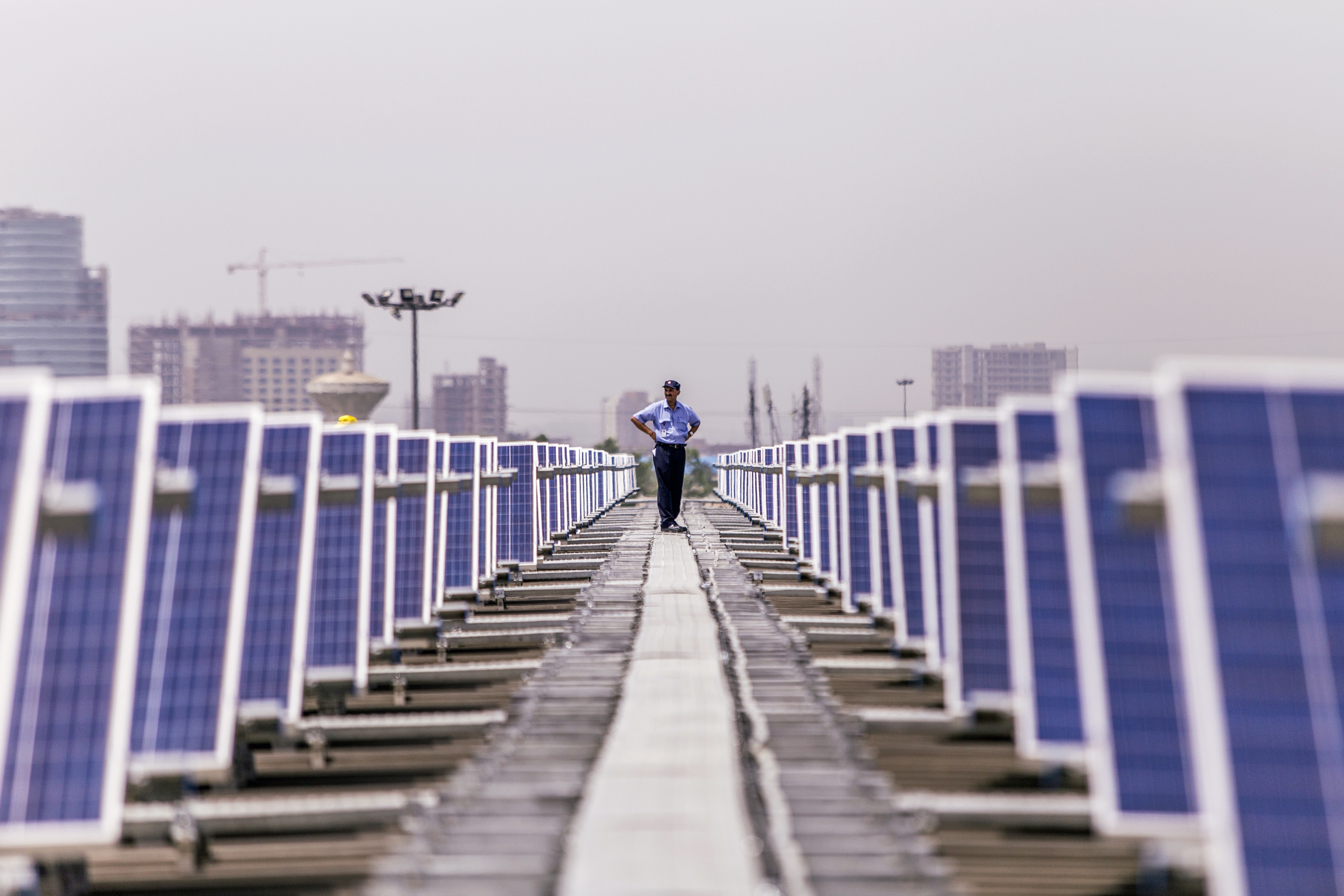
India's plan to push solar farm developers to also make photovoltaic panels received a tepid response, forcing the government to extend the deadline for the largest such auction the second time.
The tender asking developers to also make 50 percent of the panels used in a project attracted only one bidder in Azure Power, according to a person aware of the matter who didn't wish to be identified. BloombergQuint wasn't able to independently verify that, and emailed queries to the company didn't elicit a response.
The last day to submit the bids has been extended till Oct. 12, according to a statement by the state-run Solar Energy Corporation of India Ltd. It had earlier extended the first Aug. 27 deadline by a month. While it didn't give reasons, a senior official from the corporation said requesting anonymity that players sought more time to tie up with global manufacturers for bidding.
India plans to more than quadruple its solar capacity to 100 gigawatts by 2022. That's part of its 175GW renewable energy target by then to help lower fossil fuel imports and meet emission caps under the Paris agreement. To boost local manufacturing, it has already imposed a safeguard duty on solar cells imported from China and Malaysia that, according to a parliamentary panel, account for 90 percent of the market share. The integrated power generation and panel making auction is also aimed at that.
But costs can be prohibitive. Bloomberg New Energy Finance pegs it at $200-300 million (about Rs 1,400-2,100 crore) per gigawatt for setting up a fully integrated module making facility, depending on the level of automation.
That will be over and above the solar project cost of Rs 7000 crore per gigawatt, according to Kameswara Rao, partner (energy, utilities and mining) at PwC. An integrated solar manufacturing facility requires a very large capital expenditure and has limited applications, he told BloombergQuint over the phone. That becomes a challenge when guaranteed volumes are limited and operating margin is low since tariff is capped, he said.
The Solar Energy Corporation first issued the tender on May 26. According to the original bid document reviewed by BloombergQuint:
- Bidders will have to develop a total of 10 GW of generation capacity along with 5 GW of manufacturing capacity, making it the largest such tender.
- Each bidder will have to set up manufacturing capacity of at least 500 megawatts since the minimum bid size was 1GW.
- The bidder was required to submit a single price that will be applicable for 25 years.
The Solar Energy Corporation, according to a report by Mercom India, eased some of the terms, The corporation:
- Lowered the manufacturing capacity to 3 GW while maintaining the generation tender size at 10 GW.
- The minimum bid size of 600 MW generation and 300 MW manufacturing ability.
- Time allowed to set up manufacturing capacity reduced to two years from three earlier.
- The successful bidder will have to commission 40 percent of the allotted capacity within 21 months of signing the power purchase pact.
- It will have to bring the remaining capacity on-stream within three years of letter of allotment.
- Tariff cap reduced from Rs 2.93 per kilowatt hour to Rs 2.75, excluding safeguard duty.
Yet, that leaves little or no room for bidders to absorb the higher capital costs needed to set up a fully integrated production line for modules, according to an emailed response by Allen Tom Abraham, India analyst at Bloomberg New Energy Finance. The Solar Energy Corporation is finding it increasingly difficult to find buyers at prices above Rs 2,500 a megawatt hour, he said.
The government allows bidders to avail existing fiscal incentives like accelerated depreciation, lower customs and excise duties and tax holidays available for such projects.
Still, there are few takers for manufacturing since there is no long-term business visibility, said Gautam Bafna, clean energy analyst at Care Ratings. The timeline is also aggressive as it's not feasible to complete the project within three years, he said. “It will require environmental clearances; that would push the timeline to over three to four years.”
India imported solar cells worth Rs 17,000 crore from China in the year through March. Cheaper inbound shipments have helped power producers quote lower prices, bringing tariffs to all-time lows. The government imposed a 25 percent safeguard duty on imported panels in the first year, and 20 and 15 percent in the two subsequent six-month periods, respectively, to boost domestic output.
Still, module makers are hesitant to build any production facility which does not get adequate incentives to compete with China and has contracted volumes for just a few years, Shantanu Jaiswal, head of India research at Bloomberg New Energy Finance, said in an emailed reply. If the government is really serious about spurring manufacturing growth in India, then it has to show the players a long-term market for modules produced by them. “A possible solution could be to increase the volume and timeline of photovoltaic projects associated with this tender.”

-
Getting To Work Costs Women More | The Reason Why

It is not just about women paying more than men. It is about women paying much more in cities than in villages.
-
AI Bias In Investing Cannot Be Eliminated, But It Can Be Governed
Framing is a particularly important example as identical financial information presented in terms of gains rather than losses can lead an LLM to reach a different assessment.
-
Joining The Dots | Dark Skies, Steady Diya: Why Hope Holds This Diwali
With war, a weak rupee and foreign outflows weighing on sentiment, policymakers at the NDTV World Summit and market veterans at NDTV Profit Ignite: Diwali Edition offered the same advice: stay invested and filter out the noise.
-
The Curious Case of Equitas Small Finance Bank And A CEO Who Quit For Stock
PN Vasudevan believes persistent investor concerns over a perceived conflict of interest had become a governance overhang on Equitas Small Finance Bank's stock, even as the lender improved profitability and asset quality.
-
Talking Points This Week: AI Cash Burn, A Tiger Comeback And An India That Still Finds Its Own Path
India is not immune to higher oil or tighter global liquidity, yet its earnings base is broader, its domestic policy levers are still available.
-
Foreign Investors Own Half Of HDFC Bank and ICICI Bank. An LTCG Cut Could Matter Most Here
Foreign portfolio investors have US$115 billion parked in HDFC Bank, ICICI Bank. If the government cuts long-term capital gains tax, Jefferies says returning foreign money could land here first.
-
'Never Seen This Level Of Negativity': Sandeep Tandon Says The Next Rally May Be Closer Than You Think
Veteran investor Sandeep Tandon says foreign selling is easing, large-caps are due a comeback and mid-caps are crowded, while he turns positive on gold, power and pharma this Diwali.
-
Indians Stay With Family, Not In Hotels | The Reason Why
India still lacks enough clean, reliable and affordable hotels for budget-conscious travellers.
-
The Economic Imperative: Analysing The Material Driving Force Behind India-Canada Strategic Reset
This economic complementarity is further reinforced by deep institutional investment ties and talent mobility, which form the bedrock of the bilateral framework.
-
Medicine Pricing: Where Must Profit Stop?
India must confront excessive margins, hidden incentives and regulatory gaps that threaten the integrity of medicine.










