Why Astral Share Price is Falling
Share markets would be a better place for companies to survive if they operated in isolation. No impact of the external environment or economy would make businesses simpler to understand.
But sadly, that's not the case. Businesses are affected by a variety of factors like inflation, geopolitical tensions, festive seasons, weather, etc.
A tiny factor from the long list of factors affecting the company could become the one primary reason for its downfall.
In the current market context, I can relate this with Astral – a plastic products company.
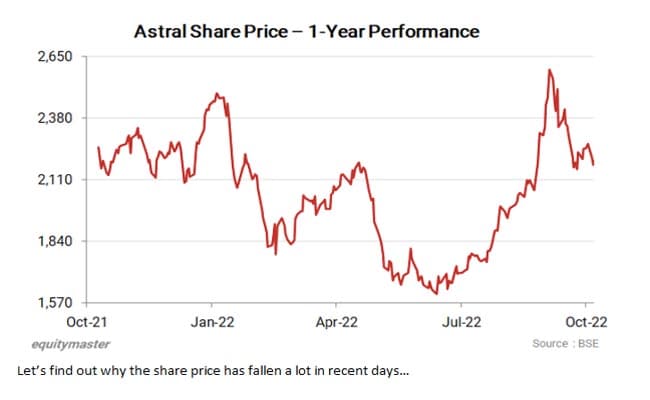
Astral share price was performing well on the bourses post the June 2022 recovery of Indian markets. On 9 September 2022, it reached its lifetime high of Rs 2,593.1.
However, the company's share price started to come down post hitting that new high.
At present, Astral is trading 21 per cent below its lifetime high, which quite a high fall for a fundamentally strong stock.
#1 Falling PVC Prices
The most important raw material for companies like Astral is Polyvinyl chloride (PVC). PVC resins cost forms almost 60-70 per cent of a pipe manufacturer's revenue.
Hence, one can imagine any change in PVC price will create a huge impact on their financials.
Between June and August, Asian PVC prices fell around 30 per cent.
Rising inflation, rising interest rates and lockdowns in China have increased the housing crisis in the UK, US and China. Resultantly, PVC resins are dumped in India. Hence there is an excess supply of PVC in India.
Now, the problem with falling PVC prices is that the companies will have to sell the existing level of inventory (that was manufactured at high PVC prices) at lower prices as market participants would demand the benefits of falling prices.
Since PVC forms a major part of the cost, selling at low prices would reduce the company's profit margins.
Plastic manufacturers had a high level of inventories at the end of the quarter ended March 2022 because of anticipated supply chain disruptions.
Hence, these companies have huge inventory losses. And as the PVC price falls further, the margin is expected to squeeze further.
Simultaneously, even the sales volumes are expected to fall.
#2 FII Selling
Interest rates are rising in developed markets like the USA. This makes the emerging markets less attractive for FIIs because the risk-free rate of return reduces.
Hence FIIs sell their holdings in companies operating in emerging markets like India to return to the safety of dollars. The same has happened with Astral.
FIIs have been divesting their stake in Astral since September 2021. FII's stake stood at 21.3% in the quarter ending September 2021. The stake was reduced to 16.1 per cent by the end of the June 2022 quarter.
Apart from FIIs, even mutual funds sold some shares of Astral in the June 2022 quarter.
For more details, check out Astral's latest shareholding pattern.
Investment Takeaway
The plastic pipes business is cyclical. The business does well in the 1st and the 4th quarter.
However, it should be noted that as PVC prices are low, the current manufacturing cost is quite low for the companies. Hence, as and when the PVC price rise, Astral will be able to sell cheaply manufactured pipes at higher prices.
Hence, the future margins may see an improvement.
Also, India has seen a good monsoon season. The demand for plastic pipes was high around the monsoon, which is expected to boost the financials of plastic pipe companies.
In June 2022, the company announced its diversification plans. It entered into paints, sanitary ware, and faucets. It has also launched new products like valves and drainage products.
These products are likely to contribute Rs 15 billion to the sales revenue over the next five years.
As a part of its diversification strategy, in May 2022 itself it has acquired a 51 per cent stake in Gem Paints, which has a strong presence in south India.
Hence company's profit margins maybe under pressure right now but it expects a high jump in revenues in the future due to diversification.
About Astral
Originally incorporated as Astral Poly Teknik, Astral is a manufacturer and provider of CPVC piping and plumbing systems in India since 1999.
The company is the first licensee of Noveon USA (formerly known as the speciality chemical division of B.F Goodrich USA) to manufacture and market CPVC piping and plumbing system in India.
Its production facilities are present in Gujarat and Himachal Pradesh to manufacture plumbing systems from ½" to 8" in diameter.
Its products include CPVC pipes and fittings for hot and cold water plumbing systems, CPVC industrial piping systems for the transportation of hazardous and highly corrosive chemicals, and lead-free PVC systems for cold water application.
For the financial year ended 2022, Astral declared a dividend of Rs 1.8. The company has last declared a bonus in February 2021, in the ratio of 1:3.
Disclaimer: This article is for information purposes only. It is not a stock recommendation and should not be treated as such.
This article is syndicated from Equitymaster.com.
(This story has not been edited by NDTV staff and is auto-generated from a syndicated feed.)

-
The Economic Imperative: Analysing The Material Driving Force Behind India-Canada Strategic Reset

This economic complementarity is further reinforced by deep institutional investment ties and talent mobility, which form the bedrock of the bilateral framework.
-
Medicine Pricing: Where Must Profit Stop?
India must confront excessive margins, hidden incentives and regulatory gaps that threaten the integrity of medicine.
-
Why Amazon And Flipkart Are Struggling To Beat Meesho In India's Smaller Cities
With 274 million users and lowest-cost logistics, Meesho is defending its value commerce crown against giants like Amazon and Flipkart.
-
High US Salaries, No Green Card Certainty: The Financial Calculation Facing Indian H-1B Families
The suspension of PERM processing at eight technology employers does not cancel existing H-1B visas. What it does is force a question many Indian families have been avoiding: is the US salary worth tying your career and family plans to one employer?
-
Swiggy vs Eternal: Food Delivery's Two Rivals Are No Longer In The Same Race
Eternal is building a private AI assistant, dark.ai. Swiggy is still working out how to make Instamart pay, with an operating loss of Rs 895 crore in the July-September quarter while Blinkit stayed profitable.
-
Where You Live Shapes How You Get To Work | The Reason Why
Two-wheelers are the most popular way to get to work in India, accounting for nearly 43% of workplace commutes.
-
Unhedged Position: Can India See An Indonesia-Style Time Correction?
The Nifty is trading below levels it first clocked in 2024. Is there, then, as I have suggested in the headline, potential that the current time correction drags on painfully for the next three-five, even ten years?
-
Navigating Friction And Energy Realities: An Analysis Of Marco Rubio's October Visit To India
Occurring at a critical juncture marked by stalled trade negotiations and escalating geopolitical pressures over global energy supplies, the visit offers a profound window into modern US-India relations.
-
India Exports Capital. Why Not Export Trusteeship?
The big question, then, is whether India can build an institution that global borrowers, investors, banks, and lawyers can trust, even without an Indian connection.
-
France's Economy & Politics Are In Crisis | The Reason Why
Let's look at how the French economy and politics evolved under Nicolas Sarkozy, Franois Hollande and Emmanuel Macron.










