When Satya Nadella Cited A Personal Story To Highlight Educational Opportunity
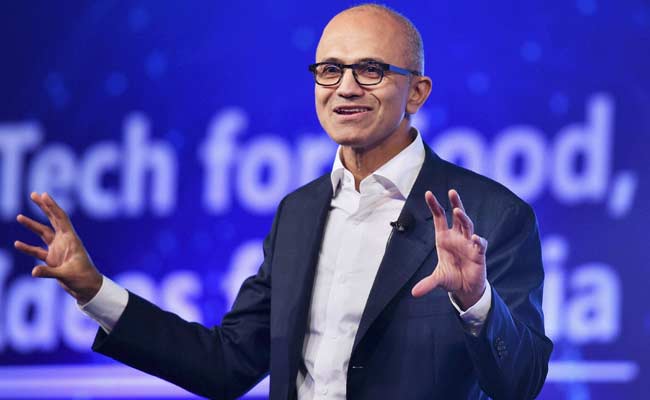
Microsoft's India-born CEO Satya Nadella has emphasised the need for educational opportunity. In a blog post, he narrated the tale of his grandfather to highlight that "democratizing educational opportunity must include everyone, not just a select few". "It was my grandfather's education and eventual career that enabled my father to pursue his own education, which eventually allowed me to follow my own passions," he wrote.
"The opportunity my grandfather was given impacted the trajectories of the generations to come. This personal story reflects that often repeated adage: 'Talent is everywhere, but opportunity is not.'
He also highlighted the use of technology for better educational opportunities. "Through the power of technology, any classroom can now promote collaborative learning with online hubs for teamwork, personalized learning tools and the ability to co-create together. By empowering students to learn together, their educational opportunities get better and better."
Here's the full text of Satya Nadella's blog post:
Toward the end of the First World War, in rural India, my great-grandfather, a marginal farmer, passed away. My great-grandmother suddenly found herself a young widow and single mother of two young sons - with no source of income. To provide for her sons and their future, she had to make some difficult choices. In search of economic opportunity, she and her sons migrated to another town. She became a domestic servant, but still could only afford to send one son to grade school. The boys were close in age, but one was considered to be more responsible and mindful, while the other was a bit of a troublemaker.
My great-grandmother opted to send the more responsible son, who was viewed as having higher potential, into the workforce. He became a day laborer at a construction site. He would continue in this field for the rest of his life, never able to move up the pay scale or gain new skills for higher-level employment.
The other son, the "troublemaker," was sent to a local school. Despite being perceived as less diligent, he continued through school and eventually became a police officer. Although he entered the workforce nearly a decade after his brother, he immediately earned an exponentially higher salary.
That boy was my grandfather.
It was my grandfather's education and eventual career that enabled my father to pursue his own education, which eventually allowed me to follow my own passions.
The opportunity my grandfather was given impacted the trajectories of the generations to come. This personal story reflects that often repeated adage: "Talent is everywhere, but opportunity is not."
This is why I so strongly believe that technology can be used as a tool to empower every student, teacher, parent and educational institution to create the world of tomorrow.
We live in a time of amazing technological progress. All aspects of our lives are increasingly being shaped by digital technologies. However, technology itself is also creating disruption. There are growing concerns over the impact on job growth, economic opportunity and the world we are building for the next generation.
At the same time, the impact of educational opportunity on modern society and on an individual's economic progress is perhaps one of the most impressive gains that humanity has made in the last century. So the real question of our time becomes how can technology create more opportunity not just for a few, but for all?
Addressing this question is core to our mission to empower every person and every organization on the planet to achieve more. This is not just a set of words, but something we care about deeply. Our success is measured by others' success.
To be sure, we are not under the illusion that technology on its own is the answer to transforming education. Instead, we want to empower all teachers with the technological support they need to spark their students' creativity and equip them for the jobs of the future. Technology often helps to amplify the work of dedicated people and institutions but rarely substitutes for it. There are no replacements for great teachers, dedicated administrators, motivated students, and involved parents and community.
One of my favorite parts of my job is meeting students from around the world. Over the past two years, I've had the opportunity to learn from students in over 20 countries. I've seen how students in Jakarta and Tel Aviv use the same Office tools that my daughters use in Seattle; how teachers in Tokyo and Madrid use "Minecraft" to introduce students to computational thinking; and how a group of young female students in Cairo were inspired to learn to code and built an app to assist Syrian refugees in their community.
I have been struck by the commonalities among these students - their ingenuity, thirst for learning, diversity and dreams for their future. As I spend time visiting these classrooms, a few things stand out to me each time:
Technology must help teachers, not hinder them. Teachers have constant demands on their time. They must create curriculum, grade tests and papers, manage classrooms, discipline, educate, and inspire.
Each time I leave a classroom, the job of a teacher makes my job look easy in comparison! Technology should make teachers' lives simpler and spark students' creativity, not detract from it.
This is a top priority we are focused on at Microsoft - to deliver streamlined platforms, readily available to all classrooms, so teachers spend less time focused on technology and more time doing what they love: inspiring students.
Learning happens in teams. The nature of work is changing. Much of work today happens in teams or within groups of people working together to solve a problem, where the sum becomes greater than the parts. We need to prepare our students for this future and enable team-based learning experiences in the classroom - among groups of students, between students and teachers, and between teachers and parents.
Through the power of technology, any classroom can now promote collaborative learning with online hubs for teamwork, personalized learning tools and the ability to co-create together.
By empowering students to learn together, their educational opportunities get better and better.
Preparing for the future. According to a recent World Economic Forum jobs report, an estimated 65 percent of students entering school today will have jobs that do not yet exist. This is an incredible statistic, because it means that it is not enough to prepare students for today's workforce. That workforce will not exist when they graduate!
Teachers know this and are hungry to help equip their students for this future. They know that computational thinking and problem-solving skills are important.
They also know that taking a broader view and bringing STEM curriculum alongside reading, writing, design and art is what will set students up for success.
We need technologies that are designed to address this reality, but more importantly, empower teachers and students to enhance learning outcomes and create the world of tomorrow.
Democratizing educational opportunity must include everyone, not just a select few. This includes students with disabilities and different learning styles, because they deserve the opportunity to pursue their dreams, too.
This issue is deeply personal to me. It is also why I so greatly value the input of teachers, administrators and parents. They are the ones on the front lines of making educational opportunity for all a reality.
Just as my grandfather's opportunity changed the trajectory of our family, this is what inspires me - how we can collectively come together to democratize educational opportunity for every student... Both for this generation

-
The Curious Case of Equitas Small Finance Bank And A CEO Who Quit For Stock

PN Vasudevan believes persistent investor concerns over a perceived conflict of interest had become a governance overhang on Equitas Small Finance Bank's stock, even as the lender improved profitability and asset quality.
-
Talking Points This Week: AI Cash Burn, A Tiger Comeback And An India That Still Finds Its Own Path
India is not immune to higher oil or tighter global liquidity, yet its earnings base is broader, its domestic policy levers are still available.
-
Foreign Investors Own Half Of HDFC Bank and ICICI Bank. An LTCG Cut Could Matter Most Here
Foreign portfolio investors have US$115 billion parked in HDFC Bank, ICICI Bank. If the government cuts long-term capital gains tax, Jefferies says returning foreign money could land here first.
-
'Never Seen This Level Of Negativity': Sandeep Tandon Says The Next Rally May Be Closer Than You Think
Veteran investor Sandeep Tandon says foreign selling is easing, large-caps are due a comeback and mid-caps are crowded, while he turns positive on gold, power and pharma this Diwali.
-
Indians Stay With Family, Not In Hotels | The Reason Why
India still lacks enough clean, reliable and affordable hotels for budget-conscious travellers.
-
The Economic Imperative: Analysing The Material Driving Force Behind India-Canada Strategic Reset
This economic complementarity is further reinforced by deep institutional investment ties and talent mobility, which form the bedrock of the bilateral framework.
-
Medicine Pricing: Where Must Profit Stop?
India must confront excessive margins, hidden incentives and regulatory gaps that threaten the integrity of medicine.
-
Why Amazon And Flipkart Are Struggling To Beat Meesho In India's Smaller Cities
With 274 million users and lowest-cost logistics, Meesho is defending its value commerce crown against giants like Amazon and Flipkart.
-
High US Salaries, No Green Card Certainty: The Financial Calculation Facing Indian H-1B Families
The suspension of PERM processing at eight technology employers does not cancel existing H-1B visas. What it does is force a question many Indian families have been avoiding: is the US salary worth tying your career and family plans to one employer?
-
Swiggy vs Eternal: Food Delivery's Two Rivals Are No Longer In The Same Race
Eternal is building a private AI assistant, dark.ai. Swiggy is still working out how to make Instamart pay, with an operating loss of Rs 895 crore in the July-September quarter while Blinkit stayed profitable.










