How Were So Many Economists So Wrong About The Recession?

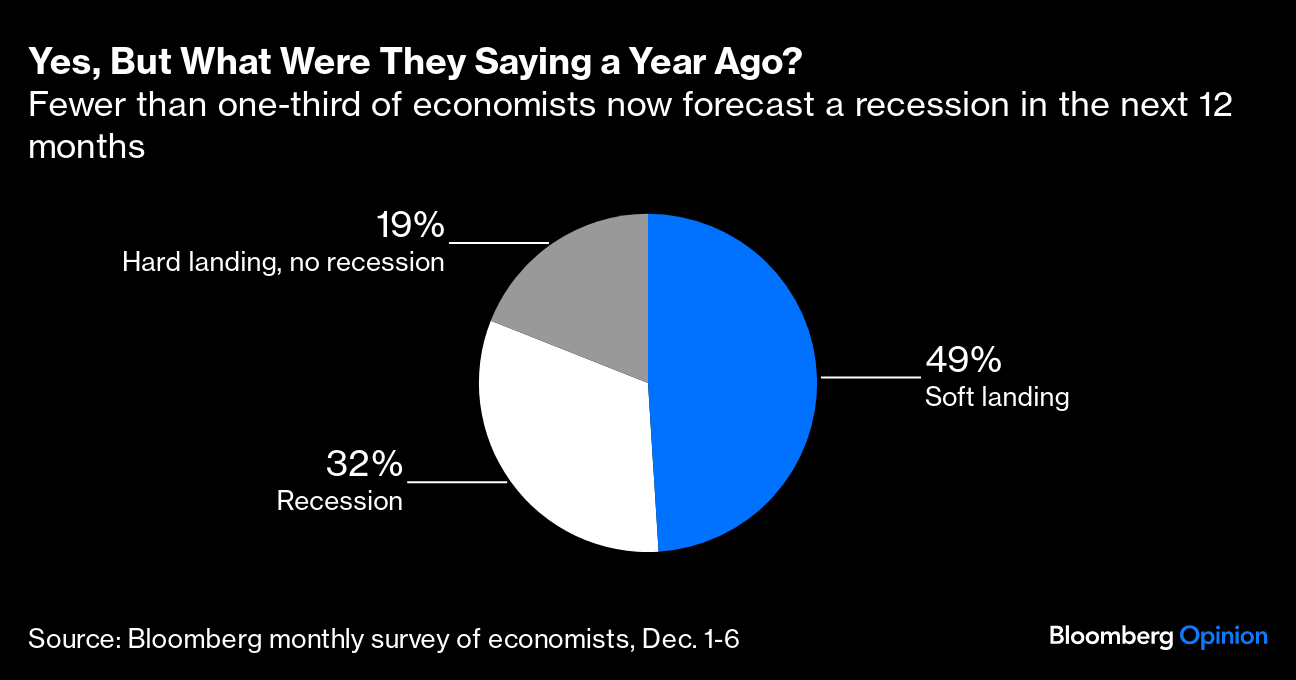
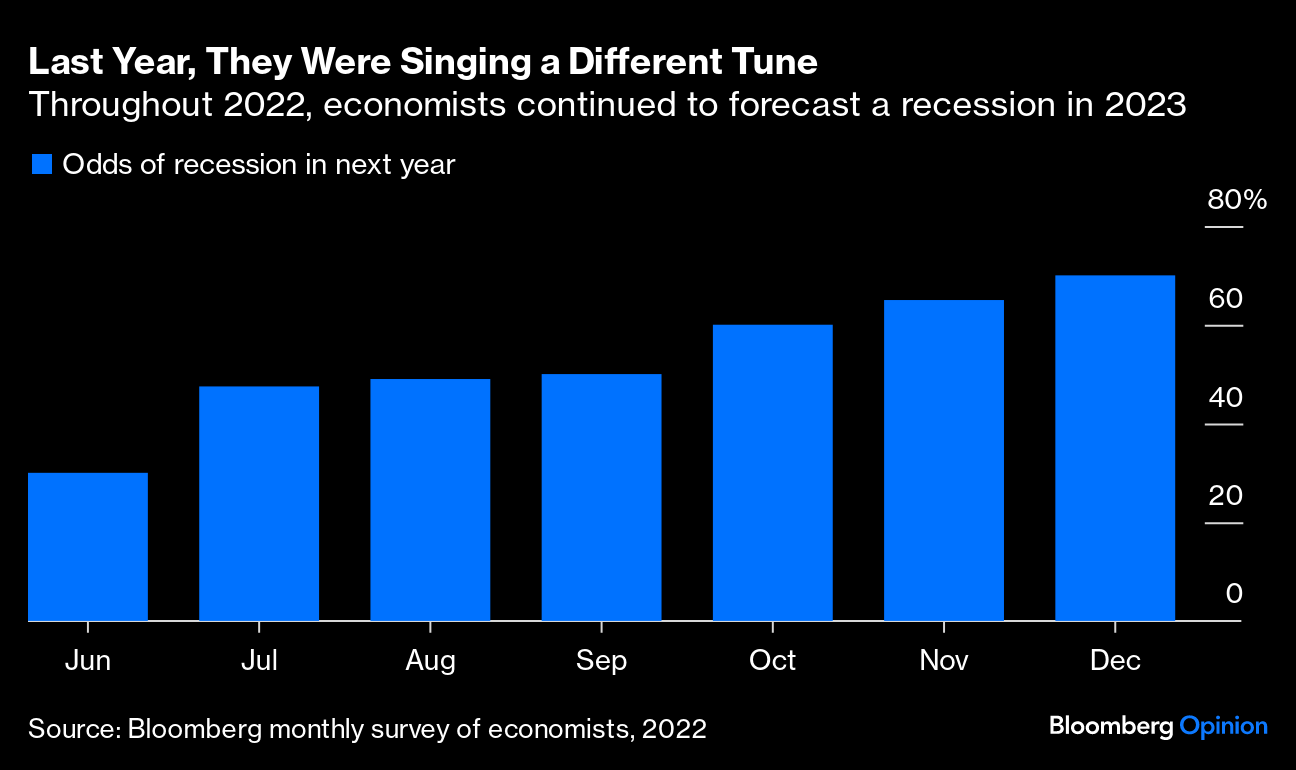
(Bloomberg Opinion) -- Last year at this time, 85% of economists in one poll predicted a recession this year — and that was an optimistic take compared to the 100% probability of a recession forecast two months earlier. Meanwhile US Federal Reserve Chair Jerome Powell, drawing upon the work of his highly able staff, expressed fear in March that bringing down the rate of inflation would cost millions of American jobs.
And yet none of this has happened. Both inflation and unemployment are headed in the right direction, and most economists expect the US to avoid a recession in 2024. Economists have yet to figure out why things went so well, but it is already clear that a reckoning is due.
As Treasury Secretary Janet Yellen said last week: “So many economists were saying there's no way for inflation to get back to normal without it entailing a period of high unemployment, [or] a recession. And a year ago, I think many economists were saying a recession was inevitable. I've never felt there was a solid intellectual basis for making such a prediction.”
Many of those economists may have been relying on the work of … Janet Yellen. Her own (highly regarded) macro research focuses on nominal price and wage stickiness and output-inflation trade-offs, predicting that if there is a significant fall in aggregate demand, employment should also fall, giving rise to a recession. She is also co-author (with many distinguished colleagues) of a well-known paper arguing that there is an output/inflation trade-off even at high rates of inflation.
Economist Christina Romer (often with co-authors) has provided some of the most persuasive evidence that negative monetary policy shocks induce recessions in output and employment. Her work has been especially influential — worthy of a Nobel Prize, in my opinion — because it does not rely on a complicated mathematical model of the economy, and it had been accepted on a bipartisan basis. Paul Krugman has been predicting for most of this year that the recent disinflation would not cause a recession, and he deserves credit for getting this right. Yet he is less keen to tell us that for many years he trumpeted the predictive virtues of old-style Keynesian macroeconomics, using models that predict disinflation will lead to a loss in output and employment.
Krugman has lately further explained his position — complete with unironic headline — suggesting that the untangling of broken supply chains had helped lower the rate of inflation. That point, too, is correct. He didn't mention that there also has been a massive negative shock to aggregate demand: High rates of M2 growth became slightly negative rates of M2 growth. Fiscal policy peaked and then retreated. The Fed raised interest rates from near-zero levels to the range of 5%, and fairly rapidly. It also sent every possible signal that it was going to be tight with monetary conditions.
And yet a recession did not come.
There is a reason that so many economists had been predicting a recession — and it is not because they are out of touch, or repeating talking points from Donald Trump's presidential campaign. They predicted a recession because that is what experts such as Yellen, Krugman, Romer and many others had been teaching for decades. I do not myself presume to have any immunity from the general confusion here, as all along I thought there was a reasonable chance of a recession.
Lawrence Summers turned out to be wrong in predicting that disinflation would have huge costs in terms of employment and output, and now he is catching grief for this on social media. Yet at least he was drawing upon a consistent model. The problem is that the real world is not as consistent as model builders might like.
The solution here is not to sweep past doctrine under the rug; it's to be more forthright. Macroeconomists very often don't know what is going on, and that holds true for all the different styles and flavors of macro.
The one theory that might at least partly explain recent events — that of a credible disinflation based on rational expectations — had fallen out of favor with economists, most of all the Keynesians. This approach still is receiving very little credit, even though it has the Nobel prizes of Robert E. Lucas and Thomas Sargent to support it.
Most of all, it's important to acknowledge how politicized macroeconomics has become. There are a bunch of economists going around right now saying they were right about how the US would avoid a recession this year. A deeper look, however, reveals a much longer and less favorable story.
Elsewhere in Bloomberg Opinion:
- Misery Has Company, But Recession Is a No-Show: John Authers
- Why My Recession Rule Could Go Wrong This Time: Claudia Sahm
- The Recession Might Be Canceled, But Economists Won't Admit It: Jonathan Levin
For more Bloomberg Opinion, subscribe to our newsletter.
This column does not necessarily reflect the opinion of the editorial board or Bloomberg LP and its owners.
Tyler Cowen is a Bloomberg Opinion columnist, a professor of economics at George Mason University and host of the Marginal Revolution blog.
More stories like this are available on bloomberg.com/opinion
©2023 Bloomberg L.P.

-
We May Need Another Tukaram Mundhe To Fight Air Pollution | The Reason Why

Developers may install basic measures such as sprinklers and green nets, resume work, and continue violating rules when this equipment stops working.
-
Extracting Value From Battery Scrap Could Be Challenging For India | The Reason Why
A discarded lithium-ion battery still contains valuable materials such as lithium, nickel and cobalt. These can be recovered and reused. When such batteries are crushed and shredded, they produce a dark powder called black mass.
-
One El Nino, India Can Handle. Two Could Break The Granary
India's grain stocks can absorb one bad year, but a second El Nino could drain the buffer in two to three years, economists say.
-
India's Troika Of Good Luck | Joining The Dots
As Jensen Huang's exit drags Nvidia down, a cooling AI trade and resilient earnings have revived investor interest in India. A likely RBI rate hike looms.
-
Talking Points This Week: Leadership Shock At Nvidia, Earnings Strength, And The Fog Over Hormuz
The Anthropic IPO pricing and first trading day, Nvidia's upcoming earnings, and any fresh signals from Iran will set the tone for the following week.
-
Signature Play: The Classic Cocktail Is Dead. Or Is It?
Classic cocktails are disappearing from India's cocktail menus. But they're still being ordered, taught to bartenders and borrowed from. So, who's really having the last drink?
-
A New Samvat Wishlist: Inclusive Prosperity And Human Development
India has strengthened its economic foundations through infrastructure, digital access and enterprise. Its next growth chapter must deepen productivity, create better livelihoods and widen participation in prosperity.
-
Love, Sex Aur Dhokha: The Audacious Plot To Spy On Jensen Huang
A Taipei dinner, a Singapore chip buyer and a suspected Chinese asset: inside the alleged spy operation that got close to NVIDIA's Jensen Huang.
-
Ten Things I Learnt This Samvat
Patience can be a trap. Cheap stocks can stay cheap. Leverage can wipe you out. What did Samvat 2082 teach us? Niraj Shah writes on 10 lessons from the year gone by.
-
Talking Points This Week: Tech Nerves, FII Buying, And A Faraway Banking Shock
The global markets are not shining this Diwali. The exception in the large markets is, India.