What Oil At $50 A Barrel Means For India, World Economy
Just a couple of months ago, major oil trading houses were predicting the return of $100 crude. Now, with oil prices at half that level, here's a look at what the slump means for the world economy. Energy importers like India and South Africa will benefit; oil producers such as Russia and Saudi Arabia will hurt. Central banks under pressure to raise interest rates will get a reprieve; those looking to revive prices, such as the Bank of Japan, face another headwind.
Ultimately, much depends on how world oil demand shapes up as it gets battered by a stronger dollar and global trade spats, and how the biggest producers react.
(Also Read: Crude Oil Prices Slump, Hit Lowest Level Since December 2017)
Saudi Arabia sits between Russia on one side, its ally in managing production to support prices, and the US, where President Donald Trump is sending Twitter messages to the producer to get prices down. All eyes are on the Group of 20 meeting this week to see if a consensus on output emerges between the Saudis and Russians, and if that can carry through to the OPEC gathering next week.
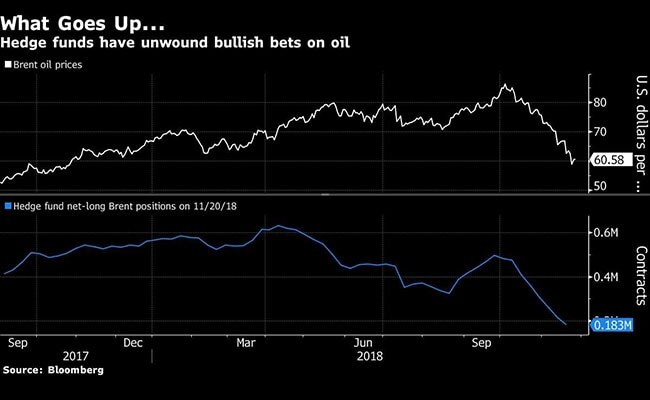
Here's a Bloomberg Economics chart showing net oil imports (or exports) as a percentage of GDP -- cheaper oil helps those at the top of the chart and hurts those at the bottom.
What does it mean for global growth?
With the northern hemisphere winter approaching, the oil-price slump will cushion households and businesses during a period of slowing economic growth. Countries that import oil and have current-account deficits, such as South Africa, will also stand to benefit. China is the world's biggest importer of oil and is already battling a broader moderation in its economy amid a trade war with the US and domestic challenges.
(Also Read: Low Crude Prices To Limit Rise In Current Account Deficit - Report)
What does it mean for inflation?
Lower oil prices mean less pressure on inflation and less pressure on central banks to raise interest rates. One example: Bloomberg Economics says the energy slump is a game changer for India and could mean the Reserve Bank of India shifts to a neutral outlook.
How will emerging markets handle the price drop?
Every $10-per-barrel fall in oil prices boosts incomes by about 0.5 to 0.7 per cent of gross domestic product in major emerging market oil importers, Capital Economics analysts estimate.
The same discount will cause a 3 per cent to 5 per cent loss of GDP in most of the Gulf economies, and a slowdown of 1.5 per cent to 2 per cent of GDP in the UAE, Russia and Nigeria, all on an annualized basis, according to the analysts.
What does it mean for the world's biggest economy?
Trump has described the slump in oil prices as the equivalent of a tax cut. Still, diminishing American reliance on imported oil due to the emergence of shale production will erode the positive economic consequences at the industry level.

-
Indians Are Travelling, But Not Every Journey Is A Holiday | The Week In Whys

Pilgrims, patients and working women are the real travellers, and the system hasn't quite caught up with them.
-
Getting To Work Costs Women More | The Reason Why
It is not just about women paying more than men. It is about women paying much more in cities than in villages.
-
AI Bias In Investing Cannot Be Eliminated, But It Can Be Governed
Framing is a particularly important example as identical financial information presented in terms of gains rather than losses can lead an LLM to reach a different assessment.
-
Joining The Dots | Dark Skies, Steady Diya: Why Hope Holds This Diwali
With war, a weak rupee and foreign outflows weighing on sentiment, policymakers at the NDTV World Summit and market veterans at NDTV Profit Ignite: Diwali Edition offered the same advice: stay invested and filter out the noise.
-
The Curious Case of Equitas Small Finance Bank And A CEO Who Quit For Stock
PN Vasudevan believes persistent investor concerns over a perceived conflict of interest had become a governance overhang on Equitas Small Finance Bank's stock, even as the lender improved profitability and asset quality.
-
Talking Points This Week: AI Cash Burn, A Tiger Comeback And An India That Still Finds Its Own Path
India is not immune to higher oil or tighter global liquidity, yet its earnings base is broader, its domestic policy levers are still available.
-
Foreign Investors Own Half Of HDFC Bank and ICICI Bank. An LTCG Cut Could Matter Most Here
Foreign portfolio investors have US$115 billion parked in HDFC Bank, ICICI Bank. If the government cuts long-term capital gains tax, Jefferies says returning foreign money could land here first.
-
'Never Seen This Level Of Negativity': Sandeep Tandon Says The Next Rally May Be Closer Than You Think
Veteran investor Sandeep Tandon says foreign selling is easing, large-caps are due a comeback and mid-caps are crowded, while he turns positive on gold, power and pharma this Diwali.
-
Indians Stay With Family, Not In Hotels | The Reason Why
India still lacks enough clean, reliable and affordable hotels for budget-conscious travellers.
-
The Economic Imperative: Analysing The Material Driving Force Behind India-Canada Strategic Reset
This economic complementarity is further reinforced by deep institutional investment ties and talent mobility, which form the bedrock of the bilateral framework.










